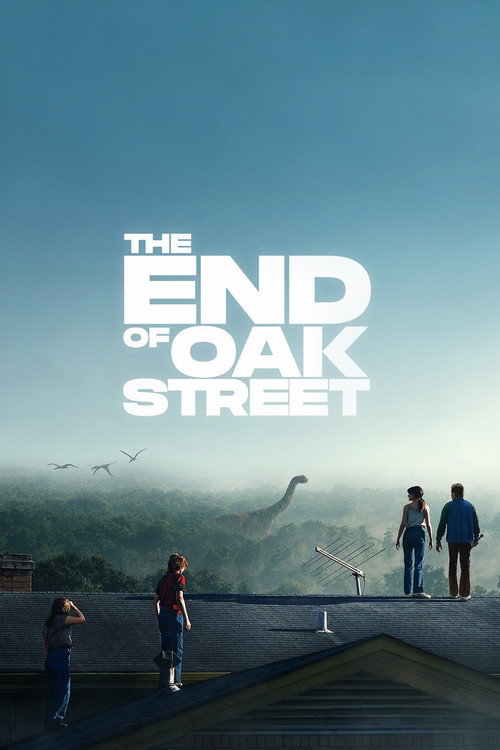
The End of Oak Street (2026)
Directed by David Robert Mitchell · $50.8M domestic
No · Ultra Based
How we score movies →Consciousness Markers
The supporting cast includes several actors of color in neighborhood roles, but the narrative centers entirely on a traditional white nuclear family. No casting choices appear motivated by representational programming.
Anne Hathaway's Denise Platt is a capable co-protagonist whose competence under prehistoric duress is visible, but the film frames this as family survival rather than gender commentary. There is no feminist architecture to the story.
The film carries a faint subtext about suburban insularity and the failure of the nuclear family as a social unit, but critics noted its deliberate avoidance of explicit commentary. The sermon, if any, is delivered in a whisper and then eaten by a dinosaur.
No LGBTQ themes, characters, or subtext are present in the film or its surrounding discourse.
No racial consciousness themes appear in the film, and no significant discourse on race emerged in critical reception.
The film contains no environmental messaging. The prehistoric setting is a survival backdrop, not a climate parable.
Critics explicitly noted the film's absence of capitalist critique, contrasting it unfavorably with Jurassic Park's 'hubris of man' themes. The market has spoken, and it has nothing to say.
No body positivity themes or discourse of any kind are present.
No neurodivergent characters or related themes are identified in the film or critical reception.
The 1982 suburban setting is deployed nostalgically, not critically. Mitchell uses it to evoke Amblin-era aesthetics rather than interrogate or reframe that era's values.
Synopsis
After a mysterious cosmic event rips Oak Street from suburbia and transports their neighborhood to someplace unknown, the Platt family soon discovers that their very survival depends on them sticking together as they navigate their now unrecognizable surroundings.
Why it received this score
David Robert Mitchell's "The End of Oak Street" arrives as a science fiction survival thriller set in 1982, a period the film regards with the warm, slightly melancholy fondness of a home video found in a water-damaged box. The Platt family, fractured by marital strain and the general spiritual malaise of cul-de-sac living, are deposited into the Cretaceous period by a cosmic event that the film wisely declines to explain. This is, it turns out, the correct instinct. The dinosaurs are not a metaphor. They are dinosaurs. This is rarer than it sounds.
The film's social consciousness registers at roughly the same temperature as a glass of tap water left on a counter overnight. Critics searching for the capitalist critique embedded in "Jurassic Park," or the government paranoia threading through "E.T.," will find themselves looking at a very large herbivore instead. Mitchell, working in the tradition of his own suburban-unease filmography, does allow a quiet observation to surface: when catastrophe arrives, the neighbors do not band together. They retreat into their individual units and hope for the best. Whether this constitutes commentary or simply accurate anthropology is a question the film declines to answer. We respect this restraint, even as we note it offers very little to classify.
The ensemble includes several actors of color in supporting neighborhood roles, placed there with the casual demographic texture of a real suburb rather than the deliberate choreography of a casting directive. Hathaway and McGregor are competent and occasionally affecting. The marketing campaign, which deployed AI-generated dog podcasts to promote the film, generated more genuine ideological heat than anything in the film's 110 minutes. In the current cultural climate, that is, depending on your perspective, either a relief or a disappointment. We record it here as a datum and move on.
Analysis generated by our Consciousness Algorithm
Critic Reviews
“The fact that this film can make space for all these facets of identity to breathe and move makes a movie miracle worth warping to time and time again.”
“Yet The End of Oak Street, despite its cheeky, ominous title, isn't a movie that wallows in grief. Whether it's the personal loss of a parent or the shared loss of a pre-pandemic America, Mitchell seems to be acknowledging the sadness of those events while being optimistic that we can find our way out of them. If nothing else, that's where the power of cinema, particularly genre cinema, can come through.”
“For a film that is confident enough to give away a sizeable amount of its premise from the get-go, The End of Oak Street remains filled with surprises and is a complete crowd-pleaser from start to finish. ”
“A seriously silly movie that misses more laughs than it reaches for, “Oak Street” summons up Spielberg suburbia of the ’70s and ’80s but wastes the period piece settings on a flat, cliched genre pic about a bunch of feathery dinosaurs — something we learned about them in the decades since “Jurassic Park” — raising hell when time and tectonic plates slip and flip.”