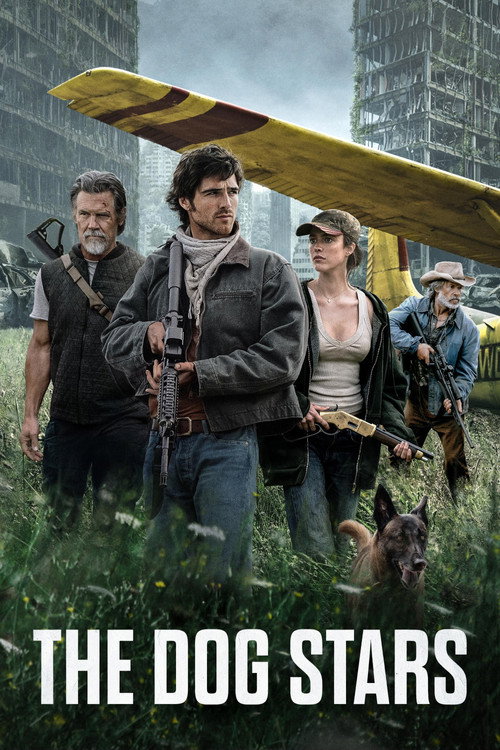
The Dog Stars (2026)
Directed by Ridley Scott · $13.1M domestic
No · Ultra Based
How we score movies →Consciousness Markers
The film structures its entire moral architecture around a contrast between Bangley's armed isolationism and Hig's yearning for community, a binary that reviewers noted lacks a sharp enough edge to feel pointed. The humanist thesis is present but, by most accounts, too diffuse to constitute genuine sermonizing.
Benedict Wong appears as the leader of a Mennonite community, a casting choice that reviewers noted without controversy or apparent agenda. The diversity is present but functions as set dressing for the story rather than as a statement about the story.
Allison Janney plays a survivalist constructing her own autonomous utopia, and Margaret Qualley anchors the film's emotional resolution. Neither role appears framed through a feminist lens in any review or commentary.
No LGBTQ+ characters, themes, or subtext were identified in the film or its surrounding discourse. The film is, in this respect, a barren wasteland, much like its setting.
No racial consciousness themes were identified. Characters of various backgrounds exist in the narrative without the film drawing explicit attention to race as a thematic concern.
The apocalypse is pandemic-driven, not climate-driven. No climate messaging, environmental allegory, or ecological commentary was identified in any review or synopsis.
No anti-capitalist themes, class critique, or wealth-inequality commentary were identified. The characters are largely too busy surviving to eat any rich.
No body positivity themes or messaging were identified. Jacob Elordi is in it, which is essentially the opposite.
No neurodivergent characters, framing, or themes were identified in the film or its critical reception.
The film is set in a near-future post-apocalyptic America. There is no historical revisionism to speak of, as history has largely been replaced by rubble.
Synopsis
After the world's population has been ravaged by a pandemic, a man lives a lonesome existence in a Colorado airplane hangar with his dog and a dour gunman he has befriended. When a mysterious transmission comes through on the radio while he's flying his old Cessna, it sparks a hunt for the provenance of the sound.
Why it received this score
Ridley Scott, a director who has given us gladiators, androids, and alien chest cavities, here turns his attention to a post-pandemic Colorado and the age-old question of whether a man with a dog and a Cessna can locate meaning in a depopulated wasteland. The answer, adapted from Peter Heller's 2012 novel, is a qualified yes, delivered at a pace that several critics found insufficiently urgent. The film's central thesis, that human connection is preferable to paranoid isolationism, is presented with the subtlety of a survivalist's perimeter alarm. We are meant to understand that Josh Brolin's heavily armed cynic is wrong about the world, and Jacob Elordi's sensitive pilot is right. Scott, to his credit, does not quite let the film become a pamphlet.
The markers of progressive cultural awareness are, in this particular vintage, almost entirely absent. Benedict Wong leads a Mennonite community, which is a casting choice of mild interest, and Allison Janney constructs a mid-century utopia with the energy of someone who has read too many self-sufficiency manuals. Neither development is coded as a social statement. The film's politics are of the older, more generalised humanist variety: grief is bad, hope is good, community is worth the risk. These are not controversial positions. They are, in fact, positions that have been uncontroversial since approximately the Bronze Age.
What the film does emit, faintly, is what we might call ambient lecture energy. The Bangley-versus-Hig dynamic is a moral argument dressed as a plot, and the argument has a correct answer that the film is not shy about telegraphing. Critics noted the political commentary "never quite has a sharp enough edge," which is a polite way of saying the sermon is audible but the congregation may have already left. As a specimen of post-pandemic cinema in a post-pandemic cultural moment, it arrived into a market suffering from considerable apocalypse fatigue. The timing was, by most accounts, poor. The dog, presumably, was excellent.
Analysis generated by our Consciousness Algorithm
Critic Reviews
“Ridley Scott piles on epic action set pieces and surreal, surprising sequences that sometimes push the film from prestige drama into absurdist spectacle.”
“Harsh but deeply humane, The Dog Stars understands that hope doesn’t have to illuminate the darkness. Sometimes a glimmer is enough.”
“Scott, of course, is an action maestro, from Alien to Gladiator, and handles the skirmishes and shootouts with aplomb. A last-minute dash from a horde of horse-riding Reapers is one of the most thrilling set pieces the film-maker has orchestrated in decades. But it’s the softer moments that really impress. ”
“It’s the sort of science fiction that fumbles around for something to say, whose filmmakers throw up their hands long before the many climaxes followed by a deflatingly anticlimactic ending.”