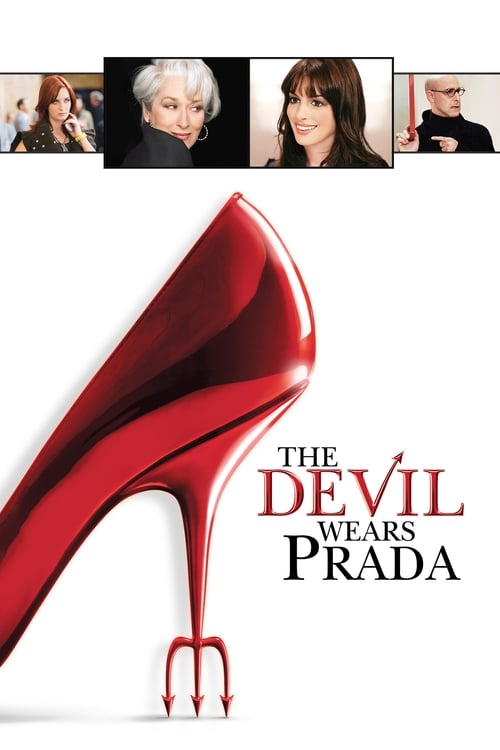
The Devil Wears Prada (2006)
Directed by David Frankel · $215.0M domestic
No · Based
How we score movies →Consciousness Markers
Female ambition and workplace power depicted, but film is ambivalent rather than prescriptive. Success comes at cost of personal relationships without systemic critique of gender inequality.
Strong female leads (Meryl Streep, Anne Hathaway) but predominantly white cast. Female presence reflects industry norms rather than intentional progressive representation.
Capitalism and consumerism are depicted observationally, but film presents no critique of capitalist systems. Success is achieved through adaptation to existing hierarchies.
Minor gay character (Stanley Tucci as Nigel) present but sexuality is incidental to plot and treated as comic relief rather than thematic focus.
Film shows rather than tells. Dialogue and monologues concern fashion and character rather than delivering social messaging or moral instruction.
No engagement with racial dynamics, racial commentary, or examination of racial representation in the fashion industry.
No environmental themes or climate-related content present in the film.
Set in fashion industry but contains no progressive messaging about body diversity or acceptance. Reinforces rather than challenges fashion industry standards.
No representation or discussion of neurodivergence in any form.
Not a historical film. No revisionist historical content present.


Synopsis
A young woman from the Midwest gets more than she bargained for when she moves to New York to become a writer and ends up as the assistant to the tyrannical, larger-than-life editor-in-chief of a major fashion magazine.
Why it received this score
The Devil Wears Prada arrives from a pre-woke era when films could depict workplace ambition without feeling obligated to deconstruct the systems that enabled it. Meryl Streep's Miranda Priestly remains a towering figure of authority, but the film treats her dominance as a character trait rather than a commentary on patriarchy. Andy's journey through the fashion industry unfolds as a personal narrative of transformation, not as a manifesto about gender in corporate spaces. The movie is fundamentally concerned with the mechanics of ambition and its costs, which is a legitimate artistic project, but it operates in a register entirely separate from contemporary progressive cultural signaling.
The film's depiction of capitalism is observational rather than critical. We see the machinery of consumerism, the cruelty of hierarchies, the reduction of human beings to their utility, and yet the film never questions whether these systems deserve to exist. Its ambivalence toward Andy's ascent could be read as subtle critique, but more honestly it reads as moral uncertainty. She succeeds by adopting the values of her environment. This is presented as neither wholly triumphant nor wholly tragic, which was a viable artistic position in 2006 but would require considerably more self-awareness to maintain today.
The film's representation remains unremarkable. Women occupy significant roles, but this reflects 2006 Hollywood practice rather than intentional statement. There is no engagement with racial dynamics, environmental concerns, or questions of bodily diversity. The minor presence of a gay character (Stanley Tucci's Nigel) functions as comic relief rather than thematic exploration. What emerges is a film that succeeds on craft and performance but carries virtually no markers of the specific cultural consciousness that would later come to dominate discourse. It is, in short, a product of its moment.
Analysis generated by our Consciousness Algorithm
Critic Reviews
“If you can tell the difference between a mule and a pump, attendance at The Devil Wears Prada is mandatory. You might have to reach back to "Funny Face" to find a fashion movie so on-trend.”
“Effortless fun: It plays like a giddy horror movie with its laughs wrapped in couture gowns.”
“Bright and crisp and funny, the movie turns dish into art--or, if not quite into art, then at least into the kind of dazzling commercial entertainment that Hollywood, in the days of George Cukor or Stanley Donen, used to turn out.”
“If you shut down your brain and simply take in the wardrobe and performances by Streep and Blunt you'll have a swell time, like aimlessly flipping the pages of a fashion magazine.”