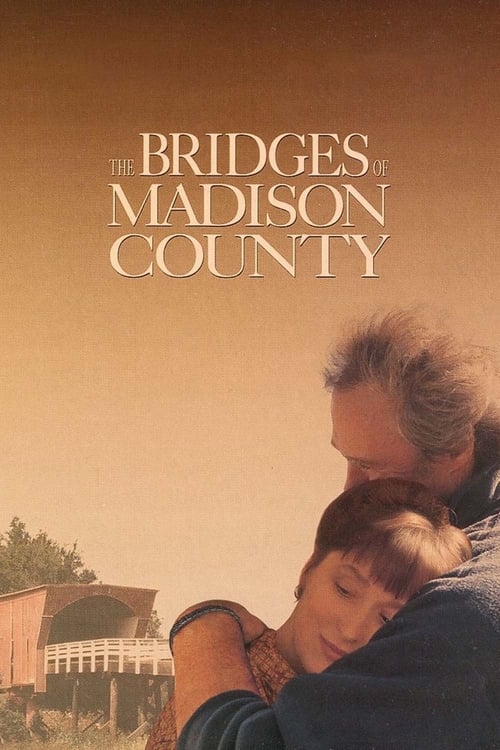
The Bridges of Madison County (1995)
Directed by Clint Eastwood
No · Ultra Based
How we score movies →Consciousness Markers
Francesca possesses agency and interiority, but the narrative ultimately endorses her sacrifice of personal desire for marital duty and family obligation.
Meryl Streep's prominent lead role reflects 1990s inclusion of established female stars, though the supporting cast is entirely white and there is no meaningful diversity in the film.
The film is primarily a character study, though Francesca's final monologue does carry some expository weight in explaining her choices to her children.
No LGBTQ+ themes, characters, or representation present in the film.
The film presents rural Iowa as an exclusively white space with no acknowledgment of racial realities or diversity.
No environmental themes or climate consciousness present in the film.
No critique of capitalism or wealth structures; the film is apolitical regarding economic systems.
The film does not engage with body positivity or contemporary discussions of physical appearance.
No representation of or engagement with neurodivergence in the film.
The film does not attempt to revise historical narratives; it exists outside historical commentary.


Synopsis
Photographer Robert Kincaid wanders into the life of housewife Francesca Johnson for four days in the 1960s.
Why it received this score
The Bridges of Madison County represents a peculiar artifact of mid-1990s American cinema, a film so thoroughly committed to its own romantic melancholy that any progressive sensibility exists purely as an accidental byproduct. Clint Eastwood's direction and performance prioritize emotional restraint and the ache of foregone possibility over any engagement with social consciousness. The film's treatment of Francesca Johnson, played with depth by Meryl Streep, hinges on her ultimate acceptance of duty over desire, a narrative choice that reads as a kind of anti-feminist meditation masquerading as romantic tragedy.
The film's world is one of almost aggressive homogeneity. Rural Iowa in the 1960s is presented as an exclusively white space, with no acknowledgment of or engagement with the racial realities of that era or setting. Class is mentioned primarily as a backdrop for Francesca's sense of confinement. The only female character of any significance is Francesca herself, and her agency amounts to choosing between her current life and an alternative one. There is no interrogation of systems, no examination of power structures, no apparent awareness that such things might be worth examining.
What emerges is a film committed entirely to the interior lives of two people and the impossible romance between them. It is, in this sense, aggressively apolitical, which in 1995 meant it could circulate as a prestige drama without the burden of having to justify itself to anyone concerned with representation or systemic critique. The film won multiple Academy Awards, including Best Editing and Best Original Dramatic Score, cementing its place in the canon as a legitimate work of American cinema. That legitimacy came without any requirement to engage with the cultural conversations that would, within two decades, become the baseline expectations for films seeking critical respectability.
Analysis generated by our Consciousness Algorithm
Critic Reviews
“To say that Eastwood, who directed, has done a first-rate job of adaptation fails to do him justice. What he's brought off is closer to alchemy.”
“Streep is an actress known for her uncanny ability with accents, but her quiet performance in "Bridges" proves that she would have made a world-class silent-film star, too.”
“It is easy to analyze the mechanism, but more difficult to explain why this film is so deeply moving.”
“Eastwood, who directed the picture adequately, is inadequate in this role. He has done a lot of impressive acting in films, but none of it has been sexually romantic, and the age of 64 was not the right time to take up that line of work. [03Jul1995, Pg. 26]”