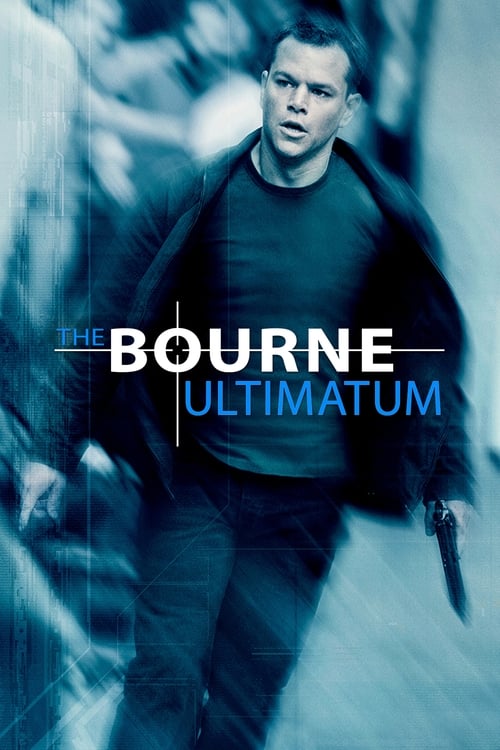
The Bourne Ultimatum (2007)
Directed by Paul Greengrass
No · Ultra Based
How we score movies →Consciousness Markers
The film critiques government institutions and corporate-military complicity, but this emerges from espionage thriller conventions rather than deliberate anti-capitalist social messaging.
Julia Stiles provides female representation, but the cast is predominantly white and male. No meaningful diversity in leading or supporting roles beyond conventional 2007 Hollywood standards.
Julia Stiles plays an active agent, but her character remains subordinate to the male protagonist's arc with no thematic engagement with feminist concerns.
Minimal preachy messaging; the film prioritizes action spectacle and plot mechanics over explicit social commentary or preaching.
No LGBTQ+ themes, characters, or representation present in the film.
No narrative engagement with racial consciousness or systemic racial issues as thematic elements.
No climate-related messaging or environmental themes present in the film.
No body positivity messaging or representation of diverse body types in the film.
No representation or thematic exploration of neurodivergence.
No revisionist historical narratives or reframing of historical events present in the film.


Synopsis
Bourne is brought out of hiding once again by reporter Simon Ross who is trying to unveil Operation Blackbriar, an upgrade to Project Treadstone, in a series of newspaper columns. Information from the reporter stirs a new set of memories, and Bourne must finally uncover his dark past while dodging The Company's best efforts to eradicate him.
Why it received this score
The Bourne Ultimatum is a 2007 action thriller that, while politically critical of government institutions, does not align with the specific markers of contemporary progressive cultural consciousness that define modern wokeness. The film's critique of the CIA and institutional power operates in a pre-2015 register of political skepticism rather than through the lens of identity-based social justice. The cast is predominantly white and male, with female characters serving functional rather than thematic roles. There is no discernible engagement with LGBTQ+ themes, racial consciousness as a narrative concern, climate messaging, body positivity, neurodivergence, or revisionist historical frameworks. The film's "lecture energy" is minimal; it opts for action spectacle over preachy messaging.
Julia Stiles' presence as Nicki Parsons, a former CIA operative, provides the film's only notable female perspective, yet her characterization remains subordinate to Bourne's arc and lacks any thematic exploration of gender dynamics or feminist concerns. The film's political engagement focuses narrowly on institutional betrayal and individual survival rather than broader structural critiques of power. Paul Greengrass' direction prioritizes visceral action sequences and documentary-style realism over social commentary. The casting reflects 2007 Hollywood conventions with no apparent commitment to representation beyond what the source material demanded.
This is a competent, entertaining thriller that critiques government overreach in a manner consistent with post-9/11 skepticism. It simply predates and operates outside the framework of contemporary social consciousness discourse.
Analysis generated by our Consciousness Algorithm
Critic Reviews
“Bravura doesn't begin to describe Greengrass's skill in mounting these complex sequences...This is, simply put, some of the most accomplished filmmaking being done anywhere for any purpose.”
“The best blockbuster of the summer and the most accomplished thriller since, well, Supremacy. This is the payoff Bourne fans have been waiting for and the standard to which future blockbusters should be held.”
“The movie is so surreal it's just not very involving. As an action extravaganza, it's busy but dull.”