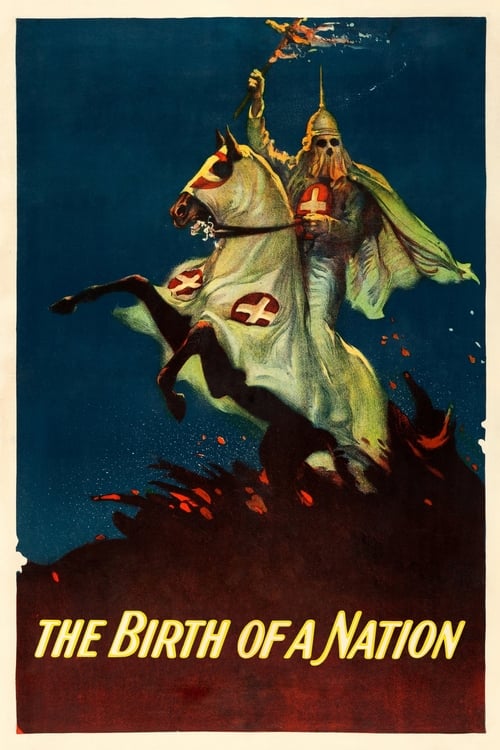
The Birth of a Nation (1915)
Directed by D.W. Griffith
No — The Birth of a Nation is not woke, scoring 0 out of 100 on our wokeness meter.
Here we have a work that has spent a century being called a landmark, and it earns the word in the narrowest possible sense.
Consciousness Markers
The film uses white actors in blackface for Black characters and presents a uniformly white heroic cast, offering no meaningful representation of marginalized groups.
No LGBTQ+ characters, themes, or subtext are present.
Women are portrayed as pure, passive objects needing protection by white men, reinforcing patriarchal and white-supremacist gender roles rather than feminist agency.
The film is explicitly white supremacist, depicting Black people as savage and the KKK as heroic; it is the antithesis of modern anti-racist racial consciousness.
No environmental or climate-related themes appear.
No critique of capitalism or economic inequality is present.
No body-positivity themes or diverse body representations are present.
No neurodivergent characters or themes are present.
The film presents a racist Lost Cause revisionist history of Reconstruction, but this is a white-supremacist narrative, not the progressive re-centering of marginalized perspectives that the marker denotes.
The film is didactic propaganda for white supremacy, not a progressive lecture on social justice.
Why it received this score
Here we have a work that has spent a century being called a landmark, and it earns the word in the narrowest possible sense. D. W. Griffith's three-hour epic of the Civil War and Reconstruction did things with the camera that nobody had done before: closeups, fadeouts, a battle staged to look like an army. That the same film is also a recruiting poster for the Ku Klux Klan is the sort of tension that keeps archivists employed.
The politics are not subtle and were not meant to be. Freedmen stuff ballot boxes, a mulatto politician lusts after a white woman, and a young Southern girl leaps from a cliff to escape a Black pursuer. Women exist to be protected or avenged. The white men exist to do the protecting. Lincoln passes through as a martyr to moderation, and that is the whole of his moral weight. There is no environmental lament here, no indictment of capital, no neurodivergent protagonist, no meditation on the dignity of varied bodies, no queer subtext waiting to be excavated. The text is the text, and the text is white supremacy in a frock coat and a hood.
What makes the artifact worth cataloguing is the reaction it provoked. The NAACP organized against it. Cities banned it. Griffith, wounded by the criticism, answered with Intolerance the next year. The box office was enormous regardless, and historians credit the film with helping revive the Klan within months of its release. A genuine milestone of the medium and a genuine piece of propaganda, fused at the root. Judge it as cinema and it earns its place in the registry. Judge it against any contemporary progressive rubric and it returns nothing, because it is precisely the thing those rubrics were assembled to oppose.
Analysis generated by our Consciousness Algorithm


Synopsis
Two families, abolitionist Northerners the Stonemans and Southern landowners the Camerons, intertwine. When Confederate colonel Ben Cameron is captured in battle, nurse Elsie Stoneman petitions for his pardon. In Reconstruction-era South Carolina, Cameron founds the Ku Klux Klan, battling Elsie's congressman father and his African-American protégé, Silas Lynch.
Questions about The Birth of a Nation
Is The Birth of a Nation woke?
No — The Birth of a Nation is not woke, scoring 0 out of 100 on our wokeness meter. That earns it a verdict of Ultra Based.
Does The Birth of a Nation have any woke elements?
No. All 10 markers score zero.
How is the Woke Score calculated?
An AI-assisted process researches the film and its reception, scores it 0–100 on ten markers, then combines those into one 0–100 Woke Score. It measures a specific set of 2020s cultural themes, not film quality.