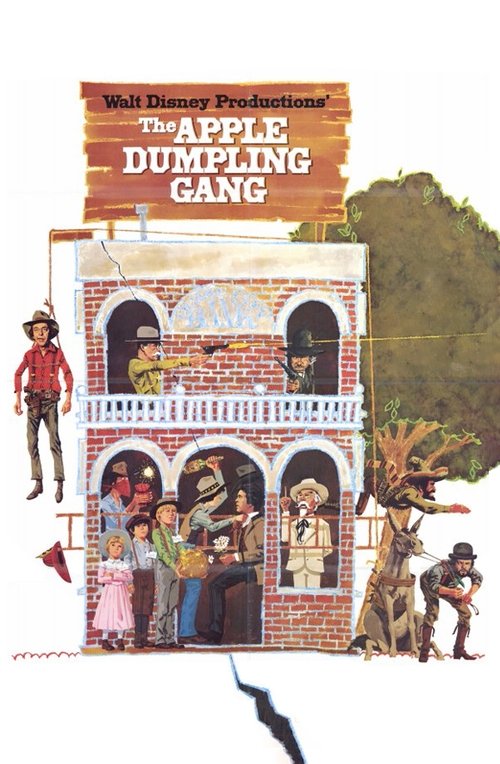
The Apple Dumpling Gang (1975)
Directed by Norman Tokar
No · Ultra Based
How we score movies →Consciousness Markers
The cast consists almost entirely of established white male comedians. Female and minority characters appear only in peripheral roles with minimal development or agency.
The film contains no commentary on body standards. Physical comedy relies on slapstick rather than body-shaming, though this is not a conscious choice.
Female characters exist primarily as background figures. Susan Clark's presence is decorative rather than consequential to the plot.
The film reflects the default racial composition of mainstream Hollywood comedy in 1975. No conscious examination of race or ethnicity occurs.
The film contains no preachy messaging or attempts to educate the audience on social matters. Comedy is its only objective.
The film contains no LGBTQ themes, representation, or subtext of any kind. The subject appears entirely outside the film's universe.
Environmental themes are entirely absent. The narrative shows no awareness of ecological concerns.
The film celebrates the pursuit and possession of gold without irony. Wealth accumulation is treated as the ultimate goal.
No representation of neurodivergent characters or conditions. The subject does not appear in the film.
This is a straightforward Western fantasy with no engagement with historical reality or revisionist intent.


Synopsis
A roving bachelor gets saddled with three children and a wealth of trouble when the youngsters stumble upon a huge gold nugget. They join forces with two bumbling outlaws to fend off the greedy townspeople and soon find themselves facing a surly gang of sharpshooters.
Why it received this score
The Apple Dumpling Gang represents the vanilla optimism of mid-1970s Disney family entertainment, a film so devoted to the pursuit of harmless amusement that it barely registers as a cultural artifact at all. Don Knotts and Tim Conway stumble through their assigned comedic business with the mechanical precision of men who have performed these routines so many times they could do them in their sleep, which may well have been the case during production. The narrative concerns itself with nothing more consequential than slapstick mishaps and the recovery of gold, a plot mechanism that existed long before anyone invented ideological frameworks to critique it.
The film's approach to representation is simply the default of its moment: white men occupy the center of the frame, the supporting cast exists to facilitate their journey, and the entire enterprise operates with the assumption that entertainment means watching familiar faces engage in predictable physical comedy. There is no consciousness of any kind to examine here, progressive or otherwise. The children function as plot devices rather than characters, their personalities flattened into the service of the adults' misadventures.
To score this film on contemporary social consciousness markers is to apply a lens so anachronistic that it borders on absurd, yet here we are. The film contains no representation agenda because it contains no agenda at all, no LGBTQ themes because it operates in a world where such matters simply do not exist, no feminist consciousness because the female characters remain peripheral and decorative. It is, in the most literal sense, innocent of the cultural preoccupations that would come to define the concept in question. One might argue that its very emptiness of ideological content is itself a form of cultural statement, but that would require reading more into this cheerful trifle than its creators ever intended.
Analysis generated by our Consciousness Algorithm
Critic Reviews
“This comic Disney Western is at its best when Don Knotts and Tim Conway are onscreen as the bumbling bandits who try to steal from a bunch of orphans. Few people remember anything about this movie apart from the hilarity generated by this scene-stealing duo.”
“The story is simple and obvious, but it's told with a lot of energy, and the cast is jammed, with character actors doing their things.”
“The traditional ingredients of homely moralising, sentimentality and raucous slapstick are used sparingly, the dialogue is fairly bright, some visual gags are neatly executed, even Knotts is bearable, and Susan Clark makes an auspicious Disney debut as the Calamity Jane-type heroine.”
“A rather pleasant period comedy that made quite a sum of money for the studio in its economically weak post-Walt period. A delightful cast of character actors helps the childish story, with Conway and Knotts beginning what would become a somewhat famous, but very simple-minded, film comedy duo. ”