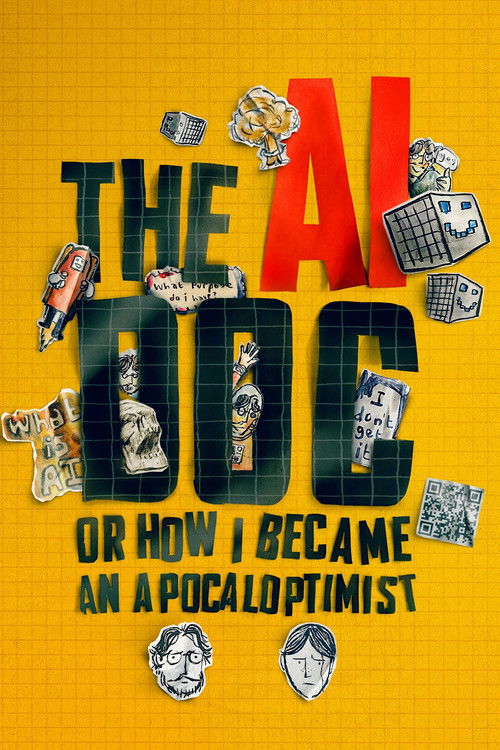
The AI Doc: Or How I Became an Apocaloptimist (2026)
Directed by Daniel Roher
No · Based
How we score movies →Consciousness Markers
A documentary in which a father-to-be processes civilizational anxiety on camera while interviewing the people building the technology that may end civilization carries a structurally sermonizing quality. The personal framing device, the hand-drawn artwork, and the explicit 'what's at stake if we get it wrong' thesis all point toward an audience being guided, carefully and warmly, toward the correct level of concern.
The documentary makes a visible effort to include women in technical and research roles, including Daniela Amodei, Emily M. Bender, Ajeya Cotra, and Liv Boeree. The ensemble is more diverse than a 2010-era tech documentary would have been, though this reads more as reflecting the actual landscape of AI discourse than as a casting agenda.
The film includes critics of the AI industry alongside its CEOs, and the framing of existential risk implicitly questions whether profit-driven development is compatible with human safety. However, multiple critics noted the film ultimately goes easy on tech executives, which caps this marker considerably.
Several prominent women researchers and executives are given substantive screen time and treated as authoritative voices rather than tokens. There is no overt feminist framing, but the film's structure implicitly pushes back against the overwhelmingly male image of Silicon Valley AI leadership.
AI's environmental footprint (energy consumption, data center emissions) is a known adjacent concern in AI governance discourse, and the film's broad scope may touch on it, but no reviewed source identifies climate as a meaningful thread in the documentary's argument.
Racial consciousness is not a documented theme of the film. A modestly diverse interview roster is present, but no source indicates the film addresses race as a lens for understanding AI's risks or benefits.
No LGBTQ+ themes, representation, or framing are present in the film's documented content or critical reception. The score is 0.
Body positivity is entirely absent from the film's themes, subjects, and documented reception. The score is 0.
No neurodivergence themes or framing are present in the film's documented content. The score is 0.
The film is concerned with the present and near future of AI, not with recontextualizing historical events or figures. The score is 0.
Synopsis
A father-to-be tries to figure out what is happening with all this AI insanity, and explores the most powerful technology humanity has ever created... and what's at stake if we get it wrong.
Why it received this score
Daniel Roher, fresh from his Oscar-nominated portrait of Alexei Navalny, has turned his camera toward a subject that is, by his own admission, slightly more complicated than a Russian dissident: artificial intelligence. The resulting documentary is a sincerely crafted, technically accomplished, and genuinely anxious piece of work that positions itself as the film your nervous system needs before you can have an informed opinion about the future. Roher frames the entire enterprise through his impending fatherhood, a choice that is either deeply humanizing or the most efficient delivery mechanism for ambient dread ever devised, depending on your tolerance for the genre. The hand-drawn artwork is lovely. The editing is crisp. Sam Altman appears to have been interviewed in a room specifically designed to make him seem trustworthy.
The film's social consciousness is distributed unevenly, which is itself a form of argument. Women researchers and executives occupy prominent positions in the film's intellectual architecture, and the inclusion of Emily M. Bender alongside three AI company CEOs signals at least a formal commitment to representing the full spectrum of informed opinion. The anti-industry critique is present, but critics at WIRED noted that it does not survive extended contact with the executives themselves, who emerge from their interviews largely unscathed. This is a documentary about the most consequential technology in human history that declines to make anyone uncomfortable. The lecture energy is high, but the lectures are polite. The stakes are existential, but the tone is that of a very good TED Talk.
What the film ultimately captures, perhaps more accurately than it intends, is the specific texture of progressive techno-anxiety in the mid-2020s: the feeling that something enormous and poorly understood is happening, that the right people should be in charge of it, and that a documentary with good producers and a Sundance premiere is a reasonable response. It is produced by the teams behind "Everything Everywhere All at Once" and "Navalny," a lineage the press materials are not shy about, and it carries their pedigree visibly. It is a film made by people who care, for people who care, about whether the people building the future also care. The answer, the film suggests, is complicated. The film itself is less so.
Analysis generated by our Consciousness Algorithm
Critic Reviews
“The AI Doc is visually pretty standard — lots of talking heads, B-roll of robots, and cutesy animation to make it more personal — but it’s also a grand primer on the topic, skipping the standard news headlines of Will It Take My Job? (maybe) and Does it Espouse Suicide (tragically, sometimes yes) in favour of a kind of point-counterpoint-synthesis setup.”
“The AI Doc: Or How I Became an Apocaloptimist is a scary, dizzying and essential documentary. If you have any interest in artificial intelligence (which is to say: the future), you should go out and see it right now. ”
“But aside from calling for some bland common sense regulations that should be uncontroversial to any sane person, Roher doesn’t attempt to make anyone agree with him. After all of the information is presented, the film is much more interested in exploring the human story of how each of us has to wrap our own mind around an impossibly large topic.”
“Roher’s willingness to blindly accept any and all of his speakers’ pronouncements leaves The AI Doc feeling toothless. ... Clearly, the filmmakers want to present the material in an evenhanded fashion so that viewers can make up their own mind, but in the name of so-called fairness, the documentary lacks any real perspective or inquisitiveness.”