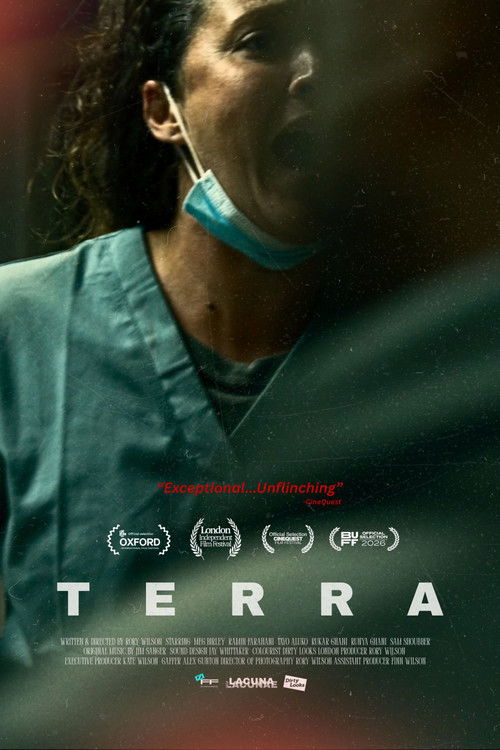
Terra (2025)
Directed by Rory Wilson
No · Ultra Based
How we score movies →Consciousness Markers
The film features a Nigerian-born lead and a cast with evident ethnic diversity, reflecting the multinational reality of conflict zones. The casting reads as story-authentic rather than performatively assembled for demographic balance.
The film's moral architecture, centered on ethical compromise under extreme duress, carries a low-grade sermonizing potential. The tagline gestures at a thesis about morality, though the film seems to complicate rather than deliver clean lessons.
The lead character is a Black African doctor in a war zone, and the film's humanitarian lens implicitly centers non-Western suffering. Race is not foregrounded as an explicit theme, but the casting choices carry a quiet awareness.
No LGBTQ+ themes, characters, or representation are evident in any available material about the film.
No feminist framing or gender-politics agenda is discernible. Meg Birley is part of the medical staff, but no evidence suggests the film foregrounds her gender as a thematic concern.
No climate or environmental themes are present. The film is set in a war zone and concerns human conflict, not ecological crisis.
No anti-capitalist messaging is evident. The film's antagonist force is war and moral desperation, not corporate or economic systems.
No body positivity themes are present. The film is a war thriller concerned with survival, not self-image.
No neurodivergence themes or representation are evident in any available material about the film.
The film appears to be an original story set in a generic war zone, not a revisionist account of any specific historical event or figure.
Synopsis
Set in a war-zone, a war doctor and his medical staff are forced underground into a make-shift hospital, only to be faced with a desperate father willing to do whatever it takes to be helped. When survival is everything, morality is the first casualty.
Why it received this score
Terra arrives as a spare, independent war drama from director Rory Wilson, set in the underground corridors of a makeshift field hospital where a Nigerian-born doctor and his staff must navigate an impossible ethical confrontation with a desperate father. The film's tagline, "When survival is everything, morality is the first casualty," announces its intentions with the bluntness of a field amputation: this is a film about moral compromise in extremis, not about the careful curation of social messaging. It is, in the taxonomy of contemporary cinema, a relatively rare creature.
The casting deserves some acknowledgment. Tayo Aluko, a Nigerian-born actor and playwright whose theatrical work has engaged with civil rights history and political resistance, brings a weight to the role of Doctor Bassey that feels earned by biography as much as craft. The ensemble, which includes Ramin Farahani and Sam Shoubber alongside Meg Birley, reflects the multinational texture of actual conflict zones. This is representation in the oldest sense: people who plausibly belong in the story are in the story. The film does not appear to pause and congratulate itself for this, which is, in 2025, a form of restraint bordering on the radical.
Where Terra registers faintly on the progressive spectrum is in its moral architecture. The framing of medical workers as heroic witnesses to civilian suffering carries a humanitarian charge, and the film's interest in impossible choices has the faint scent of a sermon about human dignity. But the tagline itself is almost a pre-emptive argument against moralizing: if morality is the first casualty, the film is not in the business of delivering clean lessons. For a contemporary drama set in a war zone with a diverse cast and serious ethical themes, Terra scores remarkably low on the scale of modern social consciousness. It appears to be, against considerable odds, simply a film.
Analysis generated by our Consciousness Algorithm