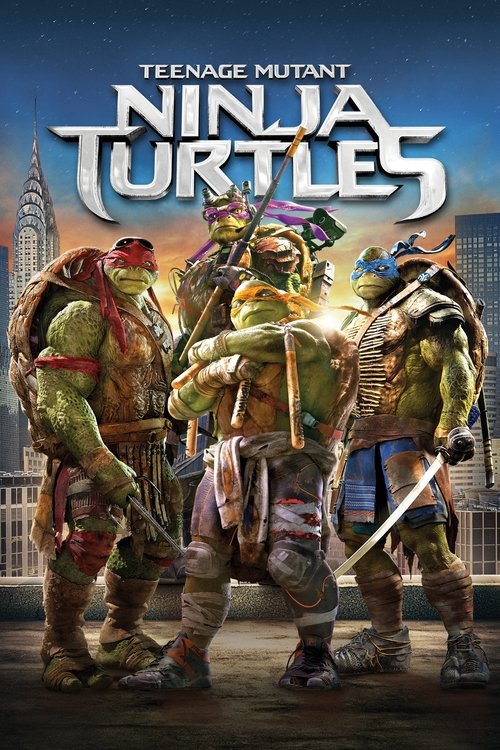
Teenage Mutant Ninja Turtles (2014)
Directed by Jonathan Liebesman
No · Ultra Based
How we score movies →Consciousness Markers
The film features Megan Fox as the female lead and includes background characters of various ethnicities, but these choices appear incidental rather than reflective of deliberate casting strategy for representation.
April O'Neil is a professional journalist and active participant in the plot, though her role remains secondary to the male turtle protagonists.
No LGBTQ characters, relationships, or themes are present in the film.
The film contains no examination of racial themes, racial justice, or racial consciousness in its narrative.
Despite the premise involving radiation and mutation, the film makes no connection to climate change or environmental catastrophe.
The film presents no critique of capitalism or wealth inequality, treating the villain's schemes as personal villainy rather than systemic exploitation.
The film contains no body-positive messaging or representation of diverse body types beyond the turtles' superhero physiology.
No characters are coded as neurodivergent or presented with neurodivergent representation.
The film contains no historical revisionism or reexamination of historical narratives.
The film makes no attempt to deliver moral lectures or social commentary to its audience.


Synopsis
When a kingpin threatens New York City, a group of mutated turtle warriors must emerge from the shadows to protect their home.
Why it received this score
This 2014 reboot emerges as a curious artifact of the pre-woke blockbuster era, a moment when the entertainment industry had not yet fully internalized the vocabulary of modern social consciousness. The film presents a cast that is demographically unremarkable by contemporary standards, yet its choices reveal an absence rather than a commitment. Megan Fox anchors the narrative as April O'Neil, a reporter protagonist, though her role remains secondary to the turtle heroes themselves. The film's New York City setting includes background characters of various ethnicities, though their presence reads as incidental rather than purposeful representation.
What strikes the contemporary viewer is the film's near-total indifference to any progressive sensibility whatsoever. There are no LGBTQ characters or themes. No discussion of environmental catastrophe drives the plot, despite the ecological implications of radiation and mutation. The capitalism that enables the villain's schemes receives no critical examination. The film contains no characters coded as neurodivergent, no body diversity beyond the turtle physiology, and no historical revisionism. Most critically, the narrative makes no attempt to lecture its audience about anything of social importance. It is content to be a simple action-comedy about ninja turtles fighting crime.
This is not a woke film. It is barely conscious of the cultural currents that would later reshape blockbuster cinema. It exists in a liminal space between the pre-2015 action cinema and the emerging social consciousness that would define the late 2010s. One might say it is the cinematic equivalent of a creature preserved in amber, frozen at a moment before the industry's cultural reckoning began.
Analysis generated by our Consciousness Algorithm
Critic Reviews
“[A] basically brainless but intermittently adrenalizing, mostly-just-for-kids reboot.”
“Teenage Mutant Ninja Turtles is about as predictable as movies get these days.”
“What the new Teenage Mutant Ninja Turtles lacks is not fidelity, but a spirit of genuine boyish fun.”
“Teenagers, even non-ninjas and non-turtles, have been eating up this cinematic waste product for weeks now. In one way, Teenage Mutant Ninja Turtles is a triumph for producer Michael Bay in that it is equally as godawful as his "Transformers: Age of Extinction" and a hit nonetheless. ”