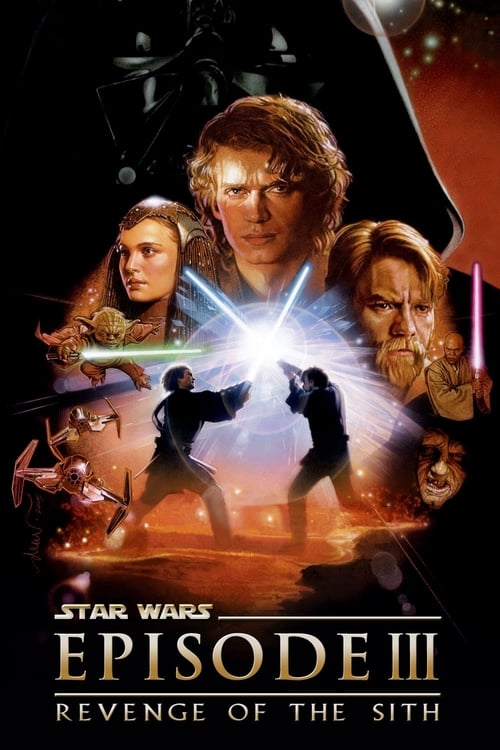
Star Wars: Episode III - Revenge of the Sith (2005)
Directed by George Lucas
No · Ultra Based
How we score movies →Consciousness Markers
Samuel L. Jackson appears in a supporting role, but the cast is predominantly white and male in positions of narrative authority. Natalie Portman is present but narratively sidelined.
While the cast includes actors of color, there is no explicit racial consciousness or commentary in the narrative structure.
Padme is pregnant, politically ineffectual, and dies in childbirth while her husband consolidates authoritarian power. The narrative does not serve feminist sensibilities.
While the film contains political allegory regarding democracy and authoritarianism, it does not heavy-handedly lecture the audience about these themes. They remain implicit.
No LGBTQ+ representation or themes present in the film.
No climate consciousness or environmental themes present in this space opera.
The Empire is portrayed as evil through authoritarianism and fascism, not through economic critique or class consciousness.
No body positivity themes or diversity of body representation in this action-focused blockbuster.
No representation of or engagement with neurodivergence in the film.
The film does not attempt to revise or reinterpret historical narratives. It is a space opera set in a fictional universe.


Synopsis
When the sinister Sith unveil a thousand-year-old plot to rule the galaxy, the Republic crumbles and from its ashes rises the evil Galactic Empire. Jedi hero Anakin Skywalker must choose a side.
Why it received this score
Star Wars: Episode III - Revenge of the Sith is a traditional blockbuster entertainment product from 2005, operating entirely within the aesthetic and thematic conventions of pre-2015 Hollywood. The film's narrative centers on masculine conflict and the consolidation of authoritarian power, with Natalie Portman's Padmé relegated to the role of pregnant bystander who expires during childbirth while her husband ascends to supreme authority. Samuel L. Jackson appears as Mace Windu in a supporting position within an institutional hierarchy, but the film exhibits no particular consciousness regarding representation beyond simple casting.
The work contains no LGBTQ+ representation, no examination of body diversity, no engagement with neurodivergence, and no climate consciousness. Its political themes, while present (the erosion of democracy, the rise of authoritarianism, the corruption of institutions), operate at a broad allegorical level rather than through the lens of contemporary social consciousness. There is no attempt at historical revisionism, no anti-capitalist critique, and minimal lecture energy regarding its political content.
This is not a film that fails to meet contemporary standards through negligence or malice. It is a pre-woke artifact that should be evaluated within its historical context. The score reflects not moral judgment but rather the simple absence of the specific cultural markers that define 2020s progressive sensibility.
Analysis generated by our Consciousness Algorithm
Critic Reviews
“All the "Star Wars" movies will continue to entertain us for many years to come. They were grand fun, and this last one's a corker.”
“The movie grabs us from its heart-pounding opening sequence and pulls us inexorably along its trajectory with the grip of the last gruesome act of a Greek tragedy. Its fascination is not what happens but HOW it happens.”
“The general opinion of Revenge of the Sith seems to be that it marks a distinct improvement on the last two episodes, "The Phantom Menace" and "Attack of the Clones." True, but only in the same way that dying from natural causes is preferable to crucifixion.”