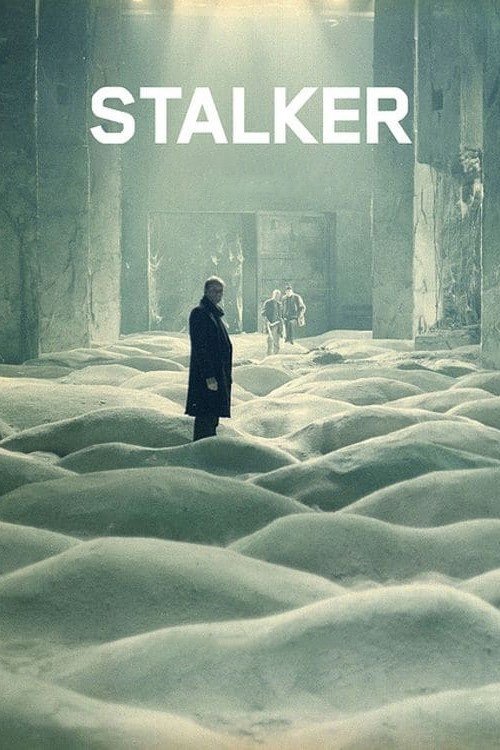
Stalker (1979)
Directed by Andrei Tarkovsky
No · Ultra Based
How we score movies →Consciousness Markers
The film contains vague anti-establishment undertones typical of Tarkovsky's philosophical work, but no explicit class critique or anti-capitalist messaging.
The single significant female character lacks narrative agency and serves primarily as a supporting figure. No feminist consciousness is evident.
The Zone's environmental anomalies are metaphysical rather than environmental commentary. No climate activism or eco-consciousness messaging.
While deeply philosophical, the film eschews preachy messaging. Its meditative pacing and sparse dialogue prioritize contemplation over polemical instruction.
The cast reflects Soviet-era cinema conventions with no conscious effort toward contemporary diversity practices. Male-dominated ensemble with minimal female presence.
No LGBTQ+ characters, relationships, or thematic engagement. The film is entirely absent of such content.
Not applicable to a 1979 Soviet science fiction film. No racial themes or consciousness are present.
Body positivity or body politics are not engaged with in any form.
No representation or thematic engagement with neurodivergence.
The film is deliberately ahistorical and metaphysical. No revisionist historical narratives are present.


Synopsis
Near a gray and unnamed city is the Zone, a place guarded by barbed wire and soldiers, and where the normal laws of physics are victim to frequent anomalies. A stalker guides two men into the Zone, specifically to an area in which deep-seated desires are granted.
Why it received this score
Stalker arrives as a work from a different era, when cinema could afford to be purely metaphysical without the burden of contemporary social consciousness. Tarkovsky's 1979 meditation on desire, faith, and the ineffable exists in a register entirely removed from modern cultural markers. The film concerns itself with the mystical rather than the material, with questions of meaning rather than identity. It is, in this sense, as distant from modern social awareness as a medieval icon.
The three men who traverse the Zone are blank vessels for philosophical speculation, not characters constructed through the lens of representation politics. The film's sole woman appears briefly, serving as a functional element in the narrative rather than as a subject of authorial consciousness. We might ask whether this reflects the limitations of 1970s cinema or Tarkovsky's deliberate aesthetic choice, but in either case, the result is the same: a work unconcerned with the social consciousness frameworks that define contemporary cinema.
What remains is a masterwork of philosophical cinema that operates entirely orthogonal to the concerns we have been tasked to measure. Stalker is neither progressive nor regressive by modern standards. It simply predates the categories entirely, offering instead a meditation on desire itself, on the human longing for transcendence, on the spaces between what we want and what we find. In an age of constant cultural positioning, this indifference to social messaging is itself a kind of statement.
Analysis generated by our Consciousness Algorithm
Critic Reviews
“Stalker is a movie to be watched as many times as physically possible, to be picked apart, discussed, argued over, written about, to inspire music, books, poetry, other movies, teachers, philosophers, historians, governments, even the way an individual might chose to live their life. It really is that astounding.”
“Arguably Andrei Tarkovsky’s finest masterpiece, the Russian director’s 1979 film Stalker is the culmination of a career-long preoccupation with memory, trauma and the relationship between subjective perception and physical reality.”
“Stalker offers the eye so little that it might well have made a better novel, or short story, than a nearly three-hour-long film.”