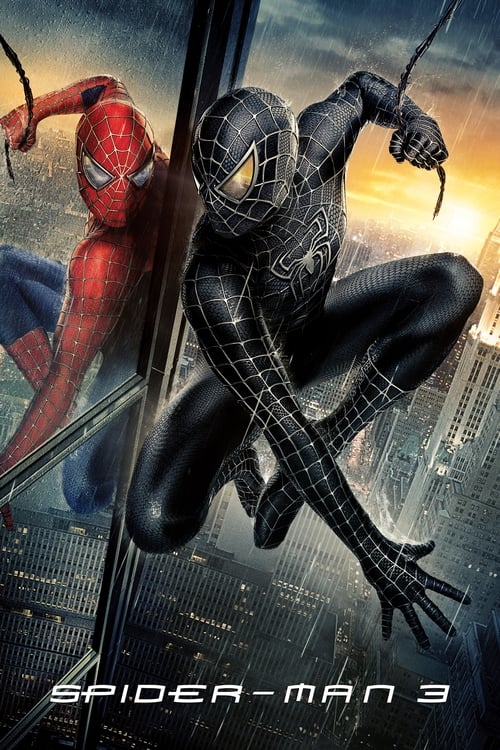
Spider-Man 3 (2007)
Directed by Sam Raimi
No · Ultra Based
How we score movies →Consciousness Markers
While Sandman's motivation involves financial desperation, this is treated as personal tragedy rather than systemic critique. The film presents no challenge to capitalist structures.
The cast is predominantly white and male. Kirsten Dunst as Mary Jane is the only significant female character, and she lacks agency or meaningful character development.
Mary Jane is passive and dependent, caught in a love triangle where her agency is minimal. She exists primarily to validate the male protagonist's emotional journey.
The film celebrates a narrow physical ideal through its action sequences and romantic leads. No diverse body types are presented as desirable or normal.
The film occasionally moralizes about responsibility and forgiveness, but these themes are delivered through character drama rather than preachy speeches.
No LGBTQ+ themes, representation, or storylines are present. The film is entirely heteronormative in its romantic plot.
No meaningful racial consciousness is present. The film treats race as invisible and irrelevant to its narrative, with a largely white cast in a New York setting.
Climate change or environmental consciousness does not factor into the film's themes or plot in any way.
No representation of neurodivergent characters or discussion of neurodiversity appears in the film.
The film is not historical and contains no revisionist historical elements or claims.


Synopsis
The seemingly invincible Spider-Man goes up against an all-new crop of villains—including the shape-shifting Sandman. While Spider-Man's superpowers are altered by an alien organism, his alter ego, Peter Parker, deals with nemesis Eddie Brock and also gets caught up in a love triangle.
Why it received this score
Spider-Man 3 arrives as a 2007 blockbuster innocent of the progressive sensibilities that would come to define contemporary cinema. The film operates in a register of pure spectacle and melodrama, concerned primarily with the internal torment of its protagonist and the escalating conflict between multiple villains vying for screen time. Mary Jane Watson remains largely a prize to be won or lost in the romantic subplot, serving less as a character with agency and more as a narrative device for Peter Parker's emotional turbulence. The film does not trouble itself with questions of representation, systemic inequality, or the social implications of its action sequences.
What we encounter instead is a straightforward superhero narrative in the mid-2000s idiom: morally uncomplicated, narratively bloated, and aesthetically committed to practical effects and soap opera drama. The casting is unremarkably white and male in positions of authority. Sandman, one of the primary antagonists, is given a sympathetic backstory tied to financial desperation and the death of his daughter, but this operates as emotional motivation rather than social critique. The film has no interest in whether Spider-Man's activities displace working people or destroy property with reckless abandon. Such questions would not arrive in superhero cinema for another decade.
The tone throughout is earnest without irony, bombastic without self-awareness. Spider-Man 3 is the product of a moment before the cultural conversation shifted, before every blockbuster felt obligated to signal its awareness of contemporary social movements. It simply wants to be a big, dumb, entertaining movie about a man with spider powers, and in this ambition, it is mercifully free from the burden of demonstrating its cultural consciousness.
Analysis generated by our Consciousness Algorithm
Critic Reviews
“With nifty new villains, a revived Green Goblin, plus $300 million worth of aerial special effects, Sam Raimi's Spider-Man 3 is definitely good to go.”
“This is a wonderfully imagined, heartfelt piece of pop entertainment that soars not only for its spectacular eye candy, but also during the moments when its protagonists simply stand still and talk to each other. How many comic-book movies can you say that about?”
“The wow factor works overtime with state-of-the-art effects sequences that often are as beautiful as they are astonishing.”
“"Spider-Man 2" was a textbook example of how to make a sequel: Deepen it, make it funnier, give it more heart and come up with a strong villain and a good story. Spider Man 3, by contrast, shows how not to make a sequel.”