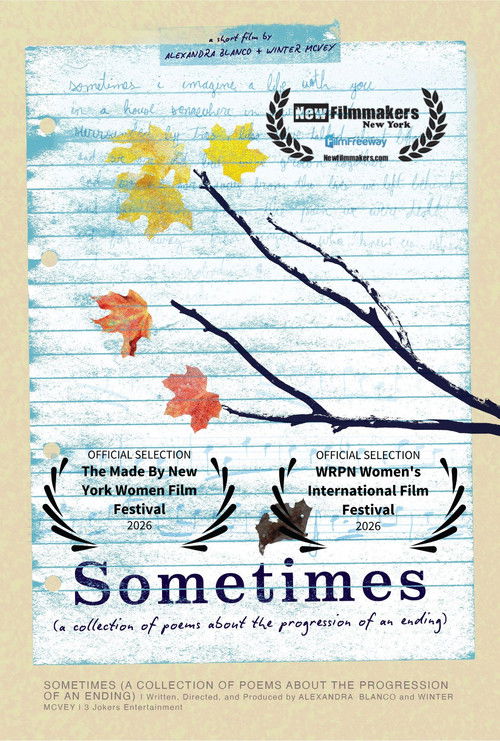
Sometimes: A Collection of Poems About the Progression of an Ending (2026)
Directed by Winter Kay McVey
No · Ultra Based
How we score movies →Consciousness Markers
The film was co-written and directed by a woman, which provides some structural representation in the production hierarchy, though the narrative itself does not engage with feminist themes or critique.
The film's micro-budget indie production model and crowdfunding approach suggest a certain resistance to commercial filmmaking conventions, though this is more circumstantial than ideological.
The poem-based structure invites introspection rather than preachiness, though the inherent nature of poetry can verge on instructive about emotional experience.
Two unnamed actors cast in roles identified only by gender. No visible effort to diversify casting or make representational statements through character selection.
The film depicts a heterosexual romantic relationship. No LGBTQ+ themes or characters are present in the available information.
No indication of racial consciousness or commentary in the film's structure, narrative, or available critical reception.
A romantic drama set in an intimate space offers no engagement with climate or environmental themes.
No evidence of body positivity messaging or commentary on bodily representation in the available material.
No indication of neurodivergent representation or themes in this intimate portrait of romantic dissolution.
A contemporary drama about personal relationships makes no historical claims or reinterpretations.
Synopsis
A collection of three poems that explores the ending of a love that was once seen as everything.
Why it received this score
Here we have a micro-budget indie short film that treats the dissolution of a romantic relationship with the gravity typically reserved for Shakespearean tragedy. Three poems structured as a visual meditation on love's ending, produced through a crowdfunding campaign that sought to raise $1,300 in March 2025. The intimacy coordinator is credited, which signals a certain consciousness about the mechanics of emotional vulnerability on set, though this is more a matter of professional practice than ideological commitment.
The film presents two unnamed figures identified only as "Girl" and "Boy," which avoids the trap of overwrought character development and instead leans into a kind of universalized heartbreak. There is nothing here that announces itself as progressive in the 2020s sense, nor does there need to be. This is a work about human dissolution, about the slow unraveling of connection that once felt permanent. The poetry-as-film structure suggests a genuine artistic ambition that transcends the current cultural moment.
What emerges most clearly is a film that simply does not concern itself with the broader questions that animate contemporary cultural discourse. It is a small, intimate work that asks only to witness the space between two people as it expands into unbridgeable distance. Whether this represents artistic purity or merely irrelevance depends on one's tolerance for sincerity in an age of irony.
Analysis generated by our Consciousness Algorithm
Critic Reviews
“In the quiet, introspective space between two people, a relationship unfolds and unravels in real time.”
“A collection of three poems that explores the ending of a love that was once seen as everything.”
“A contemplative, artistic short film exploring emotional themes through poetry. Suitable for mature children who can engage with abstract emotional concepts, but may be confusing or boring for younger viewers.”