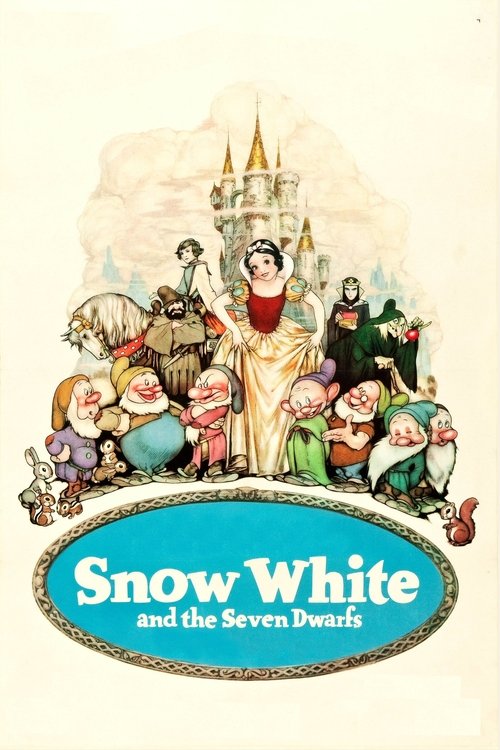
Snow White and the Seven Dwarfs (1938)
Directed by David Hand
No · Ultra Based
How we score movies →Consciousness Markers
Snow White is passive and defined by beauty and domestic labor. The Queen provides the only female character with agency, though her motivations are purely selfish.
The dwarfs are characterized as simple and childlike, which might be read as disability representation, though primarily through stereotyping.
The film tells a straightforward moral tale with minimal preachy content beyond basic good versus evil messaging.
All-white cast with no racial diversity. Typical of 1938 Hollywood but entirely homogeneous by modern standards.
Heterosexual romance culminating in a kiss with a prince. No LGBTQ+ themes or representation present.
No racial consciousness or representation. The film exists in a completely segregated cultural moment.
No environmental themes or climate messaging. The narrative is a straightforward fairy tale with no ecological dimension.
The dwarfs are depicted as miners extracting precious gems with no critique of capitalism or exploitation.
Snow White is presented as an idealized beauty standard. The Queen's obsession with being 'the fairest' reinforces rather than challenges beauty hierarchies.
This is a fairy tale adaptation, not a historical narrative, so revisionism is not applicable.


Synopsis
A beautiful girl, Snow White, takes refuge in the forest in the house of seven dwarfs to hide from her stepmother, the wicked Queen. The Queen is jealous because she wants to be known as "the fairest in the land," and Snow White's beauty surpasses her own.
Why it received this score
Snow White and the Seven Dwarfs remains a technical marvel and cultural artifact of genuine historical importance, which is precisely why it scores so dismally on contemporary progressive sensibility metrics. Released in 1938, the film operates entirely within the aesthetic and moral framework of its era, a time when such categories as we now employ for cultural analysis simply did not exist in their present form. The narrative presents Snow White as a passive figure whose primary virtue is her beauty and domestic competence, waiting ultimately for rescue via true love's kiss, a romantic conclusion that would register as deeply retrograde were it proposed today. The seven dwarfs themselves are rendered as simple, childlike figures, a characterization that, while played for charm rather than malice, would be considered offensive in its casual stereotyping. The Queen alone possesses genuine agency and complexity, though her villainy stems from vanity and jealousy, confirming rather than complicating the film's basic moral architecture. There is no effort whatsoever to address representation, diversity, or any of the social consciousness markers we now track. To fault a 1938 animated feature for these absences would be like criticizing a medieval tapestry for failing to engage with Marxist theory. The film deserves recognition as a groundbreaking achievement in animation and an important historical document. It simply exists in an entirely different cultural moment, one that predates by decades the specific constellation of progressive sensibilities we are here evaluating. As such, it registers barely a whisper on our scale.
Analysis generated by our Consciousness Algorithm
Critic Reviews
“The word genius is easily used and has been cheapened, but when it is used to describe Walt Disney, reflect that he conceived of this film, in all of its length, revolutionary style and invention, when there was no other like it--and that to one degree or another, every animated feature made since owes it something.”
“There has never been anything in the theatre quite like Walt Disney's Snow White and the Seven Dwarfs, seven reels of animated cartoon in Technicolor, unfolding an absorbingly interesting and, at times, thrilling entertainment. So perfect is the illusion, so tender the romance and fantasy, so emotional are certain portions when the acting of the characters strikes a depth comparable to the sincerity of human players, that the film approaches real greatness.”
“Perfectly delightful screen entertainment. The film is as charming as it is novel in conception and execution and it is so bound to appeal as strongly to grown-ups as to youngsters.”
“If it’s possible for a parable to be too simple to even qualify as a parable, the convincingly dim Snow White represents the dopey standard.”