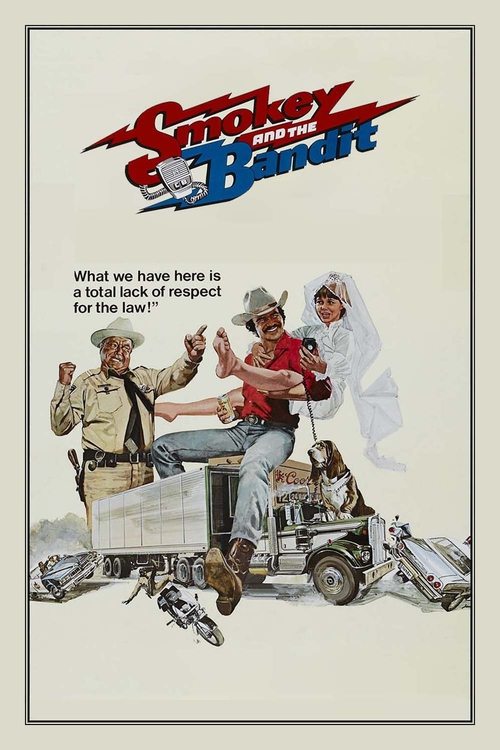
Smokey and the Bandit (1977)
Directed by Hal Needham
No · Ultra Based
How we score movies →Consciousness Markers
Illegal smuggling is the plot, but it is framed as fun rule-breaking and entrepreneurial adventure rather than systemic critique.
The cast is primarily white male leads with Sally Field in a supporting romantic role. No meaningful diversity in casting choices.
The female lead is kidnapped and functions as a romantic prize to be won by the male protagonist, fitting traditional 1970s gender dynamics.
The film features an all-white cast with no engagement with racial themes or consciousness.
The film is pure entertainment with minimal preachy moments or moral lectures.
LGBTQ+ themes are entirely absent from this heterosexual action-comedy.
The film celebrates high-speed driving and fuel consumption with no environmental consciousness whatsoever.
Standard 1970s action film bodies with no commentary on body diversity or positivity.
No representation of or engagement with neurodivergence.
This is a contemporary action-comedy with no historical revisionism.


Synopsis
A race car driver tries to transport an illegal beer shipment from Texas to Atlanta in under 28 hours, picking up a reluctant bride-to-be on the way.
Why it received this score
Smokey and the Bandit arrives as a thoroughly unreconstructed artifact of 1970s populism, a film so committed to its own apolitical hedonism that it barely registers on the scales we use to measure contemporary cultural consciousness. The narrative concerns itself with a simple proposition: a charming outlaw moves beer across state lines while evading the law, and this is treated as unambiguous entertainment. No systems are interrogated. No power structures are examined. The female lead, Sally Field, functions as a romantic MacGuffin to be rescued and eventually won over through the sheer force of the hero's charisma, a dynamic that would face considerably more scrutiny in subsequent decades.
The film's cultural DNA is essentially libertarian in the most unreflective sense, celebrating rule-breaking as a form of masculine autonomy rather than engaging with the implications of its own narrative. The all-white cast operates within a universe where such casting requires no justification or commentary. Environmental concerns do not exist. The body is simply a body. Diversity of gender expression, sexual orientation, or neurological experience are concepts that have not yet arrived in the film's universe. What we have instead is pure, unapologetic entertainment built on car chases, stunt work, and the audience's enjoyment of watching attractive people break laws and evade authority.
This is not criticism, merely observation. The film succeeds entirely on its own terms as a piece of mainstream commercial entertainment, which is precisely why it scores so low on our particular taxonomy. It predates the cultural moment that birthed the very markers we use for assessment. To hold it accountable to contemporary progressive sensibilities would be as absurd as criticizing a medieval tapestry for its lack of photorealism. Smokey and the Bandit is what a film looks like when it has nothing to say about society, only about the pleasures of speed and escape.
Analysis generated by our Consciousness Algorithm
Critic Reviews
“Smokey and the Bandit is an unexpected good time, a playful, wisecracking and curiously revealing example of All-American escapist entertainment. [29 July 1977, p.B1]”
“The direction, by a former stuntman, concentrates on the action and happily leaves everyone to their own devices, with almost nothing to do. Field shows what natural acting is all about, and Reynolds' send-ups of himself are, despite repetition, becoming more likeable. Here his kidding around is exactly in tune with this fast-moving but essentially lazy vehicle. ”
“With Mr. Reynolds playing it cool and Mr. Gleason doing his burns and investing the film with a certain raunchy humor, the rest is up to the vehicles. And they don't do anything that hasn't been seen before.”
“The stunts in Smokey are excellent but the comedy is numbing, and the acting is on a par with a junior high school production of Our Town. Even Gleason comes across badly, and that's a major feat. Adolph Coors and Sons must have been very happy to have a 97-minute commercial for their brew.”