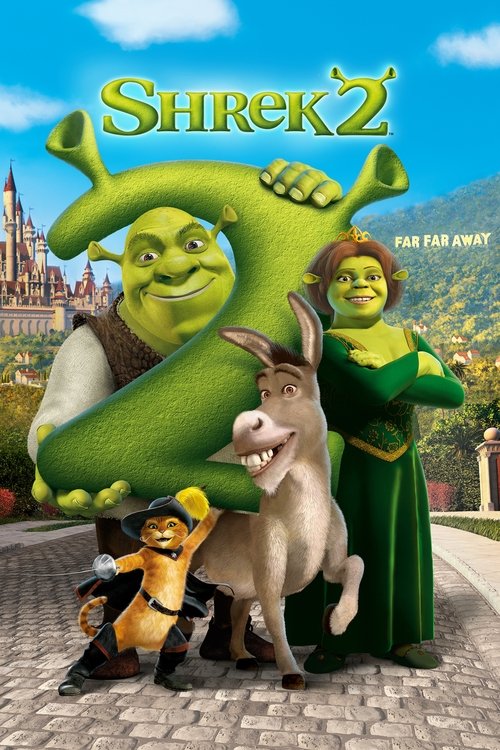
Shrek 2 (2004)
Directed by Conrad Vernon
No · Based
How we score movies →Consciousness Markers
The ensemble includes diverse voice actors and characters, but they function primarily as comic types rather than as deliberate representation. Fiona's agency as a character is somewhat progressive for 2004 animation, though the film does not emphasize this.
Shrek and other non-conventionally attractive characters are positioned as worthy of love and respect, which aligns somewhat with body positivity messaging. However, the film's approach remains comedic rather than preachy.
Fiona resists the traditional princess narrative and possesses agency, yet the film does not foreground feminist critique. The Fairy Godmother serves as a villain but not as commentary on patriarchal systems.
Puss in Boots contains subtext that audiences have read as queer-coded, and Rupert Everett's voice acting contributes to this perception. However, the filmmakers do not explicitly engage with LGBTQ+ themes, making this more retrospective interpretation than intentional messaging.
The film contains gentle endorsements of acceptance and non-conformity, but it never adopts the preachy tone or explicit moral instruction characteristic of contemporary progressive cinema.
The film features voice actors of different backgrounds, but it contains no explicit engagement with racial themes or consciousness. Characters of color exist without racial dimension to their roles.
While the film gently mocks vanity and superficiality through Prince Charming and the Fairy Godmother's schemes, it contains no systematic critique of capitalism or wealth inequality.
The film playfully deconstructs fairy tale tropes and expectations, but this operates as parody rather than as revisionist history of actual events or narratives.
The film's fantasy setting contains no engagement with environmental themes or climate consciousness. The destruction of fairy tale lands is treated as plot device, not environmental commentary.
Donkey's hyperactive personality might be read as ADHD-coded, but the film makes no explicit engagement with neurodivergence as a theme or consideration.


Synopsis
Happily ever after never seemed so far far away when a trip to meet the in-laws turns into a hilariously twisted adventure for Shrek and Fiona. With the help of his faithful Donkey, Shrek takes on a potion-brewing Fairy Godmother, the pompous Prince Charming, and the ogre-killer, Puss In Boots.
Why it received this score
Shrek 2 occupies that peculiar middle ground of early-2000s animation, a film made by people who had not yet received the memo about cultural sensitivity frameworks but whose sensibilities nonetheless aligned with certain progressive instincts. The movie's premise, that an ogre and a human princess can build a life together despite societal disapproval, contains the seeds of a diversity narrative, though the film treats this more as absurdist humor than as social commentary. The ensemble cast includes characters of various backgrounds, but they exist primarily as comic relief rather than as vehicles for representation consciousness.
The film's most noted element in retrospective cultural discussion concerns the ambiguous coding of certain characters. Puss in Boots, voiced by Antonio Banderas, has attracted interpretive readings that ascribe queer subtext to his relationship with Shrek and his general presentation, though the filmmakers themselves offer no explicit confirmation of this reading. Prince Charming functions as an antagonist whose villainy stems partly from his vanity and performative masculinity, but the film does not mobilize these traits as critique of patriarchal structures. Rather, he is simply the comedic villain, and any thematic resonance beyond that remains accidental.
The movie's climate consciousness, anti-capitalist sentiment, and engagement with neurodivergence or revisionist history register as essentially zero. Its lecture energy, while present in the film's gentle endorsement of acceptance and difference, never rises to the level of preachy moralizing that characterizes contemporary progressive cinema. Shrek 2 remains, in its essence, a product of the pre-woke era, entertaining precisely because it need not justify its own existence through the lens of cultural awareness.
Analysis generated by our Consciousness Algorithm
Critic Reviews
“Just as funny, sweet and engaging as the first film starring the big galoot. ”
“Sure, the animation work is great, but it's the actors and their subtle, complex vocal performances that make us care about these fairy-tale characters. Shrek 2 is all about fantasy, but its characters are rousingly, affectingly real -- not to mention real, real funny. ”
“Has a rowdy, jumpin'-jive vivacity. It's not quite as emotionally rounded as ''Shrek'' was... but it's got heart and delirium in equal doses, as well as a firecracker rhythm all its own.”
“The soundtrack deserves mention, mostly because its relatively high quality makes the film itself that much more irritating.”