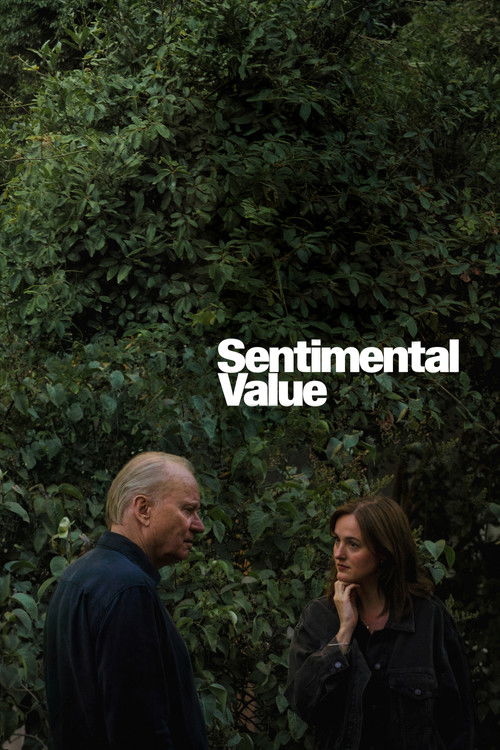
Sentimental Value (2025)
Directed by Joachim Trier
No · Ultra Based
How we score movies →Consciousness Markers
The cast includes both Scandinavian and American performers, with a female lead protagonist, reflecting practical international co-production choices rather than deliberate diversity advocacy.
Female characters are central to the narrative, but their agency appears grounded in personal autonomy and family drama rather than commentary on systemic gender dynamics.
The film explores the entertainment industry and artistic compromise, but does not appear to mount systemic critique of capitalism or wealth inequality.
The film may contain moments of thematic exposition regarding the entertainment industry, but no evidence suggests it functions as a vehicle for preachy messaging.
No evidence in the plot synopsis of LGBTQ+ themes, representation, or narrative focus.
No evidence of racial themes or racial consciousness in the plot or thematic structure.
No evidence of climate-related themes or environmental messaging.
No evidence of body positivity themes or commentary on physical appearance and acceptance.
No evidence of neurodivergence representation or themes in the plot synopsis.
No evidence of revisionist historical narratives or alternative interpretations of historical events.


Synopsis
Sisters Nora and Agnes reunite with their estranged father, the charismatic Gustav, a once-renowned director who offers stage actress Nora a role in what he hopes will be his comeback film. When Nora turns it down, she soon discovers he has given her part to an eager young Hollywood star.
Why it received this score
Sentimental Value presents itself as a chamber piece about family dysfunction and artistic compromise, a narrative that has occupied cinema for decades without requiring contemporary social consciousness. The film follows Nora, a stage actress, as she navigates the reappearance of her distant father and the professional opportunity he presents before withdrawing it in favor of a younger rival. The central conflict concerns personal betrayal and career ambition rather than systemic critique. Joachim Trier's direction seems focused on the psychological dimensions of family relationships and the compromises demanded by the entertainment industry, territory that can be explored without reference to progressive cultural frameworks.
The female characters here, while central to the narrative, do not appear to carry thematic weight regarding gender dynamics in any contemporary sense. Nora's refusal of her father's role reflects personal autonomy and artistic integrity rather than feminist consciousness. Agnes exists as a supporting figure whose emotional life orbits her sister's choices. The film's interest in the entertainment world could have served as a vehicle for commentary on systemic representation or exploitation, but the plot synopsis provides no evidence that it pursues such angles. Instead, the narrative treats the industry as a backdrop for interpersonal drama.
The international cast, featuring Scandinavian performers alongside Elle Fanning and Cory Michael Smith, reflects the practical realities of European co-production financing rather than any deliberate statement about diversity. The film appears to be a character-driven exploration of how ambition and family loyalty intersect, executed without the apparatus of contemporary progressive messaging. This is not to say the film lacks merit, only that its merits appear to rest on dramatic construction rather than cultural advocacy.
Analysis generated by our Consciousness Algorithm
Critic Reviews
“Sentimental Value is uncommonly rich in emotional rewards and contemplative in its reflections on the places where we live becoming a permanent repository for our memories, remaining there even after we move on. The movie’s poignancy accumulates gradually, every supple turn expertly modulated as the presence of generations past becomes more tangible.”
“To no one’s surprise, Reinsve is immaculately attuned to Trier’s energy, and Sentimental Value is carried by the manic frustration she brings to her part, which is as fun as it is freighted with crisis.”
“Trier captures so much while saying so little and, in many ways, Sentimental Value feels like the film he's been building toward his entire career.”
“Skarsgard and Reinsve are excellent as two damaged people who are only able to open up when they’re working, but you yearn for the film itself to open up. It’s an intriguing premise, stylishly executed but sometimes lacking a bit of heart.”