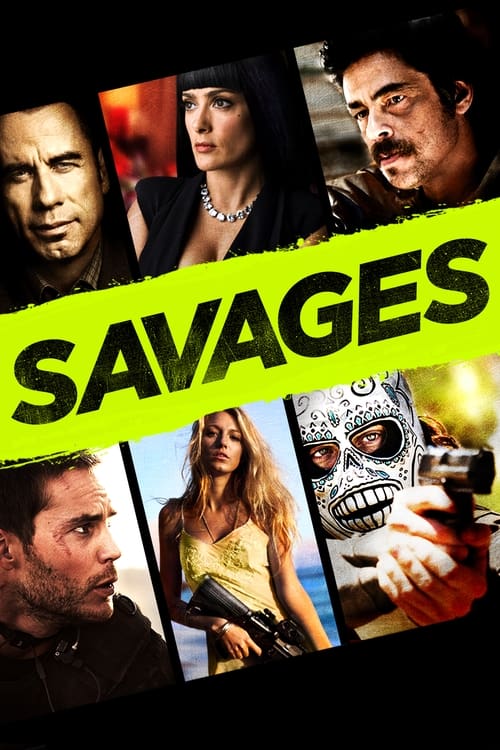
Savages (2012)
Directed by Oliver Stone
No · Ultra Based
How we score movies →Consciousness Markers
While Salma Hayek appears in a significant role, the lead cast remains predominantly white. Blake Lively's female protagonist is rendered as a passive object rather than an active agent in the narrative.
The female protagonist exists primarily as a kidnapped prize fought over by two men, with minimal agency or characterization beyond her romantic relationships.
The film relies heavily on 'savage cartel' stereotypes, depicting Latinx characters predominantly as violent criminals with no nuance or individual characterization.
No LGBTQ+ themes, characters, or representation are present in the film.
No climate-related themes or environmental consciousness are present in the film.
The film presents drug trafficking as a business venture without any critical perspective on capitalism or economic systems.
No body positivity messaging or representation of diverse body types is evident in the film.
No neurodivergent characters or representation are present in the film.
The film does not engage with historical revision or reinterpretation of past events.
The film does not attempt to instruct or preach about social issues to its audience.


Synopsis
Pot growers Ben and Chon face off against the Mexican drug cartel who kidnapped their shared girlfriend.
Why it received this score
Oliver Stone's "Savages" presents itself as a stylish thriller about marijuana entrepreneurs in conflict with Mexican cartels, but what emerges is a film thoroughly invested in the aesthetics of transgression without any corresponding commitment to social consciousness. The narrative centers on Blake Lively's kidnapped girlfriend, a character so thoroughly passive that she functions less as a person than as contested property between two male leads. Her presence in the film is justified primarily by her desirability to men, a dynamic Stone treats with a kind of leering inevitability that suggests indifference to how such framing might register to viewers accustomed to slightly more sophisticated approaches to gender.
The film's treatment of Mexican and Latinx characters operates within the most tired and most damaging stereotypes available to contemporary cinema. Salma Hayek's cartel boss aside, the overwhelming majority of Latinx characters exist as faceless villains, threats to be eliminated by the white protagonists. The narrative structure itself reinforces this hierarchy: the kidnapped white girlfriend becomes the moral center of the film, while the countless Latinx characters exist only as obstacles. Stone seems entirely unconcerned with the cumulative effect of such imagery, presenting it as merely the natural texture of the world he is depicting.
What saves this film from a truly abysmal score is the absence of overt progressive posturing. "Savages" does not attempt to lecture the audience about social justice or attempt to claim progressive credentials it has not earned. It is a film made in 2012 that thinks like a film made in 1985, indifferent to contemporary sensibilities but also not actively performing wokeness. This is perhaps the only compliment one can offer: at least it does not insult our intelligence by pretending to care.
Analysis generated by our Consciousness Algorithm
Critic Reviews
“A return to form for Stone's dark side, Savages generates ruthless energy and some, but not too much, humor.”
“At the confluence of altered states and state-sanctioned violence, this drug-fueled thriller is Stone's most successfully provocative picture since "JFK." ”
“Savages is Oliver Stone doing what he should have done a long time ago: making a tricky, amoral, down-and-dirty crime thriller that's blessedly free of any social, topical, or political relevance.”
“So. What part of this is boring? All of it. ”