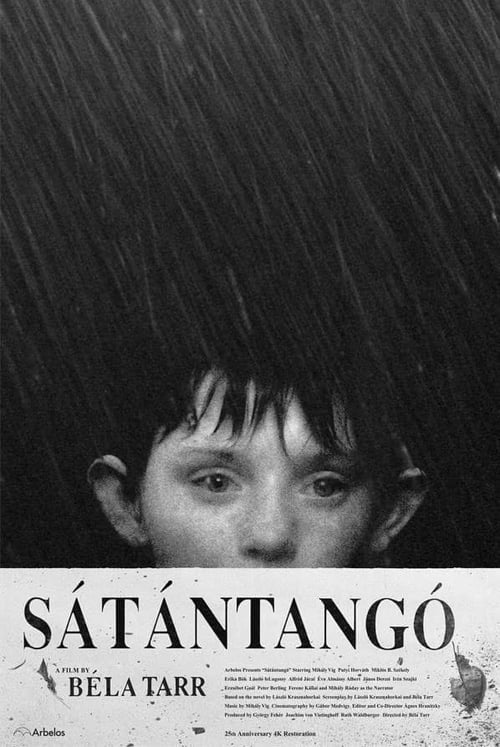
Satantango (1994)
Directed by Béla Tarr
No · Ultra Based
How we score movies →Consciousness Markers
The film depicts economic devastation and the failure of capitalist transition in post-Communist Hungary, but this emerges from historical observation rather than ideological advocacy. The critique is implicit.
The film addresses the fall of Communism and its aftermath, but from a position of historical witness rather than revisionist reframing. It does not seek to reinterpret history through a contemporary progressive lens.
Women appear in the narrative but are not foregrounded through a feminist lens. The film treats all characters with equal indifference to their gender.
The cast reflects the Hungarian village setting authentically but without ideological intent. No apparent effort to achieve demographic representation beyond natural casting.
Tarr's approach is observational and philosophical rather than preachy. The film trusts the viewer to draw conclusions without explicit moral instruction.
No LGBTQ themes, representation, or narrative elements are present in the film.
The film takes place in a homogeneous Hungarian village and contains no engagement with racial themes or racial consciousness.
No climate or environmental messaging appears in the film. The desolate landscape is aesthetic rather than preachy.
No body positivity messaging or themes are evident. Bodies are presented as vessels of age and exhaustion.
No representation of or engagement with neurodivergence appears in the narrative.


Synopsis
Inhabitants of a small village in Hungary deal with the effects of the fall of Communism. The town's source of revenue, a factory, has closed, and the locals, who include a doctor and three couples, await a cash payment offered in the wake of the shuttering. Irimias, a villager thought to be dead, returns and, unbeknownst to the locals, is a police informant. In a scheme, he persuades the villagers to form a commune with him.
Why it received this score
Satantango is a seven-and-a-half-hour meditation on post-Communist collapse that concerns itself with the universal human conditions of desperation, manipulation, and moral compromise. Béla Tarr's gray-scale tableaux depict not a triumph of progressive consciousness but rather the grinding desolation of a world stripped of both ideological moorings and economic purpose. The film observes its subjects with the detached gaze of an entomologist studying insects in their native habitat, offering no redemptive narrative, no message of social awakening, and precious little evidence that the director believes in the transformative power of collective action.
The narrative itself resists the impulse toward contemporary social commentary. Irimias, the mysterious figure who returns to orchestrate a commune, is presented not as a visionary but as a con man, a police informant, a creature of pure opportunism. The commune he establishes is depicted as a desperate capitulation rather than an act of liberation. Tarr's refusal to sentimentalize his characters' circumstances or to frame their plight in terms of systemic injustice reflects a sensibility antedating contemporary progressive frameworks. This is cinema of radical pessimism, not of political consciousness.
The casting reflects the Hungarian milieu without apparent ideological calculation, and the film contains no discernible engagement with the identity categories that structure modern social justice discourse. There is no lecture. There is only the slow, hypnotic accumulation of human misery and the suggestion that we are all, in the end, vulnerable to deception and our own base desires.
Analysis generated by our Consciousness Algorithm
Critic Reviews
“It's the cumulative alliance of a number of contrasted themes that reveals the irony of its being: that it's at once sympathetic and patronizing, both tragic and satiric.”
“For Tarr, the paradox of tangled distraction and bewildered rootlessness coinciding with a way of life that's inseparable from the grimy facts of the mucky earth is the human condition.”
“Both a masterpiece and a badge of honour for its survivors, Béla Tarr's extraordinary 1994 adaptation of László Krasznahorkai's novel Sátántangó achieves the purest imaginable distillation of a particular arthouse aesthetic.”
“The movie unspools like a modernist novel in which the audience is asked to supply much of the prose, and oddly enough, what might seem tedious at four hours is more enveloping at almost twice that length.”