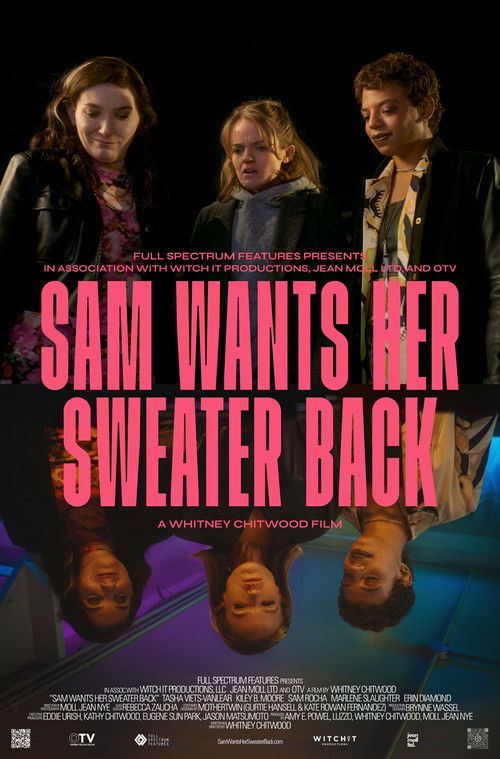
Sam Wants Her Sweater Back (2026)
Directed by Whitney Chitwood
Yes · Woke
How we score movies →Consciousness Markers
All three central characters are explicitly queer, the film screened at the Los Angeles Trans and Non-Binary Film Festival, and the director describes it as 'queer and trans joy brought to screen.' The LGBTQ+ identity of the characters is the premise, the texture, and the marketing.
The production has documented that 90% of cast and crew are POC, LGBTQ, and/or women-identified, making intentional demographic composition a core production principle rather than an afterthought. This is not incidental; it is the stated mandate.
The film centers an all-female-and-nonbinary friend group navigating post-breakup solidarity, and the director's work is noted for consistently passing the Bechdel Test as a matter of creative principle. Female and nonbinary interiority is the entire landscape of the story.
The production's 90% POC crew composition reflects deliberate behind-the-camera diversity, and the cast reflects this ethos visually. However, race as a thematic subject does not appear to be foregrounded in the narrative itself.
The director has explicitly stated the goal is to center queer characters without making queerness the central conflict, which is itself a corrective thesis about representation. The film wears its values openly but reportedly delivers them through comedy and warmth rather than sermon.
The film's celebration of queer community and joy implies a broadly affirmative stance toward bodies outside the Hollywood norm, though no specific body-positive messaging appears to be a stated theme.
The heist framework gestures vaguely at taking back what is yours from someone who has wronged you, which a determined critic could read as a micro-allegory of labor reclamation. It would take a very determined critic.
A 15-minute heist comedy about sweater retrieval offers no discernible entry point for climate anxiety. The ecological footprint of the garment in question is not examined.
No evidence of neurodivergence as a theme, character trait, or narrative element appears in any available material about this film.
The story is set in contemporary Chicago and concerns a sweater. There is no history to revise.
Synopsis
Three queer friends launch a half-witted heist to steal back a sweater from one of their exes. But recovering from heartbreak isn't quite the slick-lit, neon-noir adventure one of them imagines.
Why it received this score
Here we have a 15-minute short film about three queer friends attempting to steal a sweater from an ex-girlfriend, which is either the most low-stakes premise in cinema history or a profound metaphor for the reclamation of self after romantic dissolution. The film declines to resolve this ambiguity, and we must respect that. Director Whitney Chitwood, a queer and trans Chicago-based filmmaker, has constructed what the promotional materials describe as "goofery with a heart of gold," and it is difficult to argue with that characterization, largely because it is accurate and also because arguing with goofery feels exhausting.
The film's social consciousness is not so much embedded in the narrative as it is the load-bearing wall of the entire structure. The cast and crew are documented at 90% POC, LGBTQ, and/or women-identified, a statistic that the production wears as a badge of honor and which functions simultaneously as a genuine industry corrective and as a perfectly formed talking point for a grant application. The LGBTQ+ representation here is of the normalized, non-anguished variety: nobody is coming out, nobody is dying, nobody is delivering a speech about acceptance to a hostile family at Thanksgiving. They are simply trying to get a sweater back. This is, in its own quiet way, a political act, and the film knows it, and the film wants you to know that it knows it.
What saves this from tipping into full earnest self-congratulation is the heist comedy wrapper, which provides enough absurdist scaffolding to let the warmth breathe without curdling into a lecture. The neon-drenched fantasy sequences set against Chicago's inviting mundane reality suggest a filmmaker with genuine visual instincts. As an artifact of 2026 independent queer cinema, it scores high on nearly every axis of progressive cultural production: the intentional casting, the trans festival circuit, the Bechdel compliance as stated creative policy. It is a short film that has done its homework, filed the correct paperwork, and also managed, apparently, to be charming. The sweater, one assumes, is recovered.
Analysis generated by our Consciousness Algorithm