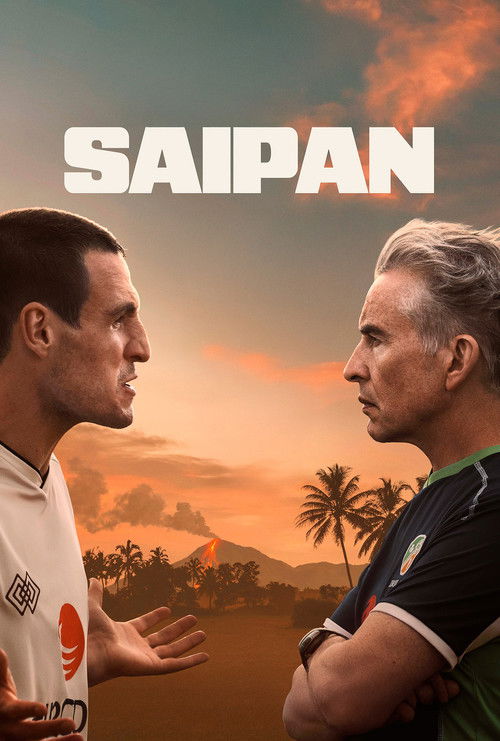
Saipan (2025)
Directed by Lisa Barros D'Sa
No · Ultra Based
How we score movies →Consciousness Markers
Éanna Hardwicke cast as Roy Keane represents a deliberate gender-blind casting choice, though the film itself treats this with studied indifference rather than celebration. The ensemble is otherwise traditionally cast with Irish actors in period-appropriate roles.
Beyond the cross-gender casting of the lead role, there is minimal engagement with feminist themes. The film does not appear to interrogate masculine culture or institutional sexism within sports.
The film dramatizes a historical event but does not appear to significantly revise its historical record. The cross-gender casting of Keane is an artistic choice but not a historical revisionism per se.
While the film depicts institutional conflict and questions about national obligation versus individual autonomy, it does not mount any sustained critique of capitalism or economic systems.
The film depicts an Irish national team in a historical context with no apparent engagement with racial representation or systemic racial themes. The narrative is entirely focused on interpersonal conflict.
The film features professional athletes in their professional context. There is no apparent engagement with body image, beauty standards, or body positivity as thematic concerns.
The film prioritizes dramatic conflict and character over preachy messaging. While it explores ideas about discipline and national identity, it does so through dialogue and action rather than explicit moral instruction.
No LGBTQ+ themes, representation, or subtext are evident in the film. The narrative concerns itself exclusively with the personal and professional conflict between two men.
No climate-related themes appear in this sports drama about a 2002 World Cup dispute. Environmental consciousness is entirely absent from the film.
No representation of or thematic engagement with neurodivergence is evident in the film. The conflict is presented as a matter of personality and principle rather than neurological difference.

Synopsis
On the eve of the 2002 FIFA World Cup, Irish captain Roy Keane forfeits his place in the squad at the team's preparation base in Saipan, following a heated disagreement with manager Mick McCarthy.
Why it received this score
Saipan arrives as a monument to restraint in an era of cultural hectoring. The film is fundamentally a two-hander about masculine pride and institutional conflict, dressed in the garb of sports drama. Lisa Barros D'Sa and Glenn Leyburn stage their narrative with the precision of a referee enforcing the rules of engagement, never once breaking formation to lecture us about what it all means. Éanna Hardwicke and Steve Coogan circle each other like boxers, their dialogue sharp and their grievances immediate. One respects the filmmakers for refusing to sand down the rough edges of either protagonist into something more palatable for contemporary sensibilities.
The film's greatest concession to modern cultural awareness is its casting of Hardwicke, a woman, as Roy Keane, a historical male figure. This choice carries a certain gender-conscious weight, though the film itself treats the fact with the same studied indifference it brings to everything else. The rest of the ensemble is populated by Irish actors playing Irish footballers in what appears to be a straightforward, unglamorous reproduction of events. There is no crusade here, no great moral awakening. The conflict between Keane and McCarthy is presented as a clash of philosophies about discipline, respect, and national obligation, none of which map neatly onto contemporary progressive frameworks.
What emerges from the film is a kind of Irish specificity that resists easy interpretation through the lens of social consciousness. The historical moment it depicts, the early 2000s, remains stubbornly itself. Saipan is a film about people disagreeing about sports in a way that mattered to them, not about what their disagreement means for the future of representation or enlightenment. In this respect, it may be the most radical choice available to a contemporary filmmaker: making a film that simply does not care to participate in the conversation at all.
Analysis generated by our Consciousness Algorithm
Critic Reviews
“At a game-length 91 minutes, Saipan smartly comes and goes with speed (for all of its anger, it’s also a breezy, funny time) but it’s the rare football movie that’s worth a replay.”
“Even those with little interest in the beautiful game should be entertained by Saipan, a breezily engaging narrative.”
“Instead of glorifying men at the top of their game (well, at least Keane), it’s a fascinating, funny, and smart breakdown of how one argument served as a microcosm for centuries of conflict, cultural values, and men’s egos. ”
“Both actors are superb, but the problem is that history isn’t really on their side. The incidents depicted in “Saipan” were dramatic in 2002, especially in the sports arena, and to a fixated Irish public who took sides. But two decades later, it all lands with a thud.”