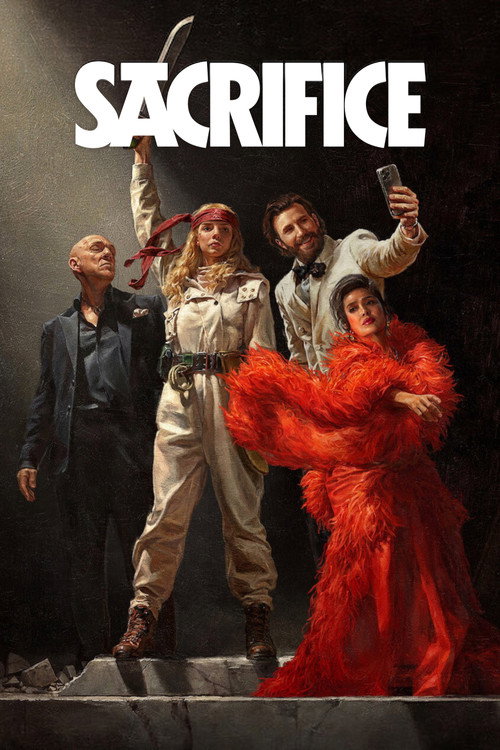
Is Sacrifice (2026) Woke?
Sacrifice · 2026 · Directed by Romain Gavras
Woke Score
CriticCritic Score
Woke-Adjacent
Critics rated this 5 points above its woke score. Among Woke-Adjacent films, this critic score ranks #145 of 170.
Answer: Partly
Woke Score 48/100 · Verdict: Woke-Adjacent
Strongest markers: Eat the Rich (78) · Climate Crusade (72) · Representation Casting (42)
Representation Casting
Score: 42/100
The cast is international and diverse, featuring Salma Hayek Pinault, Vincent Cassel, and Sam Richardson alongside Anglo-American leads. The diversity, however, is incidental to the satire rather than foregrounded as a statement, and the meta-casting choices are driven by irony rather than representation politics.
LGBTQ+ Themes
Score: 0/100
No LGBTQ+ themes, characters, or storylines are present in the available research or plot summary.
Feminist Agenda
Score: 28/100
Anya Taylor-Joy's Joan is the film's most powerful and driven figure, a militant leader who commands a devoted following and engineers the entire crisis. The film does not frame this through an explicit feminist lens, and Joan is depicted as delusional rather than heroic, which blunts any straightforward feminist reading.
Racial Consciousness
Score: 0/100
No themes of racial consciousness, systemic racism, or identity-based racial commentary are present in the film's narrative or critical reception.
Climate Crusade
Score: 72/100
Climate anxiety is the engine of the entire plot: the villain is a Greta Thunberg-coded eco-militant willing to sacrifice billionaires into a volcano to prevent ecological catastrophe, and the gala itself satirizes corporate greenwashing through a deep-sea mining startup dressed up as conservation. The film ultimately mocks climate zealotry as fanatical rather than endorsing it, which tempers the score.
Eat the Rich
Score: 78/100
The film sits squarely in the 'eat the rich' satirical wave alongside The Menu and Triangle of Sadness, with billionaire tech bros, performative charity galas, and corporate greenwashing as its primary targets. The anti-capitalist critique is so central that critics debated whether a Netflix-distributed Hollywood production could sincerely make it.
Body Positivity
Score: 0/100
No body positivity themes or related commentary are present in the film's narrative or reception.
Neurodivergence
Score: 0/100
No neurodivergence themes or characters are identified in the research or plot materials.
Revisionist History
Score: 0/100
The film is an original contemporary satire with no engagement in revisionist historical narratives.
Lecture Energy
Score: 35/100
The film is steeped in the visual language of performative lecturing: neon signs reading 'Make Earth Cool Again,' celebrities performing outrage for cameras, and an eco-militant delivering apocalyptic sermons. Critics largely agreed the social commentary is superficial and self-undermining, which prevents the film from achieving a truly high lecture score.


Synopsis
During a star-studded charity gala brimming with celebrities, billionaires and empty speeches, a movie star in the midst of an existential crisis is taken hostage by a radical warrior and her devoted followers. As the night descends into chaos, both an inward journey and an outward adventure ensue, where the line between performance and belief, salvation and sacrifice, begins to blur.
Why it received this score
Romain Gavras arrives with a film about people who care very publicly about the planet, which is itself distributed by a streaming platform that cares very publicly about content. The symmetry is, one supposes, the point. Set at a Greek charity gala where tech billionaire Ben Bracken celebrates a deep-sea mining venture beneath neon signs reading "Make Earth Cool Again," Sacrifice deploys its satirical premise with the confidence of a filmmaker who has correctly identified a target and then elected to shoot in every direction at once. Chris Evans plays a disgraced action star attempting to rehabilitate his image through performed outrage, a casting choice so on-the-nose it circles back around to being interesting. Anya Taylor-Joy, styled with the blunt bangs of a certain Swedish climate activist, plays Joan, an eco-militant who has concluded that the most logical response to the climate crisis is to throw three billionaires into a volcano. Her logic is presented as deranged. It is also, the film quietly acknowledges, not entirely without a certain internal consistency.
The film positions itself as equal-opportunity cynicism, skewering both the ultra-wealthy and the radical zealots who wish to immolate them, which is a safe place to stand when you are a film about skewering people. Critics at the A.V. Club and Roger Ebert's site observed that this balanced contempt produces something insipid: a film that declines to commit to any position long enough to say anything. The anti-capitalist framing is vivid and the "eat the rich" genre furniture is well-arranged, but the film ultimately uses radicalism as spectacle, absorbing eco-terrorism into a digestible thriller the same way the billionaires in the film absorb climate guilt into branded philanthropy. Whether this is a sophisticated meta-commentary or simply the same recuperative mechanism it depicts is a question the film appears unbothered by.
Co-written by Will Arbery, who previously wrote about young conservative Catholics with genuine curiosity in Heroes of the Fourth Turning, Sacrifice has the fingerprints of someone who finds true believers of all kinds genuinely interesting. That instinct is present but outnumbered. The film is at its most alive when it treats Joan's fanaticism as a real spiritual phenomenon rather than a punchline, and at its most inert when it retreats into the safer comedy of rich people being oblivious. Gavras, son of Costa-Gavras, clearly has the political cinema inheritance in his blood. Whether he has chosen to spend it wisely here is, like most charitable donations, a matter of some debate.
Analysis generated by our Consciousness Algorithm
Critic Reviews
“Though it has its faults, Sacrifice is one of the stronger examples of late for a Netflix released, star-driven movie, as Chris Evans' movie star is taken hostage by Anya Taylor-Joy's doomsday prophet for what is a surprisingly thoughtful endeavor.”
“Sacrifice is essentially Romain Gavras' Joe vs. the Volcano, and yes, the movie is pretty much as nutty as that comparison.”
“Starring Chris Evans and Anya Taylor-Joy, this nonsensical eat-the-rich satire follows an aging movie star swept up into a deranged eco-terrorist plot.”
Related rankings
Consciousness Markers
The cast is international and diverse, featuring Salma Hayek Pinault, Vincent Cassel, and Sam Richardson alongside Anglo-American leads. The diversity, however, is incidental to the satire rather than foregrounded as a statement, and the meta-casting choices are driven by irony rather than representation politics.
No LGBTQ+ themes, characters, or storylines are present in the available research or plot summary.
Anya Taylor-Joy's Joan is the film's most powerful and driven figure, a militant leader who commands a devoted following and engineers the entire crisis. The film does not frame this through an explicit feminist lens, and Joan is depicted as delusional rather than heroic, which blunts any straightforward feminist reading.
No themes of racial consciousness, systemic racism, or identity-based racial commentary are present in the film's narrative or critical reception.
Climate anxiety is the engine of the entire plot: the villain is a Greta Thunberg-coded eco-militant willing to sacrifice billionaires into a volcano to prevent ecological catastrophe, and the gala itself satirizes corporate greenwashing through a deep-sea mining startup dressed up as conservation. The film ultimately mocks climate zealotry as fanatical rather than endorsing it, which tempers the score.
The film sits squarely in the 'eat the rich' satirical wave alongside The Menu and Triangle of Sadness, with billionaire tech bros, performative charity galas, and corporate greenwashing as its primary targets. The anti-capitalist critique is so central that critics debated whether a Netflix-distributed Hollywood production could sincerely make it.
No body positivity themes or related commentary are present in the film's narrative or reception.
No neurodivergence themes or characters are identified in the research or plot materials.
The film is an original contemporary satire with no engagement in revisionist historical narratives.
The film is steeped in the visual language of performative lecturing: neon signs reading 'Make Earth Cool Again,' celebrities performing outrage for cameras, and an eco-militant delivering apocalyptic sermons. Critics largely agreed the social commentary is superficial and self-undermining, which prevents the film from achieving a truly high lecture score.