RUYA (2025)
Directed by Nicole Mairose Dizon
Yes · Woke
How we score movies →Consciousness Markers
Filipina cast with specific focus on T'boli indigenous identity. The director's own Filipina-American background suggests intentional cultural specificity rather than generic diversity hiring.
Explicit engagement with indigenous T'boli cultural practice and diaspora consciousness. The film treats race and ethnicity not as identity markers but as structural conditions shaping labor and survival.
Strong focus on intergenerational female trauma, maternal sacrifice, and the gendered burden of cultural preservation. Ruya's anxiety and struggle center female experience without sentimentalizing it.
Ruya's insomnia and anxiety are central to the narrative, though not explicitly pathologized. The film treats her mental state as reasonable response to impossible circumstances rather than individual deficiency.
The film foregrounds the material pressures of immigrant labor, the commodification of cultural work, and the way capitalism demands daughters continue mothers' unfinished economic obligations.
While the film engages with indigenous cultural history, it does not significantly reframe historical events. Its focus remains on contemporary survival rather than historical reinterpretation.
The film maintains a poetic, surreal tone that trusts viewers to draw connections. While culturally specific, it avoids explicit exposition or preachy framing of its themes.
Abaca (banana plant fiber) features as spiritual and material element, but climate themes remain peripheral to the narrative's primary concerns.
No apparent LGBTQ+ themes or characters in the narrative.
No particular engagement with body positivity themes. The film focuses on mental/emotional states rather than bodily representation.
Synopsis
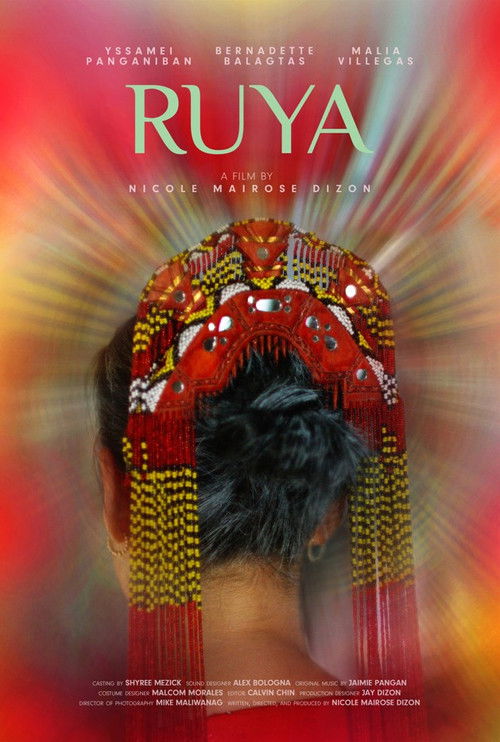
When a T'boli dreamweaver goes into a coma, her anxious, insomniac daughter must dream and communicate with Fu Dalu, the Spirit of Abaca, to pick up where her mom left off on the next t'nalak.
Why it received this score
Nicole Mairose Dizon's "RUYA" operates at the intersection of personal trauma and collective cultural preservation, deploying surrealism as both aesthetic and political tool. The film centers indigenous T'boli dreamweaving practice not as exotic backdrop but as labor, economics, and survival strategy, grounding spiritual tradition in the material pressures of diaspora and immigrant sacrifice. Dizon's attention to intergenerational trauma, particularly the ways ancestral knowledge becomes a burden for daughters asked to carry forward their mothers' unfinished work, registers as genuine cultural consciousness rather than performative gesture.
The film's formal approach complicates easy consumption. Its experimental structure mirrors Ruya's fractured mental state, refusing narrative comfort in favor of poetic meditation on inherited silence and anxiety. The deployment of Fu Dalu, the Spirit of Abaca, positions indigenous spirituality as active agent rather than nostalgic reference, though the film's brevity limits how deeply it can explore the implications of this choice. The casting of Filipina actresses and the specific centering of T'boli cultural practice, alongside Dizon's own Filipina-American identity as creator, suggests genuine investment in representation beyond tokenism.
Where the film's progressive sensibilities prove most acute is in its refusal to sentimentalize either tradition or modernity. Ruya's insomnia and anxiety are not obstacles to overcome but accurate descriptions of what survival looks like under late capitalism's demands. The work itself, the weaving, carries no redemptive arc. It is simply what must be done, what has always been done, what daughters continue to do. This unflinching materialism, paired with the film's commitment to indigenous cultural specificity, marks it as genuinely engaged with the concerns animating contemporary social consciousness.
Analysis generated by our Consciousness Algorithm