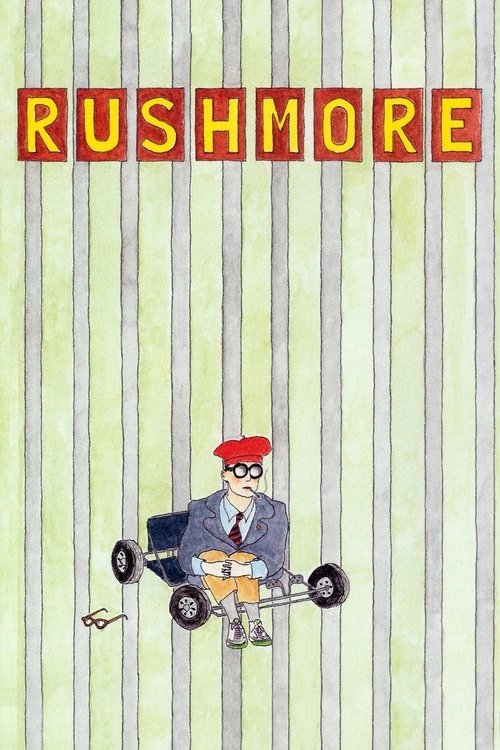
Rushmore (1998)
Directed by Wes Anderson
No · Ultra Based
How we score movies →Consciousness Markers
Miss Cross is portrayed as intelligent and has some agency, but she fundamentally exists as the object of desire for both male protagonists, with narrative focus on male competition for her attention rather than her own journey.
The film contains minimal expository dialogue, with occasional academic references that feel organic to the school setting rather than preachy or preachy.
Wealth is portrayed with some ambivalence through Herman Blume's character, suggesting money cannot buy happiness, but this is humanist rather than political critique.
The cast is predominantly white with no meaningful representation of racial or ethnic diversity. The film makes no effort toward inclusive casting.
No LGBTQ+ themes, characters, or subtext appear in the film. The narrative centers entirely on heterosexual attraction and male relationships.
The film contains no racial consciousness, commentary, or awareness. It operates entirely within a white, privileged world without acknowledgment of racial dynamics.
No environmental themes, climate consciousness, or ecological messaging appears in the film.
The film makes no statements about body diversity or body positivity. Characters are presented without commentary on physical difference.
There is no representation of or engagement with neurodivergence in the film.
Rushmore does not engage with historical narratives or attempt to revise them. It operates in a contemporary prep school setting without historical stakes.


Synopsis
When a beautiful first-grade teacher arrives at a prep school, she soon attracts the attention of an ambitious teenager named Max, who quickly falls in love with her. Max turns to the father of two of his schoolmates for advice on how to woo the teacher. However, the situation soon gets complicated when Max's new friend becomes involved with her, setting the two pals against one another in a war for her attention.
Why it received this score
Rushmore is a film of considerable charm and narrative sophistication that operates entirely within the emotional and social world of its male characters. The plot functions as a competition between two men, one a precocious teenager and the other a wealthy industrialist, for the affection of Miss Rosemary Cross, a first-grade teacher whose role in the narrative is fundamentally passive. Academic analysis of the film has identified her as a subject of objectification, a beautiful British woman rendered through the male gaze without substantial agency or interiority beyond what serves the emotional arcs of Max Fischer and Herman Blume. The film makes no apparent effort to complicate or interrogate this dynamic. Set in 1998, Rushmore reflects the cultural assumptions of its moment, which is to say it reflects almost no consciousness of contemporary progressive sensibilities regarding representation, diversity, or the construction of female characters in cinema. The world of the film is entirely white and affluent, without acknowledgment of or engagement with questions of racial or social equity. Its depiction of wealth is ambiguous, suggesting that money cannot purchase happiness or genuine human connection, but this is a humanist observation rather than a political critique. The film contains no LGBTQ+ themes, no environmental consciousness, no engagement with disability or neurodivergence, and no revisionist historical project. The film is a thoroughly period piece, not in its setting but in its assumptions about who matters in a story and whose perspective is worth centering. It is a work made by and for a particular moment in American cinema, before the cultural reckonings that would reshape how stories about desire and competition get told.
Analysis generated by our Consciousness Algorithm
Critic Reviews
“With its dry, throwaway humor and constant stream of chuckles, it creates its own category of stealth comedy.”
“For me, the experience was much like seeing Mike Nichols' "The Graduate" and George Lucas' "American Graffiti" before the hype machines kicked in.”
“You can't have Rushmore without Max, and though Anderson obviously planned it this way, the kid is finally too off-putting to tolerate.”