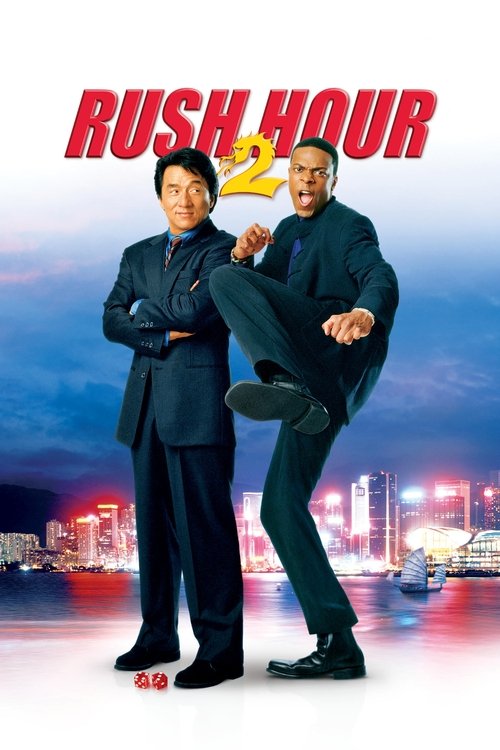
Rush Hour 2 (2001)
Directed by Brett Ratner
No · Ultra Based
How we score movies →Consciousness Markers
The film features Jackie Chan as a Chinese police officer and Chris Tucker as an African American detective, with Roselyn Sánchez in a supporting role. However, this casting serves genre convention rather than making any statement about representation itself.
While the film features Asian and African American characters in leading roles, there is no thematic engagement with racial consciousness or commentary on racial dynamics. The Hong Kong setting is treated as pure backdrop.
No LGBTQ+ themes, characters, or narrative elements are present in the film.
No feminist messaging or agenda is evident. Female characters exist primarily as romantic interests or supporting players without thematic significance.
No climate-related themes, messaging, or environmental consciousness appears in the film.
No anti-capitalist themes or critique of wealth and capitalism are present. The counterfeiting plot is treated as a simple crime to be solved, not as commentary on economic systems.
No body positivity messaging or themes appear in the film.
No neurodivergent representation or themes are present in the film.
No revisionist historical narratives or reframing of historical events appears in the film.
The film contains no preachy or lecture-style delivery of ideology. It operates purely as entertainment with no pedagogical intent.


Synopsis
It's vacation time for Carter as he finds himself alongside Lee in Hong Kong wishing for more excitement. While Carter wants to party and meet the ladies, Lee is out to track down a Triad gang lord who may be responsible for killing two men at the American Embassy. Things get complicated as the pair stumble onto a counterfeiting plot. The boys are soon up to their necks in fist fights and life-threatening situations. A trip back to the U.S. may provide the answers about the bombing, the counterfeiting, and the true allegiance of sexy customs agent Isabella.
Why it received this score
Rush Hour 2 occupies that particular purgatory of the early 2000s action comedy, a film so thoroughly committed to the pleasures of explosions and comedic riffing that the question of social consciousness never enters the frame. Jackie Chan's physical comedy and Chris Tucker's relentless chatter form the backbone of a narrative that cares little for anything beyond the immediate beat, the next fight sequence, the next quip. The film is almost admirably pre-reflexive, existing in a moment before the crystallization of modern progressive cultural markers.
The diverse casting is present, but it functions as simple casting choice rather than conscious statement. No speeches arrive to explain the significance of the characters. No camera lingers on moments of cultural significance. The film moves forward with the relentless energy of a machine designed for maximum commercial appeal, indifferent to questions of representation, identity, or social meaning. This is not a criticism so much as an observation about the film's historical moment.
The Hong Kong setting and Triad characters serve as mere backdrop for genre mechanics, treated with the casual indifference typical of early 2000s action comedies. There is no interrogation of cultural dynamics, no LGBTQ+ themes, no feminist agenda, no climate consciousness, no anti-capitalist sentiment, and no lecture-style delivery of ideology. The film operates purely within the realm of entertainment mechanics, a relic of a pre-conscious era.
Analysis generated by our Consciousness Algorithm
Critic Reviews
“Superior sequel, which is the very model of the limber, transnational Hollywood action comedy.”
“Winds up being faster and funnier than the first time. Chan's acrobatic high jinks play strikingly off of Tucker's wiseass humor.”
“Oy, it's such a pleasure that you'll be begging for Rush Hour 3.”
“The best parts of the movie occur during the outtakes, which are genuinely funny. The movie proper is insufferable.”