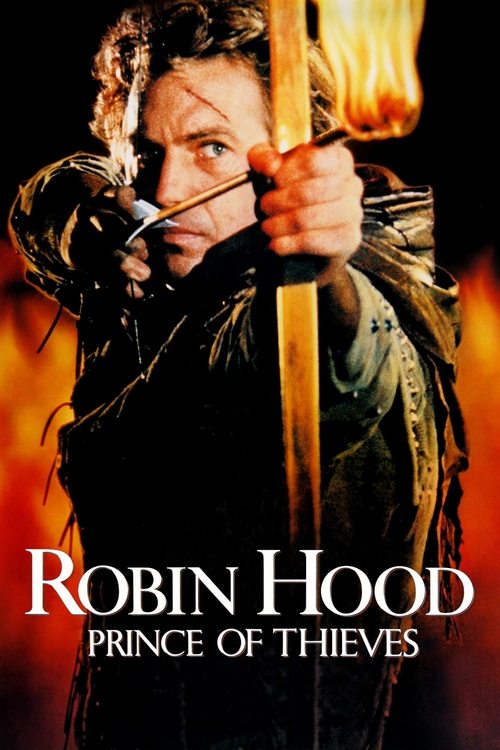
Robin Hood: Prince of Thieves (1991)
Directed by Kevin Reynolds
No · Ultra Based
How we score movies →Consciousness Markers
Morgan Freeman's prominent role as Azeem represents notable casting diversity for 1991, positioning a Black actor as co-protagonist. However, the character functions primarily as a noble sidekick rather than having his own arc or cultural identity explored.
While the film includes a Black character in a position of respect and competence, it demonstrates no conscious engagement with questions of race, colonialism, or cultural identity. Azeem's Moorish background remains largely unexplored.
The premise involves stealing from the rich to feed the poor, which suggests anti-capitalist sympathies at surface level. However, the film offers no systemic critique or examination of economic structures.
The film contains minimal preachy messaging or exposition about social issues. It entertains without pretending to educate, though occasional dialogue touches on justice themes without depth.
Maid Marian exists as a prize to be rescued rather than an active agent. She has minimal agency and serves primarily as romantic motivation for the protagonist.
The film takes considerable liberties with the Robin Hood legend and medieval history, but this is simply standard adventure fiction liberalism rather than conscious revisionism with social messaging.
No LGBTQ+ themes, representation, or subtext present in the film. The narrative contains no queer characters or relationships.
No environmental themes or climate consciousness present. The film is a straightforward medieval adventure narrative with no engagement with ecological concerns.
No body positivity messaging or representation of diverse body types. The film adheres to conventional Hollywood standards for attractiveness and physical idealization.
No representation of neurodivergent characters or conditions. The narrative contains no engagement with neurodiversity.


Synopsis
Nobleman crusader Robin of Locksley breaks out of a Jerusalem prison with the help of Moorish fellow prisoner Azeem and travels back home to England. But upon arrival he discovers his dead father in the ruins of his family estate, killed by the vicious sheriff of Nottingham, Robin and Azeem join forces with outlaws Little John and Will Scarlett to save the kingdom from the sheriff's villainy.
Why it received this score
Robin Hood: Prince of Thieves arrives as a curious artifact of early nineties sensibilities, a swashbuckling adventure that believes itself progressive primarily because it casts Morgan Freeman as Azeem, a Moorish warrior who stands as Robin's equal and moral compass. The film treats this partnership as enlightened for the era, and by the standards of 1991 blockbusters, the inclusion carries some weight. Yet the movie's progressive gestures end there, evaporating like morning mist over Sherwood Forest. The female lead, Maid Marian, exists primarily to be rescued and occasionally to make doe-eyed expressions of admiration for Robin's heroics. Her agency dissolves whenever the plot requires action.
The film contains no meaningful engagement with class consciousness beyond the surface-level premise that robbing the rich to feed the poor is good. There is no examination of economic systems, no interrogation of feudal structures, no sense that the story has anything to say about power beyond what a child already understands. The Moorish character, despite Freeman's considerable charisma, occupies the role of noble exotic companion rather than a figure whose cultural identity matters to the narrative. He is decorative diversity, present but not interrogated. The screenplay offers no moments where his perspective on Christian crusades, Islamic faith, or his own displacement might complicate the story's moral clarity.
Nothing here speaks to contemporary concerns about representation, identity politics, or systemic critique. This is a film made before such language entered mainstream discourse, and it shows no awareness of the cultural markers that would later define progressive cinema. We are watching the work of craftspeople who made an entertaining action film with a few more brown faces in the cast than was typical, and called it a day. By 2020s standards, this registers as the bare minimum of casting diversity without the accompanying consciousness to match.
Analysis generated by our Consciousness Algorithm
Critic Reviews
“Dodgy history and dodgier accents, but Kevin Costner's medieval romp still has some magic – and shouldn't be judged on the weakness of its imitators.”
“Except for the political implications of the addition of Freeman's character (which he brings off gracefully) and some revisionism about the nobility of the crusades (which, in my opinion, is long overdue), Robin Hood: Prince of Thieves is just an adventure movie - which is basically what I like about it. The second half is stronger than the first because it's swifter and more action-packed. Robin's feats of derring-do are always (as Costner might put it) neat - the more improbable, the better.”
“Robin Hood: Prince of Thieves looks like big money. It has the stars, it's based on a classic (and foolproof) story and it's an exhilarating couple of hours. It fills the entertainment megabill utterly. ”
“Kevin Costner’s Robin Hood is a Robin of wood. Murky and uninspired, this $50 million rendition bears evidence of the rushed and unpleasant production circumstances that were much reported upon.”