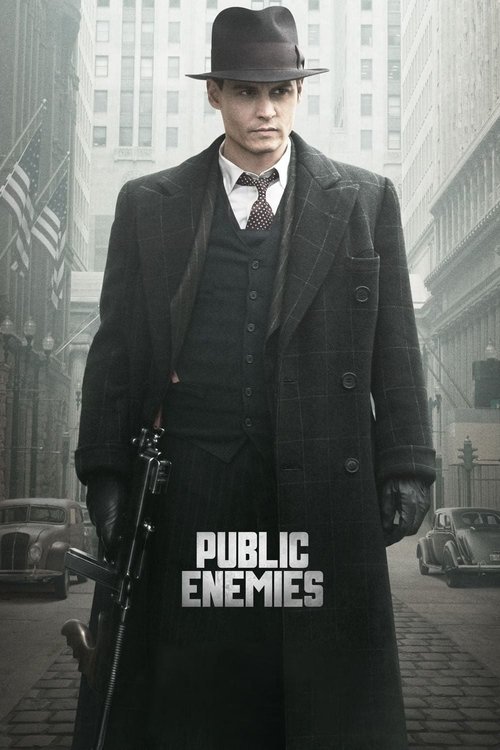
Public Enemies (2009)
Directed by Michael Mann
No · Ultra Based
How we score movies →Consciousness Markers
Marion Cotillard is present but largely subordinate to the male-dominated narrative. The lead roles are white men in a film where the cast is predominantly white and male.
No LGBTQ+ themes, representation, or subtext are present in the film.
No feminist consciousness or agenda is evident. Female characters exist as supporting roles with minimal agency.
The film contains no racial consciousness, analysis of race, or meaningful racial representation beyond an entirely white-centered narrative.
There is no climate-related content, environmental messaging, or ecological awareness in this crime drama.
Despite Depression-era setting, the film makes no critique of capitalism or wealth inequality. Dillinger's criminality is treated as personal choice rather than systemic response.
There is no body positivity messaging or representation of diverse body types as a thematic concern.
No neurodivergent representation or themes related to disability, mental health, or neurodiversity are present.
The film presents a conventional historical narrative with no attempt to recontextualize the Depression era or FBI history through modern social lenses.
Michael Mann's approach is cool and procedural with no preachy moralizing, educational messaging, or attempt to instruct the audience about social structures.


Synopsis
Depression-era bank robber John Dillinger's charm and audacity endear him to much of America's downtrodden public, but he's also a thorn in the side of J. Edgar Hoover and the fledgling FBI. Desperate to capture the elusive outlaw, Hoover makes Dillinger his first Public Enemy Number One and assigns his top agent, Melvin Purvis, the task of bringing him in dead or alive.
Why it received this score
Public Enemies operates as a classical crime narrative set during the Depression, presenting John Dillinger as a charismatic antihero locked in a cat-and-mouse struggle with the nascent FBI. Michael Mann's approach is technical and detached, focused on the mechanics of crime and law enforcement rather than any systemic interrogation. The film makes no meaningful attempt to contextualize Dillinger's criminality through economic injustice, nor does it offer any critique of capitalism or institutional power structures. While the Depression provides a historical backdrop, it functions as setting rather than subject matter.
The cast composition is overwhelmingly white and male in positions of narrative weight, with Marion Cotillard present but subordinate. There is no engagement with LGBTQ+ themes, racial consciousness, feminist perspective, climate awareness, neurodivergence, disability representation, or body positivity. The film contains no revisionist historical framing and no lecture energy. It is simply a well-crafted entertainment product from 2009, released before the cultural shift that would define modern progressive sensibilities.
This is a film that exists entirely outside the markers of contemporary social consciousness. It predates the cultural moment that would generate the discourse this scoring system measures. Mann's cool professionalism and aesthetic precision are devoted to genre rather than message, making Public Enemies a straightforward period crime drama with no meaningful engagement with social awareness.
Analysis generated by our Consciousness Algorithm
Critic Reviews
“Intelligent and challenging: Mann's crime epic could take two viewings to fully absorb, but it's worth every devoted minute.”
“This is the purest of American narratives, and this, indeed, is one of our finest storytellers.”
“It's also a double-barreled bummer. There's no excitement in the bank-robbing, no thrill of the chase, no emotion over justice served or thwarted. Depp's Dillinger is neither charming nor despicable, nor does he occupy that delicious gray area between the two. His spree unspools dispassionately, cold as a Colt .380.”