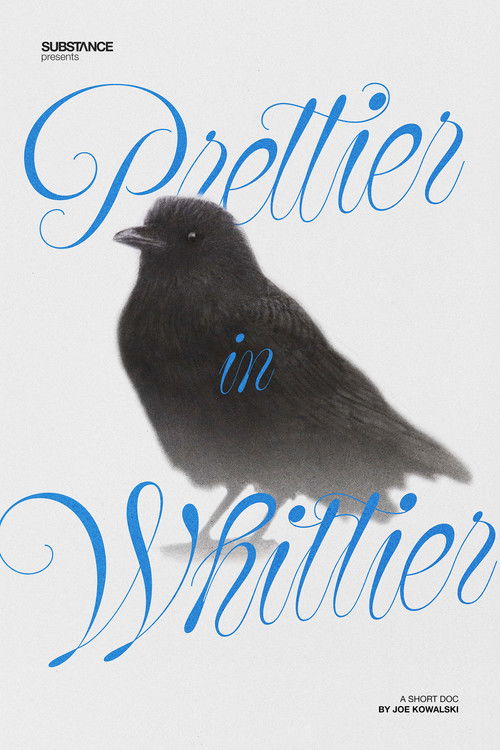
Prettier in Whittier (2026)
Directed by Joe Kowalski
No · Ultra Based
How we score movies →Consciousness Markers
The contest's name and its description as celebrating 'much more' than conventional beauty suggests a gentle, inclusive attitude toward appearance, though this is never foregrounded as an explicit message.
The 'Prettier in Whittier' contest carries a faint self-deprecating irony that may implicitly push back on conventional beauty ideals, but no explicit feminist framing is in evidence.
This is a documentary about the actual residents of Whittier, Alaska. The cast is whoever lives there, not an assembled diversity slate. No representational agenda is evident.
No LGBTQ themes, characters, or framing are present or documented anywhere in available material about this film.
No racial consciousness framing, commentary, or themes are present. The film does not engage with race as a subject.
The Alaskan rainforest setting offers an obvious opening for climate commentary that the film declines to take. No environmental advocacy is present.
No anti-capitalist themes or critique of economic systems are present in this community portrait.
No neurodivergence themes or characters are identified in available research on this film.
The film's historical context (an Army-built Cold War building) is treated as backdrop, not as an opportunity for historical reframing or critique.
The film is notably free of sermonizing. It observes its subjects without apparent desire to correct the audience's values.
Synopsis
Nestled in a mountainous rainforest in Alaska is the town of Whittier, where nearly the entire population lives in a single apartment building. They bring new meaning to the idea of getting along with your neighbor.
Why it received this score
There are approximately 280 people living in Whittier, Alaska, the majority of them in a single fourteen-story building constructed by the U.S. Army in the 1950s. Joe Kowalski's twelve-minute documentary arrives to document their annual "Prettier in Whittier" contest, a tradition the film describes as celebrating "much more" than the contest itself. We are left to contemplate what that "much more" might be, and the answer, it turns out, is simply community: the durable, unglamorous, profoundly unfashionable act of people tolerating and eventually cherishing one another in close quarters. This is not a film that has read the discourse.
The social consciousness present here predates every contemporary framework by several decades. The residents of Begich Towers are not deconstructing beauty standards so much as cheerfully ignoring them, which is a different and arguably more effective approach. There is no lecture energy, no racial reckoning, no climate grief. There is a contest, some neighbors, and a rainforest outside the window that nobody appears to be using as a metaphor. For a critic trained to locate the ideological freight in any cultural artifact, this film presents a genuine diagnostic challenge. The needle barely moves.
In a landscape where documentaries routinely arrive pre-loaded with their own moral conclusions, "Prettier in Whittier" commits the quiet radicalism of simply observing. It is twelve minutes long. It does not want anything from you. In 2026, this counts as a provocation.
Analysis generated by our Consciousness Algorithm