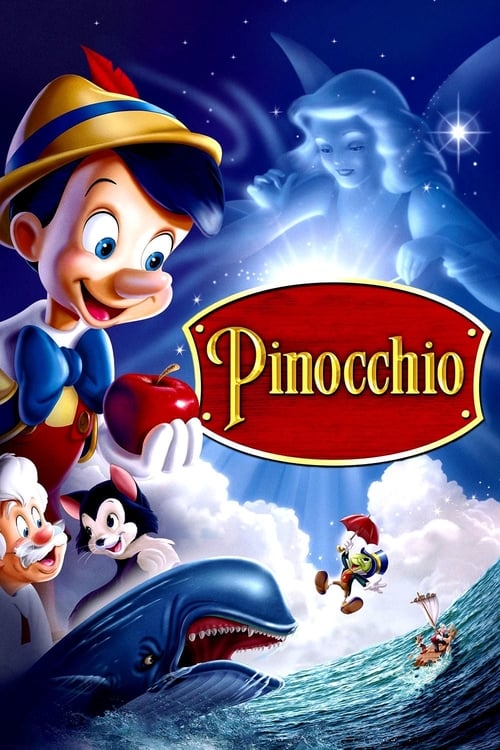
Pinocchio (1940)
Directed by Hamilton Luske
No · Ultra Based
How we score movies →Consciousness Markers
The entire film functions as a moral lecture, with characters repeatedly explaining lessons to Pinocchio and the audience. Jiminy Cricket serves as a literal conscience figure delivering instruction.
The cast consists entirely of voice actors, with no visible performers. Character designs reflect 1940s ethnic stereotyping conventions typical of the era, including caricatured character types that would be considered offensive today.
The film contains ethnic caricaturing in character design and voice work typical of 1940s animation. There is no engagement with racial themes or consciousness whatsoever.
The film reinforces traditional gender roles with Pinocchio as the active male protagonist and the fairy godmother as a passive helper figure. The narrative rewards obedience to male authority figures (Geppetto, Jiminy Cricket).
The transformation of Pinocchio into a real boy is presented as a reward for correct behavior, implying that his original form is inadequate or shameful. No body positivity messaging exists.
No LGBTQ+ themes, characters, or representation of any kind. The film presents an entirely heteronormative family structure as the goal.
No environmental themes, climate consciousness, or ecological awareness present in the narrative or visuals.
The film contains no critique of capitalism or wealth systems. Economic structures are simply background to the moral fable.
No representation of neurodivergent characters or acknowledgment of neurodiversity. The film presents a neurotypical worldview as universal.
This is a fairy tale adaptation with no historical content to revise. It makes no claims about history.


Synopsis
When the gentle woodcarver Geppetto builds a marionette to be his substitute son, a benevolent fairy brings the toy to life. The puppet, named Pinocchio, is not yet a human boy. He must earn the right to be real by proving that he is brave, truthful, and unselfish.
Why it received this score
Pinocchio stands as a monument to a different era of American filmmaking, one in which moral instruction took precedence over all other considerations and the cultural anxieties of 1940 were rendered with a directness that modern audiences find, at minimum, uncomfortable. The film's core narrative, a straightforward moral fable about obedience and the consequences of straying from the righteous path, carries no particular progressive sensibilities. Rather, it functions as a parable of conformity, rewarding the protagonist for abandoning his desires and submitting to authority figures who claim to know what is best for him.
The film's representation is, by contemporary standards, a museum of historical insensitivity. The character designs reflect the ethnic caricaturing common to 1940s animation, and the narrative offers no gender complexity whatsoever, presenting a distinctly patriarchal family structure as the natural and desirable endpoint. There are no LGBTQ+ themes, no environmental consciousness, no interrogation of economic systems, and certainly no neurodivergent representation. The film exists in a cultural moment before such categories of analysis became relevant to mainstream entertainment.
What makes Pinocchio a cultural artifact of considerable interest is precisely its wholehearted commitment to values that have since been questioned. It is not a film that apologizes for its worldview or hedges its bets. It simply presents its moral universe as obvious and complete. For the purposes of woke analysis, this makes it a baseline case study in what entertainment looked like before such consciousness emerged. It is neither offensive in its intent nor progressive in its effect, but rather a time capsule of pre-social-justice filmmaking.
Analysis generated by our Consciousness Algorithm
Critic Reviews
“There's no getting past the shockingly poorly dubbed voice work of the English speaking cast; Meyer's voice is particularly shrill and grating.”
“The spirit of the late Federico Fellini -- with whom Benigni talked of doing the project together -- surfaces repeatedly. But that spirit fails to enliven a film substantially lacking in personality, energy, magic and humor.”
“It's an oddity that will be avoided by millions of people, this new Pinocchio. Osama bin Laden could attend a showing in Times Square and be confident of remaining hidden.”
“By film's end I was fantasizing that Peter Stormare would drop by with his "Fargo" wood-chipper in tow, but it was not to be. Appalling.”