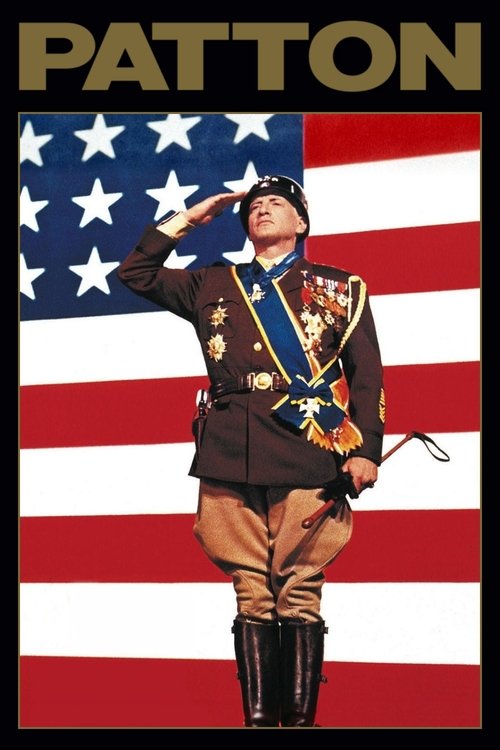
Patton (1970)
Directed by Franklin J. Schaffner
No · Ultra Based
How we score movies →Consciousness Markers
The film presents a sympathetic, heroic portrait of Patton that glosses over his controversial statements and actions. It subtly revises history in favor of a more flattering narrative.
The film celebrates military hierarchy and chain of command. While not explicitly pro-capitalist, it shows no critique of economic systems or class structures.
The opening monologue is preachy, but the film generally lets action speak for itself. Minimal explicit moralizing, though the entire film is an argument for military virtue.
Cast is entirely white male in all positions of authority. Women appear only as supporting characters in traditional roles. No meaningful representation of diversity.
No LGBTQ+ themes or representation. The film is entirely heteronormative and traditional in its portrayal of relationships.
Women are relegated to passive roles as wives and nurses. The film celebrates masculine military culture without any feminist critique or counter-perspective.
No examination of racial dynamics or consciousness. The film treats World War II as a conflict between commanders with no consideration of racial dimensions.
No climate-related themes or environmental consciousness. The film is a military biography with no engagement with ecological concerns.
No body positivity messaging. The film presents a traditional masculine ideal without commentary on body diversity or acceptance.
No representation or discussion of neurodivergence. Patton's behavioral quirks are portrayed as personality traits, not neurodevelopmental characteristics.


Synopsis
Patton tells the tale of General George S. Patton, famous tank commander of World War II. The film begins with Patton's career in North Africa and progresses through the invasion of Germany and the fall of the Third Reich. Side plots also speak of Patton's numerous faults such his temper and habit towards insubordination.
Why it received this score
Patton is a film of the old guard, made at a moment when the old guard was rapidly losing purchase on American culture. Released in 1970, during the height of Vietnam War-era skepticism about military adventurism, this film responded by offering an aesthetically sumptuous, narratively confident portrait of a war hero whose flaws are presented as endearing eccentricities rather than serious moral liabilities. George C. Scott's performance captures a man of appetites and conviction, and the film treats his insubordination and temper not as cautionary signs but as the necessary traits of a man who gets things done. The entire enterprise rests on an assumption that has become increasingly unfashionable: that we can celebrate martial virtue without complication.
The film's representation is entirely traditional, which is to say unremarkable by 1970 standards. It features an all-male ensemble of white actors in positions of authority and consequence. Women appear only as wives and nurses, relegated to the background of a masculine world. There is no interrogation of colonial or imperial attitudes, no consideration of how power operates beyond the battlefield, no suggestion that the world might be organized differently. The film is, in this sense, politically inert by modern standards. It has no interest in the machinery of representation or the questions that have preoccupied serious cultural critics for the past two decades.
What emerges instead is a pure military drama, concerned only with tactics, personality, and the clash of wills between commanders. By contemporary measures, this makes it almost aggressively unconcerned with social consciousness. It is, paradoxically, a film so uninterested in contemporary progressive sensibilities that it achieves a kind of innocence. One cannot accuse it of performing activism it never attempted. It simply wanted to tell the story of a great general, and it did so with considerable craft and conviction.
Analysis generated by our Consciousness Algorithm
Critic Reviews
“The movie holds up far better than its detractors guessed - splendidly, in fact - not only thanks to Scott's spellbinding acting, but to the epic imagery, Coppola's (and Edmund North's) highly intelligent script and Schaffner's lucid, perfectly controlled direction.”
“Patton remains to this day one of Hollywood's most compelling biographical war pictures.”
“Patton is a war movie of unusual depth and a landmark in screen biographies.”
“This movie is both a satirical epic and a square celebration, yet the satire backfires. ”