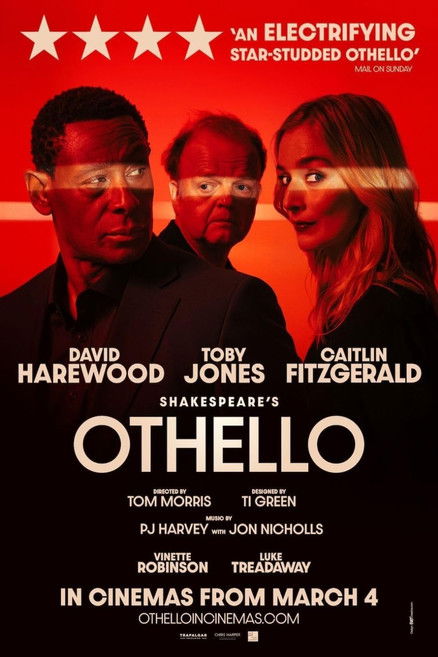
Othello (2026)
Directed by Tom Morris
Partly · Woke-Adjacent
How we score movies →Consciousness Markers
The play itself is fundamentally about racial prejudice and the destructive power of racism. However, this appears to be a classical staging that relies on the text's inherent themes rather than adding explicit contemporary racial commentary or reframing through modern social justice analysis.
David Harewood's casting is historically significant (first Black actor at National Theatre in 1997), but the production treats this as natural rather than a statement. Vinette Robinson in supporting role adds some representation, but casting feels organic to the play rather than performatively progressive.
Desdemona is a character with agency in Shakespeare's tragedy, but this production appears to stage the play as written rather than reimagine gender dynamics through contemporary feminist frameworks. Caitlin FitzGerald's performance may bring nuance, but the production does not foreground feminist critique.
While the play's themes invite discussion of prejudice and manipulation, this appears to be a classical production focused on dramatic execution rather than preachy messaging. The staging does not seem designed to instruct the audience on social issues.
This is a straightforward staging of an early seventeenth-century play, not a revisionist reinterpretation of history. The production does not appear to reframe historical events or narratives through contemporary social justice frameworks.
The play deals with military hierarchy and power dynamics, but this production does not appear to foreground anti-capitalist critique or systemic economic analysis. Any such themes would be incidental to the psychological drama.
No discernible LGBTQ+ themes or representation in this traditional staging of Shakespeare's text. The play itself contains no such content, and there is no evidence the production has added contemporary reinterpretation in this direction.
No climate-related themes, messaging, or imagery evident in this Shakespeare adaptation. The play contains no environmental content, and there is no indication the production has incorporated such themes.
No evidence of body positivity messaging, representation of diverse body types, or critique of beauty standards in this classical theatrical production. The focus is on dramatic performance rather than such contemporary sensibilities.
No representation of neurodivergent characters, no exploration of neurodivergence as a theme, and no indication that the production engages with contemporary understanding of mental health or neurodiversity.
Synopsis
Moorish general Othello is manipulated into thinking that his new wife Desdemona has been carrying on an affair with his lieutenant Michael Cassio when in reality it's all part of a scheme orchestrated by bitter ensign Iago. Filmed live at the Theatre Royal Haymarket in London especially for the big screen.
Why it received this score
Tom Morris's filmed production of "Othello" presents a curious artifact of contemporary Shakespeare adaptation, one that inherits rather than invents its engagement with racial dynamics. David Harewood, who made history as the first Black actor to play the title role at the National Theatre nearly thirty years ago, returns to the part with the authority of a performer who has already broken that particular barrier. The production itself avoids the trap of treating his casting as a novelty or statement, instead allowing the play's own preoccupations with prejudice, manipulation, and the corrosive effects of jealousy to operate as written. This is not a reimagining that foregrounds contemporary social consciousness, but rather a straightforward staging of a text that was always about these themes.
The creative team assembled here, including composer PJ Harvey and designer Ti Green, suggests artistic ambition oriented toward formal and psychological depth rather than explicit social commentary. The live filming at the Theatre Royal Haymarket preserves the theatrical event intact, which means the production's cultural positioning relies primarily on the text itself and the casting choices, neither of which constitute overt markers of the progressive sensibilities that have come to dominate contemporary cultural production. Othello remains a play about racism, yes, but that racism is intrinsic to Shakespeare's seventeenth-century tragedy, not a contemporary layer of interpretation added by the production.
What emerges from this staging is a classical interpretation that treats the material with respect for its dramatic architecture rather than subordinating the story to external ideological frameworks. For those seeking cultural consciousness expressed through explicit thematic emphasis and directorial commentary, this production may feel restrained, even old-fashioned in its commitment to letting the play speak for itself. That restraint, whether intended or not, positions it as a work primarily concerned with theatrical excellence rather than cultural pedagogy.
Analysis generated by our Consciousness Algorithm
Critic Reviews
“Stellar performances anchor this compelling production, which features David Harewood returning to the title role.”
“Harewood digs deep into his own well-documented experience of psychosis to show how Othello's easy and assured nature collapses into crazed, murderous credulity.”
“David Harewood's stately mien and richly resonant voice give us a calm, confident and centred Othello.”
“One of Shakespeare's most notorious villains loses much of his malevolence in this starry reimagining of Othello.”