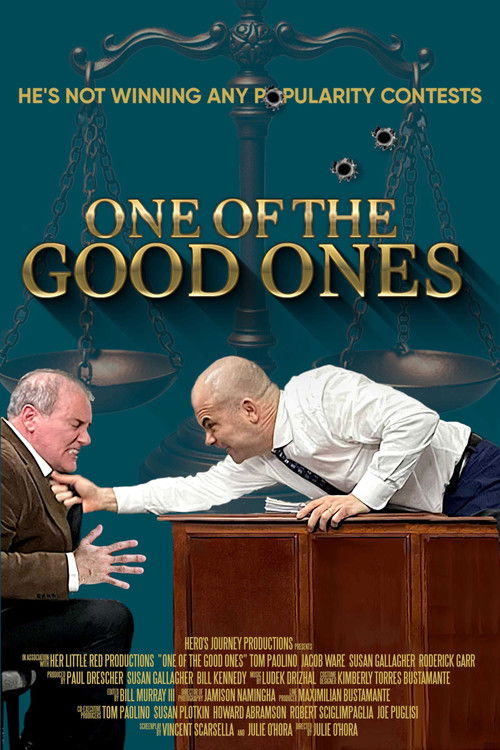
One of the Good Ones (2026)
Directed by Julie O'Hora
No · Ultra Based
How we score movies →Consciousness Markers
A film whose logline includes the phrase 'sacred promise' and whose protagonist has made accountability his 'life's mission' carries an inherent moral earnestness. The tone is that of a man who would absolutely tell you about his oath at a dinner party.
The film is directed by a woman and features a mixed ensemble cast in Buffalo's legal milieu. The protagonist, however, is a conventionally heroic male attorney, and no casting choices appear to have been made with representational intent as a primary concern.
The film targets institutional corruption driven by greed and political power, which carries a faint anti-establishment charge. This is, however, the standard operating premise of every crime thriller produced since 1974, and does not constitute a modern progressive critique of capital.
Julie O'Hora sits in the director's chair, and the production company is named Her Little Red Productions, which gestures toward a female creative identity. The story itself, however, is a male-centered hero narrative with no discernible feminist framing.
Dean Alessi is noted to battle 'personal demons,' a phrase that could encompass addiction, mental health struggles, or garden-variety Catholic guilt. No specific neurodivergent framing or identity is established in available sources.
No LGBTQ+ characters, themes, or subtext are present in any available synopsis or review material. The film's romantic and personal tensions appear to be strictly heterosexual and domestic.
The research surfaces no racial themes, no commentary on systemic racism, and no characters whose racial identity is treated as narratively significant. The corruption at issue is legal and political, not racial.
Buffalo's legal system is corrupt, but its carbon footprint is not under scrutiny. No environmental themes of any kind appear in the film's premise or available reviews.
No body positivity themes, commentary on appearance, or related discourse appears anywhere in the film's available materials.
The film is set in a contemporary Buffalo legal office and does not engage with history, revisionist or otherwise. No historical figures are recontextualized.
Synopsis
In a system corrupted by politics, greed and sex, there's an honest man in Buffalo who's made it his life's mission to hold his peers accountable. Dean Alessi is an attorney in Buffalo's Lawyer Disciplinary Office who fights for justice, even as he battles his own personal demons. Dean took an oath to protect the public from bad lawyers, and is willing to risk everything to keep that sacred promise. As the bodies pile up, Dean puts his own life on the line when he disobeys orders to expose a corrupt District Attorney who has committed the ultimate ethical wrong - murder.
Why it received this score
One of the Good Ones arrives bearing the full weight of its title's self-assurance. Dean Alessi, attorney and apparently the last functioning conscience in Buffalo's legal system, is the kind of protagonist who takes oaths seriously and wants you to know it. The film plants itself firmly in the "one honest man" tradition, a genre so well-established it has its own parking space, and proceeds to navigate institutional corruption with the solemnity of a man who has never once jaywalked.
Director Julie O'Hora frames this as a story about personal integrity versus systemic rot, which is a noble and time-honored premise. The social consciousness on display here is of the pre-ideological variety: corruption is bad, justice is good, and greed corrupts. These are not controversial positions. They are, in fact, the positions held by virtually every crime drama produced in the English language since the invention of the genre. The film's most progressive credential may be that its production company is called Her Little Red Productions, which at least suggests someone on the creative side has read a fairy tale.
The markers of contemporary progressive filmmaking are largely absent. There is no climate subtext lurking behind the courtroom scenes. Nobody's identity is being celebrated or interrogated. The corrupt District Attorney is not corrupt because of late-stage capitalism or colonial legacy; he committed murder, which is the more traditional form of prosecutorial misconduct. What we have, in the end, is a fairly conventional moral thriller wearing its ethics plainly on its sleeve, directed with apparent sincerity by a filmmaker who believes in her protagonist. In the current cultural landscape, that is almost a radical act. Almost.
Analysis generated by our Consciousness Algorithm