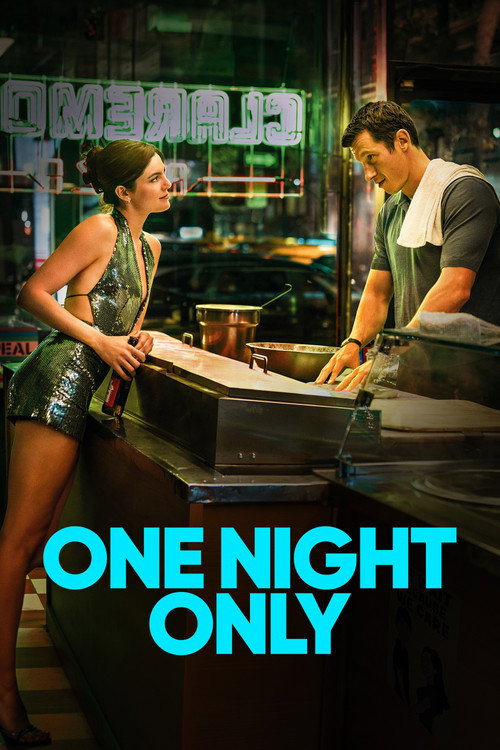
One Night Only (2026)
Directed by Will Gluck · $9.9M domestic
No · Based
How we score movies →Consciousness Markers
The ensemble is assembled with visible intentionality: LeVar Burton, Okieriete Onaodowan, Quintessa Swindell, and Mateo Ray Garcia populate a cast that reads like a diversity grid completed by a diligent studio intern. The film does not interrogate this diversity, it simply presents it, which is its own form of statement.
Maya Hawke and King Princess, both prominent LGBTQ+ public figures, appear in supporting roles, and the film nods toward queer characters operating outside the heterosexual mandate without explanation. The nod is acknowledged and then immediately abandoned, which is perhaps the most honest thing the screenplay does.
The premise, a government mandate over sexual access, carries an implicit bodily-autonomy dimension that critics clocked as a loose Roe-adjacent metaphor. The film declines to pursue this reading with any conviction, preferring instead to use it as a meet-cute delivery mechanism.
Critics noted surface-level references to tech-bro surveillance capitalism and Big Pharma advertising embedded in the film's speculative world-building. These references are deployed as set dressing and then left untouched, like a Banksy print in an Applebee's.
The film's supporting-character line, 'Choice itself is romantic. Maybe the fascists were right about this one,' is the closest the screenplay comes to a thesis, and it appears to be arguing against itself. The lecture energy is present but thoroughly confused, which reduces its effective dosage.
The director's publicly documented decision to cut extensive nudity following Gen Z test screening discomfort is itself a data point. The film gestures toward sexual freedom as a theme while systematically removing its visual evidence. The body is present in concept only.
There is no evidence the film engages with race as a thematic concern. The diverse casting is present but the script, by all accounts, does not comment on how the mandate intersects with race or historical bodies-of-color legislation. A missed opportunity noted by no one in the film itself.
No climate themes are present or implied. The near-future setting appears to have solved no environmental problems and introduced only bureaucratic ones.
No neurodivergence themes are present in any available research or critical commentary. The characters appear to be neurotypical people navigating an absurd legal framework, which is its own kind of madness.
The film is set in a speculative near-future, not a reimagined past. No historical events are reframed or reclaimed. History is not revised here; it is simply extrapolated into mild dystopia.
Synopsis
Two love-starved strangers crash into each other on the one night of the year when single people are allowed to have sex.
Why it received this score
Will Gluck's *One Night Only* arrives as a near-future romantic comedy in which the United States Congress has legislated human sexuality into a single twelve-hour annual window, a premise that the film treats with approximately the same gravity as a parking ticket. Critics have reached for "The Purge but for sex" as their shorthand, and it is not inaccurate. What is more interesting is that a film featuring Maya Hawke, King Princess, and Ziwe in its supporting cast, set against a backdrop of government control over bodily autonomy, has been reviewed in multiple outlets as conservative-coded. This is an achievement of a specific and unusual kind.
The ensemble has been assembled with the demographic comprehensiveness of a committee presentation, and the speculative world contains what appear to be pointed references to surveillance capitalism, pharmaceutical advertising, and congressional overreach. These references exist in the film the way furniture exists in a stage set: they suggest habitation without providing any. The queer characters navigate the heterosexual mandate without the screenplay pausing to explain how, which reads less as progressive inclusion and more as progressive neglect. The director, meanwhile, has given extensive interviews explaining that he removed significant sexual content after test screenings revealed Gen Z audiences' discomfort with on-screen nudity, a finding he described as "empirical data" and a "societal shift." A film about the government restricting sex, scrubbed of sex by audience feedback. The irony is doing considerable structural work that the script declines to do itself.
The result is a movie that has gathered all the correct progressive personnel, gestures at all the correct progressive anxieties, and then retreats into the warm bath of standard rom-com convention, where two attractive people fall in love and the political scaffolding collapses quietly behind them. A supporting character delivers the line "Maybe the fascists were right about this one" and the film does not appear to be joking. We are left to conclude that *One Night Only* is not a film with a point of view so much as a film with a mood board, and the mood board contains both a Planned Parenthood tote bag and a Nicholas Sparks novel, coexisting in productive tension that nobody has thought to resolve.
Analysis generated by our Consciousness Algorithm
Critic Reviews
“There are a lot of fun hijinks to enjoy, and I laughed quite a bit. In fact, I haven’t enjoyed a romantic comedy this much in a theater for a long time. I looked over at my friends and could see the smiles on their faces throughout. Normally, I’d say you can wait for streaming, but this is worth seeing in the theater, especially as a fun date movie.”
“One Night Only is sexy, hilarious, and tremendously fun. It actually looks and feels like it was shot on location. It devotes just enough energy to its premise to be genuinely involving, and spends the rest of it ensuring its two leads become the kind of movie stars you can't help but swoon over. It's exactly what you'd hope a movie like this would be.”
“One Night Only shouldn't work. I am shocked that I left the theater grinning ear to ear and, one could say, fully satisfied. One Night Only is a high-concept, patently absurd romantic comedy that defies the odds and makes you fall in love with it. You'll want more than one night with this one.”
“If this is what it takes to get a rom-com greenlit these days, maybe we should just let them die. Death with dignity is surely a better fate for the genre than fascist capitulation.”