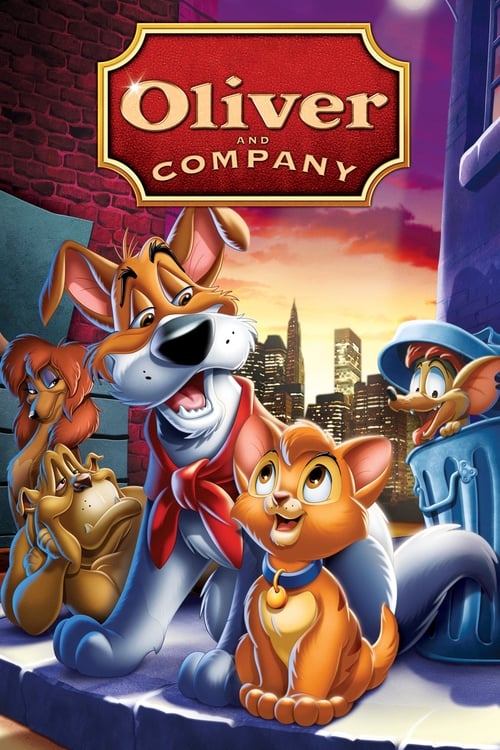
Oliver & Company (1988)
Directed by George Scribner
No · Ultra Based
How we score movies →Consciousness Markers
The voice cast includes performers of color like Cheech Marin, Sheryl Lee Ralph, and Roscoe Lee Browne, but this reflects 1980s casting practicality rather than deliberate representation strategy. The characters they voice are not inflected with their racial identities.
The film portrays economic hardship and wealth disparity as plot elements, with Fagin's poverty and Sykes' wealth creating conflict. However, this is adapted from 19th-century source material and reflects no contemporary critique of capitalism or systemic inequality.
The female characters (Rita, Jenny) are present but passive. They serve narrative functions without agency or meaningful character development, which is standard for pre-1990s Disney animation but shows no feminist consciousness.
The film contains minimal preachy messaging. While it shows consequences for villainy and rewards for friendship, these are presented as natural plot outcomes rather than moral lectures to the audience.
No LGBTQ+ themes or characters are present in this film. It is a straightforward family adventure with no engagement with sexual orientation or gender identity.
There is no racial consciousness in the film. Race is not thematized, discussed, or acknowledged in any way. The multiracial voice cast does not reflect deliberate racial awareness in the storytelling.
Environmental concerns are entirely absent from this urban adventure story. The film contains no climate messaging or ecological consciousness of any kind.
Body positivity is not a consideration in this animated children's film. The characters are stylized animals with no engagement with body diversity or acceptance messaging.
No neurodivergent characters or themes are present. The film makes no representation of autism, ADHD, learning disabilities, or other forms of neurodiversity.
The film adapts Dickens' Victorian-era narrative to 1980s New York but does not reinterpret historical events or engage in revisionist historiography. It is a straightforward genre transposition.


Synopsis
A young cat named Oliver is left alone in a kitten box, while all the other young cats have new owners. A big dog named Dodger shows him how to get food and later Oliver lives with him, his owner Fagin and Fagin's other dogs Tito, Rita, Einstein, and Francis. Fagin has one problem besides being broke he owes a nasty man named Sykes a lot of money. If he can't pay it back he's in big trouble. While Oliver runs into a little girl named Jenny who becomes his new owner which he is happy with and later Sykes sees Jenny as the key for him to get his money.
Why it received this score
Oliver & Company stands as a curious artifact of late-1980s animation, a film that has been retrospectively subjected to readings it was never equipped to withstand. The picture arrives from an era when cultural sensibilities operated on entirely different frequencies, when a voice cast featuring Cheech Marin, Sheryl Lee Ralph, and Roscoe Lee Browne was noted primarily for star power rather than representation strategy. The film adapts Dickens with the casual indifference of a studio that believed a contemporary New York setting was sufficient updating for material written a century prior.
The narrative concerns itself with class as a plot mechanism. Fagin is poor, Sykes is predatory, and Jenny is wealthy, and these facts drive the machinery of the story forward without generating any particular social consciousness about the conditions they represent. The film does not interrogate why Fagin must resort to using animals for petty crime, nor does it suggest systemic solutions to urban poverty. It simply shows us that having money solves problems and lacking it creates them, a statement of fact rather than an argument. The moral universe of Oliver & Company is individualist: one finds one's proper family, one escapes one's circumstances, and one is rewarded with domestic contentment.
This is a film genuinely innocent of contemporary progressive sensibilities, which is precisely what one would expect from a Disney children's picture made in 1988. It is neither offensive nor conscious, neither harmful nor enlightened. It simply is, a product of its moment, asking nothing of audiences except their acceptance of a talking dog's street wisdom and a cat's journey toward belonging.
Analysis generated by our Consciousness Algorithm
Critic Reviews
“Oliver & Company, the directorial debut of veteran animator George Scribner, is Mouse Factory magic with edge. It's the claws ce'le`bre. ”
“Oliver and Company is the most fully realized animated film from the Disney Co. since 101 Dalmatians. It is inspired entertainment in all departments: characters, animation, comedy, plot and voices. [28 Nov 1988]”
“The film offers a fanciful, lush urban setting, unusual for Disney animated features, and a couple of good songs, Once Upon a Time in New York City performed by Huey Lewis and Perfect Isn't Easy sung by Midler.”
“Oliver & Company is as out-of-touch as anything the studio ever made.”