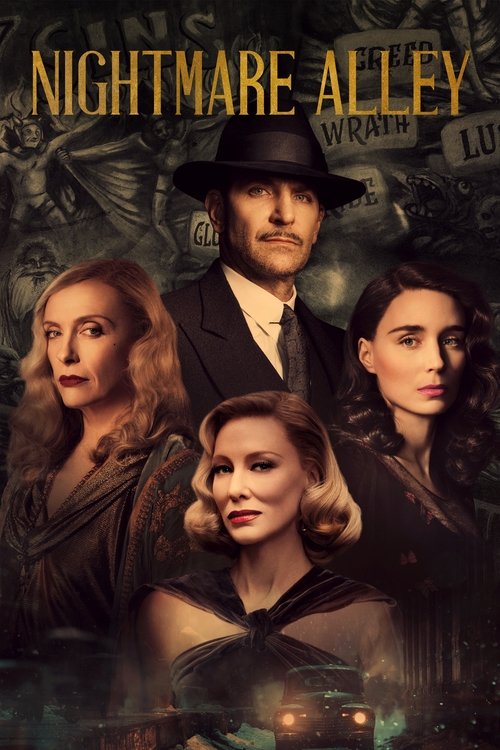
Nightmare Alley (2021)
Directed by Guillermo del Toro
No · Based
How we score movies →Consciousness Markers
The film critiques ambition and wealth-seeking through classical noir morality rather than contemporary anti-capitalist discourse. The concern with capitalism derives from genre tradition, not modern progressive economics.
Cate Blanchett's Dr. Ritter is presented as equally manipulative and dangerous as her male counterpart, subverting traditional noir archetypes. However, this represents meta-commentary on the genre rather than systematic feminist project.
Diverse ensemble cast including Collette, Dafoe, Mara, and Perlman, but diversity appears incidental to the narrative rather than a deliberate progressive statement about representation.
Functions as classical noir morality tale about personal corruption and ambition, but without the preachy progressive messaging characteristic of contemporary cinema.
No LGBTQ+ representation, themes, or subtext present in the film. The narrative focuses entirely on heterosexual dynamics.
No racial themes, racial justice narratives, or racial consciousness present. The film operates within the classical noir framework without engaging racial discourse.
No environmental themes or climate messaging. The carnival setting and period noir elements contain no ecological consciousness.
No body positivity themes or contemporary discourse about body acceptance. The carnival setting includes performers but engages no progressive body consciousness.
No representation or thematic engagement with neurodivergence, mental health conditions, or related progressive frameworks.
The film remains faithful to its 1946 source material and period setting. It does not attempt to rewrite history or challenge narratives through contemporary progressive lens.


Synopsis
An ambitious carnival man with a talent for manipulating people with a few well-chosen words hooks up with a female psychologist who is even more dangerous than he is.
Why it received this score
Guillermo del Toro's Nightmare Alley stands as a masterwork of aesthetic control and narrative precision, yet it remains fundamentally committed to the classical noir tradition rather than the progressive sensibilities of contemporary cinema. The film presents a carnival world of grifters and con artists where ambition and moral compromise lead inexorably toward destruction. Bradley Cooper's Stan Carlisle and Cate Blanchett's Dr. Lilith Ritter circle each other in a dance of mutual manipulation that recalls the great noir antagonisms, though del Toro does subvert certain genre conventions by rendering his female character equally ruthless and dangerous as her male counterpart. This represents a modest departure from mid-century noir formulas where women typically functioned as temptresses or victims rather than calculating operators in their own right.
Yet the film's thematic concerns remain rooted in timeless questions of personal morality and the corrupting influence of ambition rather than systemic critique. The carnival setting, the period framing, the emphasis on psychological manipulation and class mobility, all derive from the source material and the noir tradition itself, not from contemporary progressive discourse. The film does not engage with racial consciousness, environmental concerns, LGBTQ+ representation, or neurodivergence. Its diverse ensemble cast appears organically within the narrative without serving as commentary on representation itself. The ensemble functions as supporting players in what remains fundamentally a two-character psychological thriller.
Del Toro's visual mastery and the film's meticulous construction cannot obscure the fact that this is an exercise in genre fidelity rather than cultural intervention. The moral lesson conveyed is classical noir morality: that those who live by deception and manipulation will ultimately be consumed by their own schemes. This is not the lecture energy of contemporary progressive cinema. It is the weary wisdom of an earlier era of American filmmaking, rendered with technical brilliance but without the social consciousness markers that define modern progressive cinema. The film is excellent precisely because it refuses to subordinate its narrative to contemporary ideological requirements.
Analysis generated by our Consciousness Algorithm
Critic Reviews
“Even those unfamiliar with one or both materials can detect the cyclical parable del Toro establishes through his understanding and repurposing of noir tropes, both visual and thematic. His “Nightmare Alley” is a movie of psychological tunnels and downward spirals.”
“Del Toro can do worldbuilding in his sleep, but you might also find Cooper’s brittle performance, filled with such elemental sadness, hard to shake off. Nightmare Alley is the shadow that lingers.”
“Years ago, I compared Del Toro to Orson Welles, a film-maker who instinctively understood the hypnotic power of cinema to dazzle, delight and deceive. On the basis of Nightmare Alley, which is blessed with more than a touch of evil, that’s a comparison by which I still stand.”
“A terrific, despair-drenched final scene is the viewer’s reward for staying the course: pitilessly cruel, spare and shivery, it’s got everything the rest of this strangely stiff and synthetic film lacks.”