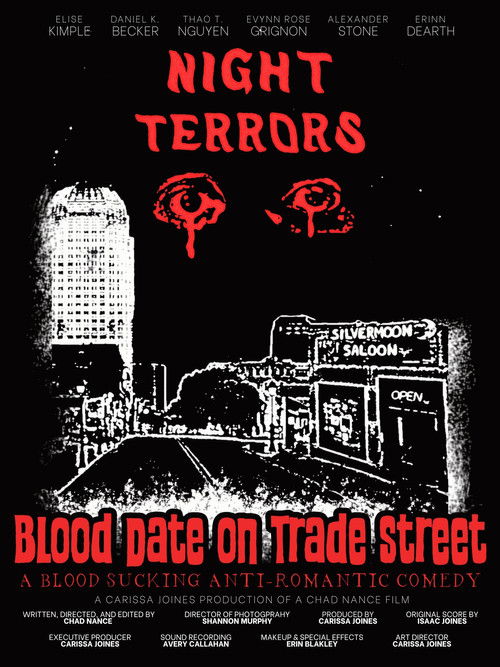
Night Terrors: Blood Date on Trade Street (2026)
Directed by Chad Nance
No · Ultra Based
How we score movies →Consciousness Markers
The cast includes Thao T. Nguyen alongside a predominantly local ensemble, suggesting organic regional diversity rather than a deliberate representational mandate. The film's promotional materials make no claims about its casting politics.
The female protagonist is framed as a true-crime-obsessed woman with enough agency to survive a date with a vampire, which is something. The film bills itself as an anti-romantic comedy, which carries a faint whiff of genre subversion, but nothing in the available record elevates this to a feminist thesis.
A protagonist described as 'true-crime obsessed' could be read as a nod to a recognizable neurodivergent internet archetype, but this is speculative. No explicit framing of neurodivergence is present in available sources.
Director Chad Nance has a prior documentary record engaging with African American communities in North Carolina, but no evidence exists that this film imports those concerns. The diverse cast appears to reflect Winston-Salem's population rather than a racial argument.
A micro-budget indie filmed outside any major studio system in a mid-sized Southern city carries a structurally anti-capitalist posture by default, but the film itself shows no evidence of making that argument explicitly.
An anti-romantic comedy by definition pushes back against certain romantic conventions, which is a low-grade form of cultural editorializing. There is no evidence of the film pausing its vampire plot to deliver a sermon on any subject.
No LGBTQ+ themes, characters, or subtext are identified in any available promotional or production materials. The central romantic pairing is presented as a conventional heterosexual blind date, albeit with one participant being undead.
There is no climate content here whatsoever. The ecological footprint of a vampire is, admittedly, a subject the film does not appear to address.
No body positivity themes or messaging are present in any available materials. The film is a horror-comedy about a vampire date, not a meditation on physical self-acceptance.
The film is set in contemporary Winston-Salem and involves vampires. It is not revising any history, though it may be doing a disservice to the reputation of blind dates.
Synopsis
Local radio host Bob Campbell will introduce the screenings. Director Chad Nance, Producer Carissa Joines, and selected cast and crew will be present. A blood sucking anti-romantic comedy filmed in Winston-Salem! A jaded comedian and a desperate actress host a live late-night comedy horror show featuring "Blood Date on Trade Street" the story of a true-crime obsessed girl, a vampire, and the blind date that brings them together for a night of romance, suspense, and terror.
Why it received this score
There is a particular kind of film that exists almost entirely outside the machinery of cultural discourse: no think-pieces, no Twitter pile-ons, no panel discussions at industry conferences. "Night Terrors: Blood Date on Trade Street" is, at this early stage of its existence, precisely that kind of film. It is a micro-budget horror-comedy from Winston-Salem, North Carolina, in which a woman with a true-crime fixation goes on a blind date with a vampire, and it is very difficult to accuse it of having a geopolitical agenda. We have tried. We have found little.
The film's most legible progressive credential is its cast, which includes Thao T. Nguyen among a roster of local actors, reflecting the demographics of a mid-sized Southern city rather than the casting directives of a studio diversity consultant. Director Chad Nance arrives from documentary work about marginalized communities in North Carolina, which is a biography that could theoretically flavor his fiction work, but the available evidence suggests he has made a campy horror-comedy about a vampire date rather than a referendum on structural inequality. The "anti-romantic comedy" framing implies a light skepticism toward the genre's conventions, the kind of eye-roll at candlelit dinners that does not require a manifesto. It is the mildest possible form of subversion.
We note, for the record, that a film with a zero vote count and a popularity score of 0.0343 is technically beyond the reach of the culture war. It exists in a sovereign territory where no one has yet arrived to be offended or to applaud. This is, in its own quiet way, a rare achievement in the current climate. The vampire, at least, is apolitical. He is simply hungry.
Analysis generated by our Consciousness Algorithm