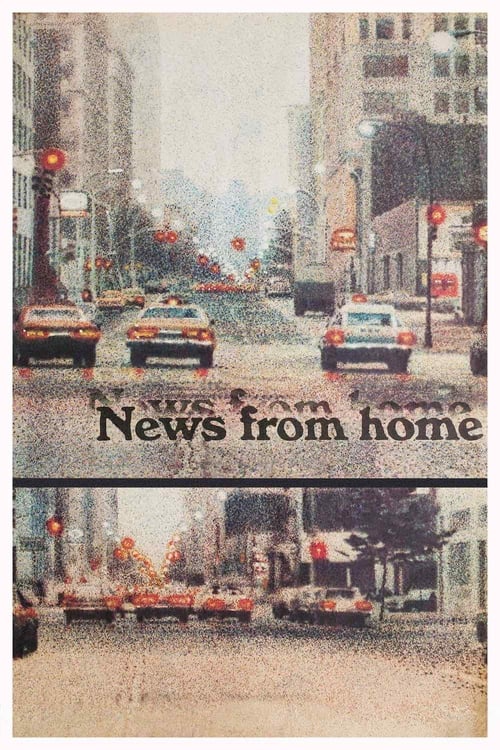
News from Home (1977)
Directed by Chantal Akerman
No · Ultra Based
How we score movies →Consciousness Markers
Akerman's work is foundational to feminist cinema theory, yet the film operates through formal experimentation rather than explicit feminist messaging. The exploration of female subjectivity and maternal ambivalence predates contemporary frameworks.
The mother's letters read by Akerman create a kind of voiceover instruction, yet the film resists preachy clarity. Its opacity functions as a refusal of the explicatory impulse.
The film documents consumer culture and urban commerce without critique or anti-capitalist positioning. Any critique emerges through formal distance rather than ideological statement.
The film features only Akerman, filmed in New York. There is no casting in the traditional sense and no consideration of demographic representation.
No LGBTQ+ themes are present. The film concerns maternal relationships and urban solitude without engaging queer identity or sexuality.
The film contains no engagement with racial themes or consciousness. New York street scenes include diverse populations but without commentary or thematic emphasis.
Climate concerns are entirely absent from this 1977 work. The film's relationship to urban environments is phenomenological rather than ecological.
Body positivity as a contemporary concept is irrelevant to this work. The film's relationship to bodies is formal and phenomenological.
Neurodivergence is not a thematic concern. The film's slow, meditative pacing reflects aesthetic choice rather than representation of neurodiverse experience.
No historical revision occurs. The film is a personal documentary without engagement with historical narratives or collective memory.


Synopsis
Impersonal and beautiful images of Akerman's life in New York are combined with letters from her loving but manipulative mother, read by Akerman herself.
Why it received this score
Chantal Akerman's "News from Home" is a work of formalist rigor that predates contemporary social consciousness frameworks by several decades. The film's engagement with maternal relationships and the construction of female subjectivity through documentary practice marks it as genuinely progressive for its moment, yet it operates entirely outside the vocabulary of modern progressive sensibilities. Akerman's approach is one of aesthetic distance rather than explicit ideological positioning, a quality that renders it incompatible with the lecture energy and earnest moral clarity that characterizes contemporary cultural discourse.
The film documents New York street scenes with impersonal precision while Akerman reads letters from her mother, creating a layered meditation on absence, obligation, and the texture of lived experience. This is cinema of genuine intellectual ambition, concerned with form, temporality, and the phenomenology of urban space rather than questions of representation or demographic inclusion. The work's resistance to conventional narrative and its refusal to position itself as a statement about anything in particular constitutes a kind of formal indifference to the categories we now use to evaluate cultural products.
To score this film by contemporary metrics is to commit a category error, yet we persist in our taxonomies. Akerman's exploration of family dynamics and gender might register faintly on measures of feminist consciousness, but the film's true allegiance is to modernist aesthetic principles rather than social messaging. We are evaluating a serious work of art by the standards of a consumer culture that would find it bewildering and hostile to its own purposes.
Analysis generated by our Consciousness Algorithm
Critic Reviews
“An audacious, brilliant reinvention of what a movie can be.”
“A deeply personal movie about real time and real space that makes you consider how frequently movie time and movie space are fudged.”
“Sweeping scenes of New York City contrasted to the letters from the director's mother in Brussels.”