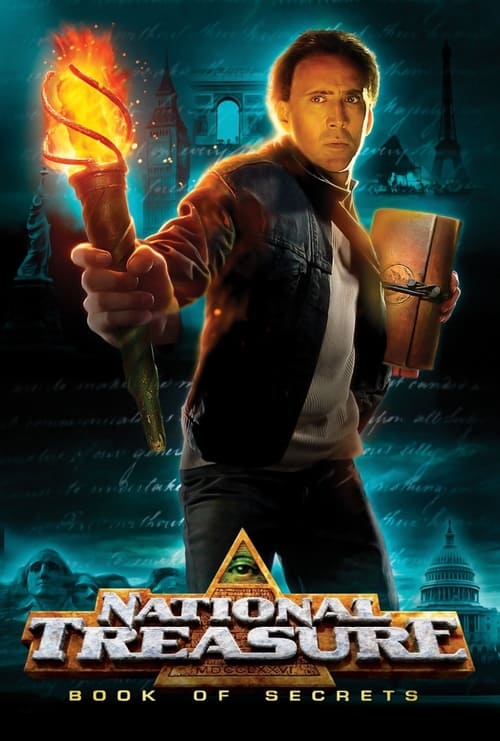
National Treasure: Book of Secrets (2007)
Directed by Jon Turteltaub
No · Based
How we score movies →Consciousness Markers
The film engages in significant historical revision regarding the Lincoln assassination and American history, but this is done through the lens of adventure fiction rather than progressive revisionism. It reimagines history for entertainment rather than social consciousness.
The film includes Diane Kruger in a lead role and several actors of color in supporting positions, but this reflects standard Hollywood practice rather than conscious progressive casting choices. No apparent effort to address systemic representation issues.
While the film contains exposition and historical explanation typical of the adventure genre, it lacks the preachy tone characteristic of overtly progressive cinema. The educational content serves plot mechanics rather than moral instruction.
Diane Kruger's character exists as a capable professional, but the film contains no feminist agenda or critique of gender dynamics. She functions as a supporting player in a male-driven narrative.
The film includes actors of color in supporting roles but shows no racial consciousness or engagement with racial themes. Historical content involving Lincoln and Booth contains no critical racial analysis.
The narrative revolves around treasure hunting and wealth acquisition with no critique of capitalism or economic systems. If anything, it celebrates material gain.
No LGBTQ+ themes, representation, or subtext of any kind. The film is entirely heteronormative and contains no queer content.
No climate-related themes, messaging, or consciousness whatsoever. The film is entirely indifferent to environmental concerns.
No body positivity messaging or representation of diverse body types. The film features conventionally attractive leads and contains no commentary on physical diversity.
No representation of neurodivergence or disability. The film contains no characters coded as neurodivergent or disabled.


Synopsis
Benjamin Franklin Gates and Abigail Chase re-team with Riley Poole and, now armed with a stack of long-lost pages from John Wilkes Booth's diary, Ben must follow a clue left there to prove his ancestor's innocence in the assassination of Abraham Lincoln.
Why it received this score
National Treasure: Book of Secrets is a film of such profound cultural indifference that it barely registers as a product of the twenty-first century at all. Here we have Nicolas Cage stumbling through historical conspiracy theories with the earnestness of a man who has consulted exactly one Wikipedia article, accompanied by a cast that includes Diane Kruger and a collection of older white men delivering exposition with the gravitas of people reading from a phone book. The film contains no apparent anxiety about representation, no lectures on systemic anything, and no detectable feminist subtext beyond the presence of a woman who occasionally has opinions.
The narrative pursues its treasure-hunting objectives with the single-minded focus of a golden retriever, stopping occasionally to engage in what might charitably be called historical revision but is more accurately described as Hollywood's standard indifference to accuracy. The film treats American history as a backdrop for elaborate heist sequences rather than as material worthy of critical examination. There is no climate consciousness here, no critique of capitalism, no meditation on the body, and certainly no neurodivergence representation. The only marginally progressive element is the film's willingness to cast a woman in a lead role and a few actors of color in supporting positions, but this represents the bare minimum of contemporary Hollywood practice rather than any conscious commitment to progressive casting principles.
What makes Book of Secrets so thoroughly unremarkable from a cultural perspective is its absolute commitment to the apolitical adventure formula. It is a film designed to entertain without challenging, to move forward without looking inward, and to maintain the exact cultural posture of mainstream Hollywood from approximately 2005. One might almost admire this refusal to engage with contemporary sensibilities if it were not so thoroughly boring.
Analysis generated by our Consciousness Algorithm
Critic Reviews
“A welcome throwback to family-friendly PG moviemaking.”
“This ain’t "The Da Vinci Code," folks, and the reason you can tell is that it’s actually quite entertaining.”
“Cage is back in crackling good form in National Treasure: Book of Secrets.”
“Like a grade-school version of an Indiana Jones adventure.”