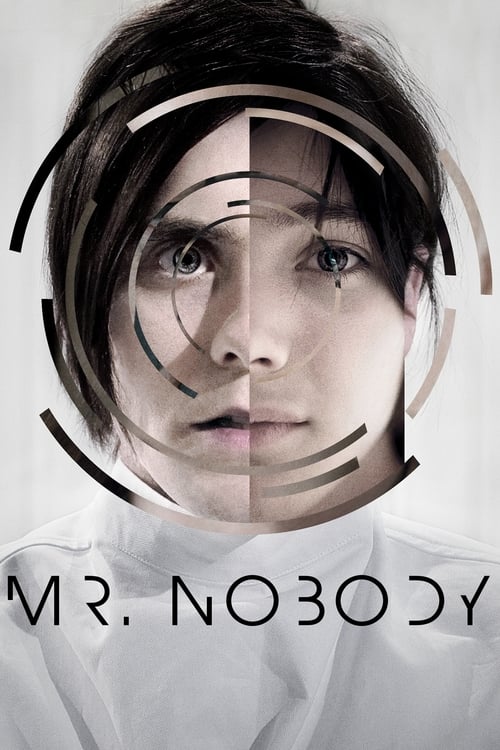
Mr. Nobody (2009)
Directed by Jaco Van Dormael
No · Ultra Based
How we score movies →Consciousness Markers
While the film contains philosophical and scientific exposition about quantum mechanics and determinism, this is delivered through narrative context rather than direct preachy lecturing to the audience.
The cast includes Linh-Dan Pham in a supporting role, reflecting international co-production rather than deliberate representation initiatives. Casting appears driven by narrative fit rather than progressive casting principles.
Limited racial diversity in the primary cast, with Linh-Dan Pham's role as a supporting character rather than central to the narrative. No thematic engagement with racial issues or consciousness.
Female characters exist primarily as romantic objects within the protagonist's possible lives rather than as autonomous agents. The film reflects pre-feminist attitudes about women's narrative function, though this is incidental rather than intentional.
No LGBTQ+ themes, characters, or representation present in the film. The narrative focuses exclusively on heterosexual romantic relationships across its multiple timelines.
No environmental or climate-related themes present. The film's far-future setting (2092) makes no commentary on ecological concerns or climate catastrophe.
The film contains no critique of capitalism, wealth disparity, or economic systems. Its concerns are purely metaphysical and romantic rather than socioeconomic.
No body positivity messaging or representation of diverse body types. The film does not engage with body image issues or body diversity narratives.
No representation of neurodivergent characters or themes. The protagonist's existential confusion could not reasonably be read as neurodivergence representation.
The film contains no historical narrative or revisionist historical engagement. It operates in fictional timelines and metaphysical spaces rather than historical contexts.


Synopsis
Nemo Nobody leads an ordinary existence with his wife and 3 children; one day, he wakes up as a mortal centenarian in the year 2092.
Why it received this score
Mr. Nobody arrives as a genuinely bewildering specimen from the pre-woke era, a Belgian-French co-production that concerns itself with multiverse philosophy, romantic destiny, and the death of meaning in an increasingly deterministic universe. Jared Leto's centenarian protagonist exists across a series of branching timelines where his personal choices either matter profoundly or not at all, a metaphysical puzzle box that the film treats with the utmost earnestness despite its narrative incoherence. The film's scattered casting includes Vietnamese actress Linh-Dan Pham in a supporting role, but this reflects the international scope of the production rather than any deliberate engagement with representation politics.
The film's thematic preoccupations are apolitical. It obsesses over quantum mechanics, determinism, and the romantic notion that love transcends probability. There exists no social consciousness regarding gender dynamics, no interrogation of power structures, and certainly no climate commentary. The female characters (Sarah Polley, Diane Kruger) exist primarily as romantic objects within Nemo's various possible lives, embodying a pre-feminist sensibility about women's narrative function that would be considered retrograde if the film possessed enough cultural footprint to warrant that criticism.
This ornate temporal labyrinth is a work of pure escapism dressed in philosophical drag. The film has no interest in lecturing audiences about social responsibility, nor does it engage with any of the cultural markers that define contemporary progressive cinema. It is, in this sense, perfectly innocent of progressive sensibility, a relic of an era when ambitious science fiction could be concerned solely with metaphysics rather than social consciousness.
Analysis generated by our Consciousness Algorithm
Critic Reviews
“Van Dormael has crafted a saga that, even at two-plus hours, is endlessly, enormously watchable.”
“van Dormael’s vivid visual sense and genuine curiosity about the nature of love and life, time and death, make it well worth surrendering to his imagination for a while.”
“Van Dormael's intriguing script is more than matched in his flamboyant direction of this 2-hour-plus tale, heroically edited by Matyas Veress and Susan Shipton into a fluid, generally understandable narrative.”