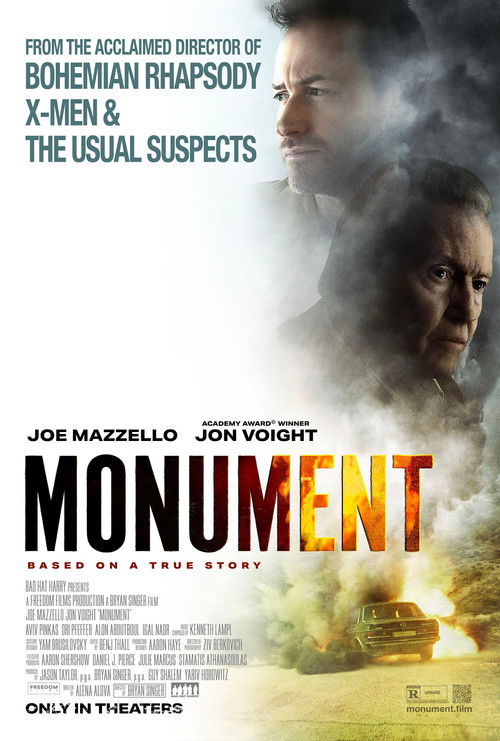
Monument (2026)
Directed by Bryan Singer
No · Based
How we score movies →Consciousness Markers
The film engages with occupation and conflict, including Lebanese and Palestinian perspectives through its cast and setting. However, this appears grounded in historical context rather than contemporary racial justice framing.
The central dramatic conflict between father and son over what a monument should commemorate likely carries moral weight and argument. The film may have moderate expository dialogue about these themes without descending into didactic preaching.
The cast is primarily Israeli and Lebanese performers in historically appropriate roles. While the ensemble includes non-Jewish Israeli and Lebanese actors, the casting appears driven by authenticity rather than contemporary diversity metrics.
The film appears to present the 1999 occupation of Lebanon from a perspective sympathetic to acknowledging multiple victims, which could be read as revisionist. However, this is grounded in actual historical events and debate rather than wholesale rewriting.
The narrative centers on male characters and a father-son conflict. While women appear in the cast, the available synopsis and materials suggest limited focus on feminist themes or female-centered storytelling.
The protagonist is an architect commissioned by institutions, suggesting no particular critique of capitalism. The film's focus is moral and political rather than economic.
No evidence of LGBTQ+ themes or representation in available material. The film centers on a family conflict about memorialization with no apparent queer dimensions.
No evidence of climate-related themes. The film is set in 1999 and focuses on military history and memorialization.
No evidence of body positivity themes. The film is a historical drama about occupation and memory, not body representation.
No evidence of neurodivergence representation. The narrative centers on historical conflict and family disagreement.
Synopsis
In 1999, as Israel's occupation of southern Lebanon crumbles, architect Yacov Rechter is commissioned to build a soldiers' memorial. His son Amnon urges a monument for all war victims instead.
Why it received this score
Monument arrives as a meditation on memory, occupation, and the question of whom we choose to honor in stone. The film's central tension pits a father's desire to memorialize Israeli soldiers against his son's insistence that a monument should acknowledge all victims of conflict, a moral disagreement that Singer treats with apparent seriousness rather than polemical fervor. This is the work of a filmmaker engaging with genuine ethical complexity, not scoring points on a cultural checklist.
The cast, drawn from Israeli and Lebanese performers, occupies the roles with historical appropriateness rather than the calculated diversity mathematics of contemporary prestige cinema. The film's critical stance toward occupation exists, but it arrives through narrative and character rather than through the hectoring tone that characterizes thoroughly modern progressive cinema. We might describe this as morally conscious without being culturally performative, a distinction that matters when assessing the specific markers of contemporary progressive sensibility.
Monument appears to be a film about serious things made seriously, rather than a film about serious things made with an eye toward cultural applause. The universalist argument at its heart, all victims deserve remembrance, sounds progressive until one considers that it might also flatten the particular historical power dynamics that contemporary social consciousness insists we foreground. The film's restraint may ultimately frustrate those seeking clear ideological alignment in either direction.
Analysis generated by our Consciousness Algorithm