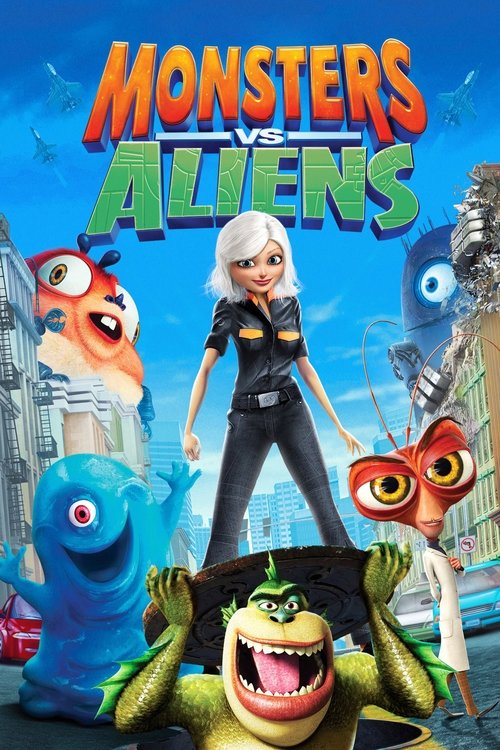
Monsters vs Aliens (2009)
Directed by Rob Letterman
No · Based
How we score movies →Consciousness Markers
Susan Murphy's arc involves rejecting her fiancé and embracing autonomy, but this narrative is presented as plot convenience rather than conscious feminist statement. No explicit engagement with gender politics.
The film features a diverse voice cast and a female lead protagonist, but diversity is treated as comedic rather than meaningful. No conscious effort to represent marginalized communities authentically.
Susan's giant size is treated as comedic and monstrous rather than as a vehicle for body positivity messaging. Her transformation is presented as an accident to overcome rather than an identity to embrace.
The film contains minimal preachy messaging. It is a straightforward action-adventure comedy without moralizing or social instruction.
No LGBTQ+ themes, characters, or references present in the film.
No racial themes or consciousness evident. Characters are fantastical monsters without racial markers or commentary.
No climate themes or environmental messaging present.
No anti-capitalist or class-conscious messaging. The film centers on military and governmental action without critique.
No representation of neurodivergence or neurodivergent characters.
No historical revisionism or reframing of historical events present.


Synopsis
When Susan Murphy is unwittingly clobbered by a meteor full of outer space gunk on her wedding day, she mysteriously grows to 49-feet-11-inches. The military jumps into action and captures Susan, secreting her away to a covert government compound. She is renamed Ginormica and placed in confinement with a ragtag group of Monsters.
Why it received this score
Monsters vs Aliens stands as a relic of the pre-woke animation era, a period when films could feature female protagonists without the accompanying infrastructure of cultural commentary. The film's central conceit, Susan Murphy's transformation from wedding-day casualty to giant warrior, contains the skeleton of a feminist narrative, but the meat has been stripped away in favor of conventional action beats and comedic set pieces. Her rejection of her fiancé and embrace of her new identity might read differently to contemporary audiences, yet the film treats this primarily as plot mechanics rather than as conscious cultural statement.
The casting choices present a diverse array of voice actors, but this diversity functions as a source of comedy rather than as representation worthy of examination. The monster squad includes characters of various sizes, shapes, and temperaments, yet the film makes no attempt to explore what this diversity might signify. We are meant to laugh at the incongruity of the team, not to contemplate their significance. The film's sensibilities remain fundamentally those of early-2000s family entertainment, concerned with spectacle and humor rather than with the social architecture that would later become central to mainstream animation.
The absence of LGBTQ+ themes, climate consciousness, anti-capitalist positioning, or any form of what we might now recognize as progressive lecture energy marks this as a film produced in a different era. It is not hostile to such sensibilities, merely indifferent to them. In the landscape of contemporary cinema, this indifference itself becomes notable, a reminder of how thoroughly cultural expectations have shifted in little more than a decade.
Analysis generated by our Consciousness Algorithm
Critic Reviews
“The grandeur of the effects--the honest-to-God spectacle of the thing--elevates Monsters vs. Aliens to something approaching art. It's not a masterpiece, but it's most certainly a milestone.”
“The richly multilayered picture tends to have a gently immersive effect, akin to a stroll through the world's most expensive diorama.”
“Dreamworks Animation's clunky and wildly unimaginative Monsters vs. Aliens really doesn't have a clue what to do with the [3-D] technique.”