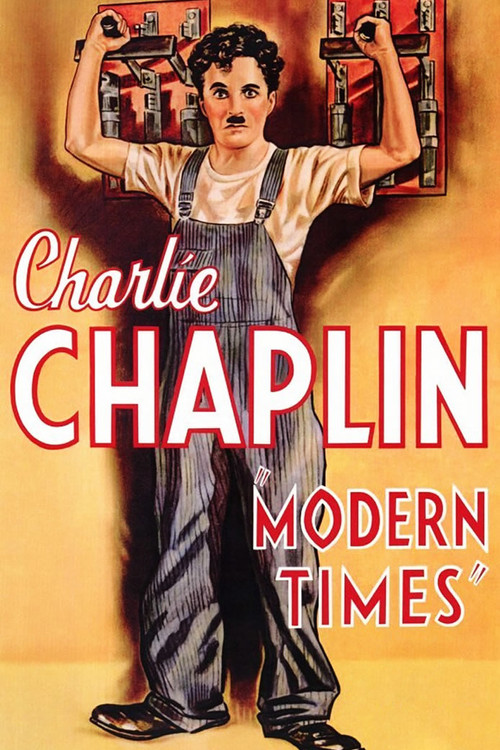
Modern Times (1936)
Directed by Charlie Chaplin
No · Based
How we score movies →Consciousness Markers
Explicit critique of industrial capitalism, mass production, and worker dehumanization. This is the film's central concern.
Silent film relies on visual storytelling and physical comedy rather than explicit exposition, minimizing preachy tone despite clear social message.
Paulette Goddard's character is sympathetic but primarily a love interest with limited agency or arc.
All-white cast reflects 1936 Hollywood segregation. No conscious effort toward representation.
No LGBTQ+ themes or characters present in the film.
No engagement with racial issues. Segregated casting reflects era norms without critique.
Climate themes are not applicable to 1936 cinema and absent from the film.
No body positivity messaging or themes present.
No representation or engagement with neurodivergence.
Film critiques contemporary capitalism rather than reinterpreting historical events.


Synopsis
A bumbling tramp desires to build a home with a young woman, yet is thwarted time and time again by his lack of experience and habit of being in the wrong place at the wrong time.
Why it received this score
Charlie Chaplin's 1936 masterwork remains a devastating critique of industrial capitalism and mass production, documenting the Tramp's futile struggle against a dehumanizing factory system that treats workers as interchangeable machine parts. The film's anti-capitalist sensibilities are unmistakable and historically significant, yet they predate the specific cultural markers we associate with contemporary progressive consciousness by nearly a century. Paulette Goddard provides romantic interest and companionship, though her character lacks agency beyond serving as motivation for the Tramp's increasingly desperate schemes. The film's visual storytelling is nearly wordless, operating through physical comedy and social observation rather than preachy explanation. What demands acknowledgment is that Modern Times critiques capitalism from a humanist perspective concerned with dignity and survival, not from the particular constellation of social justice frameworks that would emerge decades later. The cast remains entirely white, reflecting both the segregation of 1936 Hollywood and the film's lack of any racial consciousness. There are no LGBTQ+ themes, no exploration of neurodivergence, no body positivity messaging, and no engagement with revisionist history. The film is a monument to a different kind of social criticism, one that predates the contemporary cultural sensibilities we measure here. Its moral seriousness does not translate into the specific markers of modern progressive cultural awareness.
Analysis generated by our Consciousness Algorithm
Critic Reviews
“Chaplin's sentimental politics and peerless comic invention dovetailed more perfectly in this film than in any other he made.”
“An ungainly masterpiece, but Chaplin's ungainliness is something one can grow fond of. ”
“Charlie Chaplin finally got around to acknowledging the 20th century in this 1936 film, which substitutes machine-age gags for the fading Victoriana of his other work. Consequently, it's the coldest of his major features, though no less brilliant for it. ”
“Remains Chaplin's most sustained burlesque of authority.”