Miras Davası (2026)
Directed by Unknown
No · Ultra Based
How we score movies →Consciousness Markers
The documentary explicitly examines how historical narratives have been manipulated and reinterpreted for political purposes, showing awareness of how dominant narratives can be contested and revised.
As a documentary examining political mythology and elite manipulation, the film likely contains explanatory and analytical passages, though the degree of preachy moralizing remains unclear from available information.
While the film examines Turkish nationalism and its contradictions, there is no apparent critical engagement with how this nationalism has marginalized ethnic minorities or constructed Turkish identity through exclusion.
The documentary focuses entirely on political and intellectual elites discussing Atatürk's legacy. No apparent effort to center working-class voices, women, or marginalized groups in the narrative.
The film critiques political manipulation and state power but shows no interest in economic systems or class analysis beyond the political elite's maneuvering.
No discernible engagement with LGBTQ+ themes or perspectives. The documentary remains focused on nationalist and state power dynamics without addressing sexual orientation or gender identity.
No apparent feminist analysis of how competing visions of Atatürk affect women or gender relations in Turkish society. The documentary treats nationalism as a gender-neutral political phenomenon.
No engagement with climate or environmental themes. The documentary remains entirely focused on political history and state mythology.
No engagement with body positivity or appearance-based social consciousness. Not applicable to this documentary's concerns.
No engagement with neurodiversity or neurodivergent representation. The documentary does not address disability or cognitive difference.
Synopsis
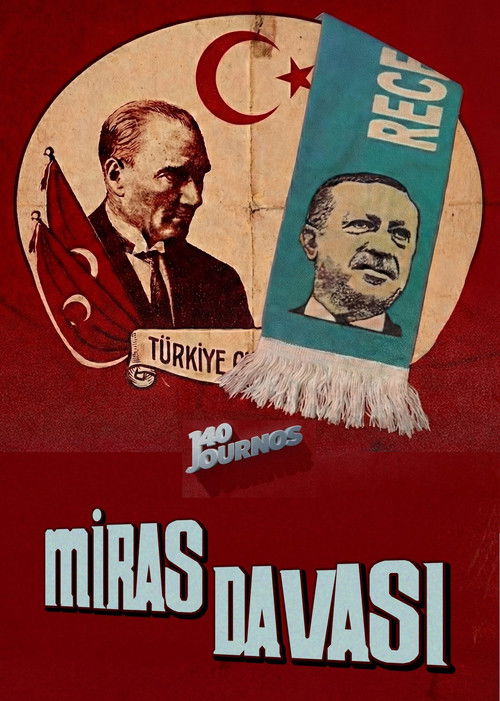
A Turkish documentary examining the contested legacy of Atatürk and how his image has been reinterpreted by successive Turkish governments. The film explores how Atatürk became a mythological hero for the populace while simultaneously serving as a symbol of state legitimacy, and specifically analyzes how the Erdoğan regime has attempted to construct a version of Atatürk compatible with its own political project, creating an inevitable conflict over the founder's true legacy.
Why it received this score
Miras Davası presents itself as a critical examination of Turkish state mythology and the weaponization of historical narratives by those in power. The documentary's central argument, that competing political factions have conscripted Atatürk's legacy into their respective ideological projects, contains some elements of the demystification impulse that characterizes contemporary progressive criticism. However, the film's actual engagement with power structures remains largely conventional, focusing on the mechanics of political manipulation rather than interrogating deeper questions of imperialism, ethnic nationalism, or the foundational violence upon which the Turkish state was constructed.
The documentary's framing suggests a kind of even-handed skepticism toward state power, which might superficially resemble cultural criticism. Yet the work appears primarily concerned with exposing hypocrisy among political elites rather than questioning the nationalist project itself or centering the experiences of those marginalized by Turkish state policy. There is no apparent engagement with minority perspectives, no examination of gender dynamics within these competing visions of nationhood, and no interrogation of how working-class Turks have been mobilized by these competing mythologies. The film treats political struggle as a contest between different interpretations of a national hero rather than as a system requiring fundamental restructuring.
The result is a documentary that performs intellectual critique without embracing the specific cultural consciousness markers that define contemporary progressive sensibilities. It is a film about power and manipulation, certainly, but not a film that appears motivated by the desire to center marginalized voices, interrogate systems of structural oppression, or advance the particular social justice frameworks that have become culturally salient in the past decade.
Analysis generated by our Consciousness Algorithm