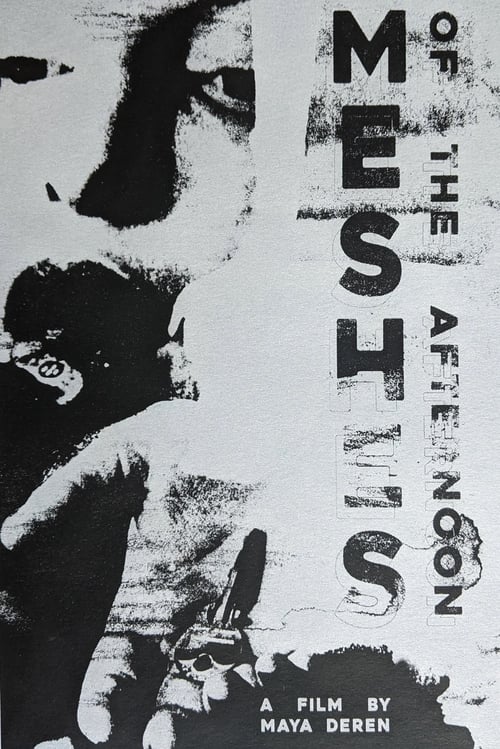
Meshes of the Afternoon (1943)
Directed by Maya Deren
No · Ultra Based
How we score movies →Consciousness Markers
While the film centers a woman's interiority and was made by a woman filmmaker, it predates modern feminist discourse and contains no explicit engagement with patriarchal critique or gender politics. Its feminist significance is retrospective, not intentional.
The film features Maya Deren as the sole performer, but this reflects artistic necessity rather than any conscious commitment to diverse representation. There is no engagement with casting diversity as a social principle.
The film contains no LGBTQ+ themes, representation, or subtext. The dreamscape is entirely concerned with heterosexual desire and female consciousness.
The film contains no engagement with race, racial identity, or racial justice. It operates entirely within a dehistoricized dreamscape with no social specificity.
There is no environmental or climate consciousness present in the work. The film's concerns are purely psychological and formal.
The film contains no critique of capitalism, wealth inequality, or economic systems. It is wholly unconcerned with material conditions.
Body positivity discourse is entirely absent. While Deren's body is central to the film, this reflects artistic choice rather than any engagement with contemporary body image politics.
The film contains no representation of neurodivergence or engagement with disability and neurological difference as social categories.
There is no historical content to revise. The film operates in an ahistorical dream space and makes no claims about history.
The film contains no preachy element, no voiceover exposition, no explicit messaging. It trusts the image entirely. There is no attempt to instruct the viewer about social issues.

Synopsis
A woman returning home falls asleep and has vivid dreams that may or may not be happening in reality. Through repetitive images and complete mismatching of the objective view of time and space, her dark inner desires play out on-screen.
Why it received this score
Maya Deren's "Meshes of the Afternoon" remains one of cinema's most formally audacious works, a fourteen-minute incursion into the subconscious that eschews narrative logic in favor of recursive imagery and temporal distortion. Deren's decision to star in her own film while directing it was, for 1943, an act of considerable independence. The work's exploration of female desire and interiority would later become foundational to feminist film theory, particularly in discussions of the male gaze and cinematic representation.
Yet we must be precise about what this film is and is not. It is not a work of modern progressive social consciousness, despite its later canonical status in feminist discourse. "Meshes of the Afternoon" predates by decades the specific cultural markers that define contemporary social awareness. Deren was not making a statement about systemic inequality or identity politics. She was making art about consciousness itself, using her own body and her partner's camera to explore the texture of dream and desire. This is radical in its own right, but it is not radical in the manner the scoring system measures.
The film's power derives from its formal innovation and its depiction of a woman's inner life as worthy of cinematic attention. These are achievements of genuine consequence. They simply do not register as "woke" in the contemporary sense, which requires explicit engagement with modern frameworks of social justice and progressive identity politics. A masterpiece need not be woke. This one is not.
Analysis generated by our Consciousness Algorithm
Critic Reviews
“Deren took the dreamlike, intellectual surrealism of Un Chien Andalou and made it intimate.”
“Maya Deren from 1943 until her death in 1961 led the avant-garde movement in cinema.”
“Decades later, this avant-garde, experimental film holds up extremely well.”
“Often her own visually arresting, dramatically intense onscreen protagonist, Deren conveys a sense of entrapment as a quintessentially female condition.”