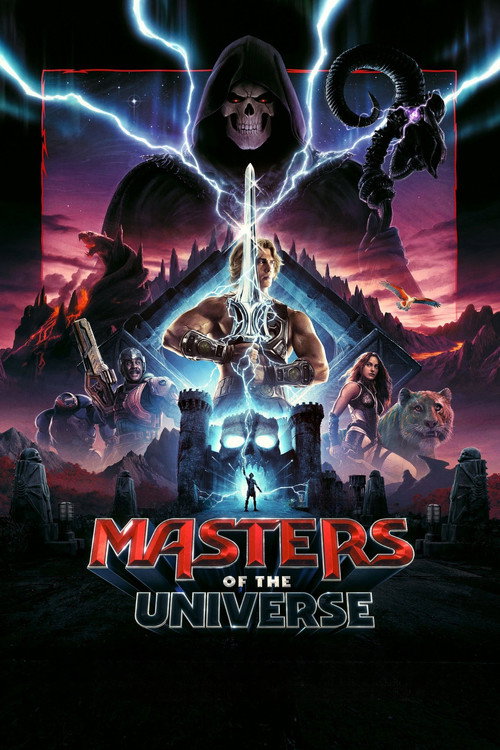
Masters of the Universe (2026)
Directed by Travis Knight · $63.9M domestic
Partly · Woke-Adjacent
How we score movies →Consciousness Markers
The casting departs conspicuously from the franchise's historically pale, blonde, Nordic template. Camila Mendes as Teela, Idris Elba, Jon Xue Zhang, and Sam C. Wilson constitute an ensemble that would be unrecognizable to anyone who grew up with the 1983 Filmation cartoon, and this appears to be the point.
Teela's role has been explicitly elevated and foregrounded in promotional materials, and the director has framed the entire film as a reexamination of He-Man's hypermasculine legacy. The film appears to position her as a co-protagonist rather than a supporting love interest, which is a structural feminist choice.
Travis Knight reportedly spent significant portions of press roundtables explaining his theory of masculinity, and this philosophical energy appears to have migrated into the film itself. A director who tells journalists what he thinks it means to be a man rarely keeps that opinion off the screen.
The film consciously reframes a 1980s cultural artifact associated with a specific, now-unfashionable model of masculinity. Director Travis Knight's stated thematic ambitions constitute a soft act of revisionism against the source material's original ideological assumptions.
The diverse casting appears intentional and promotional rather than incidental, suggesting a self-conscious approach to representation. However, no evidence suggests the film's narrative engages with race as an explicit theme.
No evidence of LGBTQ+ themes, characters, or subtext in available research or promotional materials.
No evidence of climate or environmental themes in the film's narrative or promotional framing.
No evidence of anti-capitalist themes. Mattel Studios producing a film based on their own toy line suggests the opposite orientation entirely.
No evidence of body positivity themes. He-Man remains, by all accounts, extremely muscular.
No evidence of neurodivergence themes or characters in available research.
Synopsis
After being separated for 15 years, the Sword of Power leads Prince Adam back to Eternia, where he discovers his home shattered under the fiendish rule of Skeletor. To save his family and his world, Adam must join forces with his closest allies, Teela and Duncan/Man-At-Arms, and embrace his true destiny as He-Man — the most powerful man in the universe.
Why it received this score
There is a certain audacity in taking He-Man, a character whose entire existence was engineered to sell plastic muscles to eight-year-olds, and deciding that what the property truly needed was a meditation on the nature of manhood. Travis Knight has made exactly this decision, and the resulting film arrives in 2026 carrying the full weight of his convictions about gender, identity, and the burden of legacy. The original He-Man asked only that children find him sufficiently exciting to request him for Christmas. This version asks considerably more of everyone involved.
The casting alone announces the film's intentions with the subtlety of a herald blowing a trumpet. Nicholas Galitzine occupies the loincloth, but the ensemble surrounding him, Camila Mendes as an elevated and narratively central Teela, Idris Elba in a prominent role, Jon Xue Zhang and Sam C. Wilson in supporting positions, represents a comprehensive reimagining of a franchise that once populated Eternia almost exclusively with characters who resembled Renaissance fair enthusiasts of Northern European extraction. The film acknowledges He-Man's historical association with a specific, now-scrutinized model of masculinity, and does not mock it, which is the most sophisticated thing anyone has said about the production. Not mocking it is presented as a virtue. The bar has been calibrated accordingly.
What the film ultimately delivers is a blockbuster that has done its homework, assembled its talking points, and deployed them with the earnestness of a director who genuinely believes that Eternia is the correct venue for a serious conversation about what it means to be a man. Knight reportedly spent considerable press-tour energy elaborating this thesis to journalists, which is a reliable sign that the thesis also appears on screen, probably during a quiet moment before the third act. The film entered the culture war, as these things tend to do, and the culture war received it with the enthusiasm the culture war reserves for all such offerings: loud, immediate, and largely disconnected from whether the movie is any good.
Analysis generated by our Consciousness Algorithm