Is Masterplan (2026) Woke?
Masterplan · 2026 · Directed by Thomas Vincent
Woke Score
CriticCritic Score
Ultra Based
Critics rated this 46 points above its woke score. Among Ultra Based films, this critic score ranks #1188 of 1501.
Answer: No
Woke Score 4/100 · Verdict: Ultra Based
Strongest markers: Representation Casting (18) · Eat the Rich (12) · Feminist Agenda (10)
Representation Casting
Score: 18/100
The cast is international in a broadly European sense, mixing Italian, French, and American talent, though this reads more as co-production logistics than deliberate representational engineering. No evidence of casting choices framed as corrective or symbolic.
LGBTQ+ Themes
Score: 8/100
The Guardian noted camera work that nods to 'the female and gay male gaze' via lingering shots of Victor Belmondo's torso, which is the thinnest possible reed upon which to hang a score. No LGBTQ characters or themes are present in the narrative.
Feminist Agenda
Score: 10/100
Simona Tabasco's character gets a platinum-blonde-wig diva moment, which critics clocked as a stylistic flourish. There is no broader feminist framing or commentary in the film's narrative architecture.
Racial Consciousness
Score: 0/100
No racial consciousness themes, commentary, or framing are present in the film or its critical reception. The story is a European art heist caper with no evident racial subtext.
Climate Crusade
Score: 0/100
No climate or environmental themes of any kind are present. The Mona Lisa, to the film's knowledge, has no carbon footprint.
Eat the Rich
Score: 12/100
Stealing a priceless artwork from an institution could theoretically be read as redistributive, but the film frames it as a family caper, not a critique of cultural ownership or wealth inequality. The anti-capitalist reading requires more generosity than the film earns.
Body Positivity
Score: 0/100
No body positivity themes or messaging are present. No evidence in any critical source or audience discussion.
Neurodivergence
Score: 0/100
No neurodivergent characters, themes, or framing are identified in any source.
Revisionist History
Score: 0/100
The film does not engage with history in any revisionist capacity. The Louvre is a setting, not a thesis.
Lecture Energy
Score: 5/100
The absentee-father-as-redemption-arc carries faint moral scaffolding about family and second chances, but critics universally describe the film as breezy and uncommitted to any message. The lecture never materializes.

Synopsis
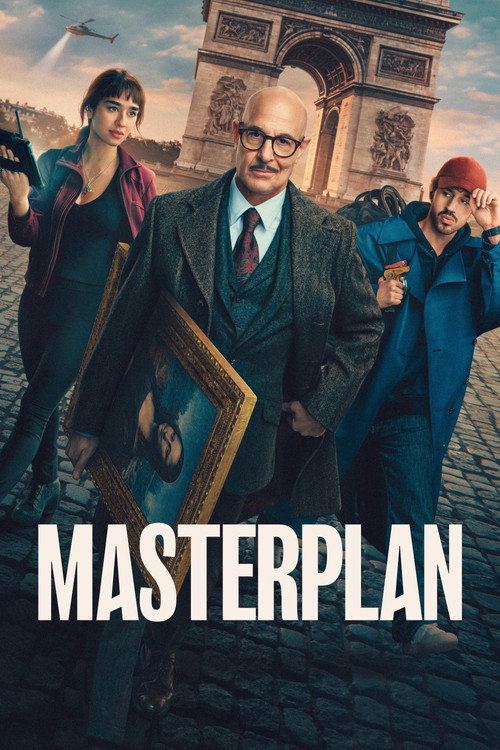
When a legendary thief sets his sights on the Mona Lisa, he recruits two young strangers to help him before revealing they are long-lost siblings… and oh yes, by the way, he is their father. Thrown into a chaotic reunion they never asked for, this new family must learn to work together — and try not to kill each other — if they want any chance at pulling off the heist of the century.
Why it received this score
*Masterplan* arrives on streaming as precisely what it advertises itself to be: a heist film about stealing the Mona Lisa, starring Stanley Tucci, directed with the narrative ambition of a Sunday night takeout order. The film's central conceit, that a legendary thief would recruit two strangers for a major job and only then disclose that they are his biological children, raises questions about his competence as both a criminal and a father that the screenplay declines to pursue. This is, we are assured by everyone who has seen it, a feature, not a bug.
The progressive social content here is so negligible that cataloguing it feels like an act of aggression against the concept of cataloguing. The camera does, by one critic's account, linger appreciatively on Victor Belmondo's torso, which The Guardian filed under the "gay male gaze," a designation that represents either a significant expansion of the term or a slow news week in cultural criticism. Simona Tabasco gets a wig. These are the data points. The film otherwise concerns itself with family banter, gadgetry, and the logistical challenges of removing a very famous painting from a very well-guarded room, none of which registers on any known scale of social consciousness.
The most culturally transgressive thing about *Masterplan* is that it exists as a major streaming release in 2026 without a single discernible agenda beyond mild entertainment. Conservative watchdog sites rated it nearly immaculate on their ideological purity metrics. The aggregated woke-monitoring apparatus of the internet looked at this film and shrugged in unison. In a cultural moment defined by the exhausting imperative to mean something, *Masterplan* has achieved a kind of radical blankness. We should probably not give it credit for this, but here we are.
Analysis generated by our Consciousness Algorithm
Critic Reviews
“Masterplan knows it's ridiculous, which helps with its watchability if not exactly its quality.”
“Masterplan is a lot of fun, because it's a kind of crime procedural involving likable criminals with lofty aspirations.”
“Beyond a few clever twists and some lovely exotic locales, it's a familiar tale of dishonor among thieves that's hardly masterful.”
“Proper, unabashed, unequivocal rubbish, with nothing about it worthy of even a cursory recommendation.”
Related rankings
Consciousness Markers
The cast is international in a broadly European sense, mixing Italian, French, and American talent, though this reads more as co-production logistics than deliberate representational engineering. No evidence of casting choices framed as corrective or symbolic.
The Guardian noted camera work that nods to 'the female and gay male gaze' via lingering shots of Victor Belmondo's torso, which is the thinnest possible reed upon which to hang a score. No LGBTQ characters or themes are present in the narrative.
Simona Tabasco's character gets a platinum-blonde-wig diva moment, which critics clocked as a stylistic flourish. There is no broader feminist framing or commentary in the film's narrative architecture.
No racial consciousness themes, commentary, or framing are present in the film or its critical reception. The story is a European art heist caper with no evident racial subtext.
No climate or environmental themes of any kind are present. The Mona Lisa, to the film's knowledge, has no carbon footprint.
Stealing a priceless artwork from an institution could theoretically be read as redistributive, but the film frames it as a family caper, not a critique of cultural ownership or wealth inequality. The anti-capitalist reading requires more generosity than the film earns.
No body positivity themes or messaging are present. No evidence in any critical source or audience discussion.
No neurodivergent characters, themes, or framing are identified in any source.
The film does not engage with history in any revisionist capacity. The Louvre is a setting, not a thesis.
The absentee-father-as-redemption-arc carries faint moral scaffolding about family and second chances, but critics universally describe the film as breezy and uncommitted to any message. The lecture never materializes.