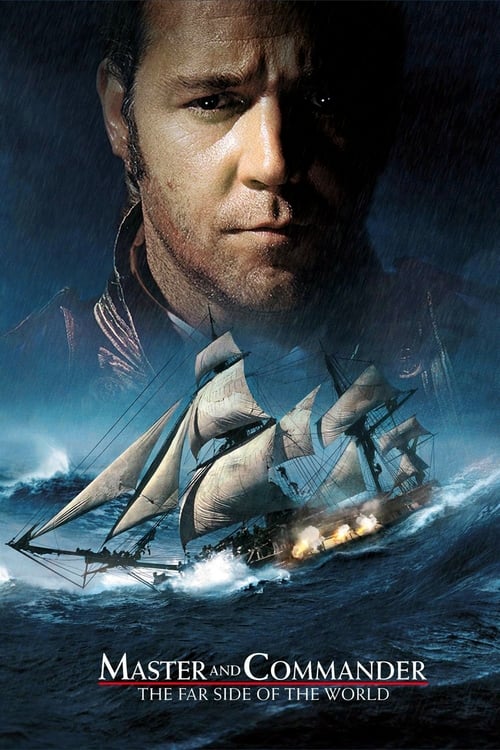
Master and Commander: The Far Side of the World (2003)
Directed by Peter Weir
No · Ultra Based
How we score movies →Consciousness Markers
The film occasionally carries mild preachy moments about naval tactics and military command philosophy, but lacks the earnest pedagogical tone that would constitute true lecture energy.
The cast is entirely white and predominantly male, with no visible effort toward diverse representation. No characters of color appear in significant roles.
No LGBTQ+ characters, themes, or subtext are present. The film makes no attempt to engage with queer identity or representation.
Women are functionally absent from the narrative. The film presents a male-dominated military hierarchy without any feminist critique or female agency.
No racial consciousness or commentary on colonialism, slavery, or racial dynamics appears in the film despite its Napoleonic Wars setting.
Climate themes are entirely absent. The film is set on sailing ships but engages no environmental or climate-related messaging.
No anti-capitalist messaging or critique of economic systems appears. The film is unconcerned with economic politics.
Body positivity themes do not appear. The film presents fit military men without commentary on body diversity or acceptance.
Neurodivergence is not represented or discussed. No characters are portrayed with autism, ADHD, or other neurodivergent conditions.
The film does not revisit history through a contemporary progressive lens. It treats historical events straightforwardly without reframing colonial or imperial narratives.


Synopsis
After an abrupt and violent encounter with a French warship inflicts severe damage upon his ship, a captain of the British Royal Navy begins a chase over two oceans to capture or destroy the enemy, though he must weigh his commitment to duty and ferocious pursuit of glory against the safety of his devoted crew, including the ship's thoughtful surgeon, his best friend.
Why it received this score
Master and Commander exists in a cultural moment when the progressive sensibilities we now associate with social consciousness had not yet calcified into their contemporary form. The film is, at its core, a straightforward adaptation of a beloved literary series, concerned primarily with naval tactics, masculine camaraderie, and the glory of military duty. Russell Crowe commands the vessel and the narrative with the authority one would expect from a period piece that treats hierarchical structures not as ideological questions but as historical facts.
The cast is almost entirely male and entirely white, reflecting both the historical period and the production's complete lack of interest in interrogating that history. There are no characters of color among the crew or officers, no queer subtext, no feminist reframing of masculine adventure narratives, and no particular consciousness about representation. The film treats women as essentially absent from its world, which is historically accurate but politically unremarkable by design. A female surgeon does not appear; a female stowaway does not challenge the patriarchal order.
This is a film that has nothing to say about social justice because it is not designed to say anything about social justice. It is content to be a well-made historical adventure, and in that ambition it largely succeeds. The absence of contemporary progressive sensibilities in a 2003 film set in 1805 is not an oversight worth scoring. It is simply what the film is: a period piece that predates the cultural moment we are measuring for.
Analysis generated by our Consciousness Algorithm
Critic Reviews
“Master and Commander is to movies what Russell Crowe is to acting. With subtlety and power, it explores the complexities of men at war, even with themselves. It puts the passion into action, and the thrill into thought. ”
“Rare proof that a gigantic production in contemporary Hollywood can possess a distinctive personality and its own approach to storytelling, Master and Commander: The Far Side of the World proves as bracing as a stiff wind on the open sea. ”
“One of this year's best films--a classic, even, like a C.S. Forester "Hornblower" story on steroids.”
“It seems as if every possible cliche and story twist from any seafaring picture of the past 80 years made its way into this flick.”