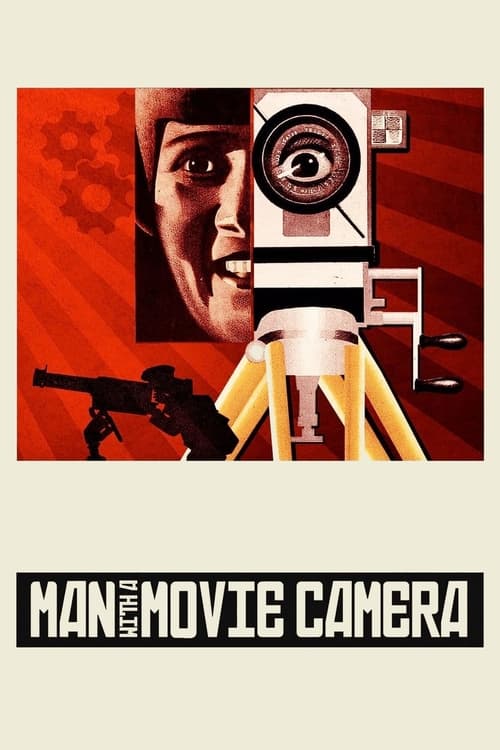
Man with a Movie Camera (1929)
Directed by Dziga Vertov
No · Ultra Based
How we score movies →Consciousness Markers
The film documents Soviet collective labor and industrial production as part of a communist state's vision, which carries inherent anti-capitalist ideology. However, this reflects historical context rather than contemporary anti-capitalist rhetoric or systematic critique of wealth inequality.
The film documents women and men working across various occupations, including factory work and domestic labor, but this representation is incidental to the film's broader cataloging project rather than a deliberate statement about equity or inclusion.
While women appear throughout the documentary in various roles, the film makes no explicit argument about gender relations or women's liberation. The representation is observational rather than advocacy-oriented.
While the film presents a curated vision of Soviet urban life emphasizing productivity and modernity, it does not engage in the specific contemporary practice of reframing historical narratives to center marginalized perspectives.
The film documents Soviet urban life with no apparent engagement with racial consciousness or identity politics as understood in contemporary terms. The subject matter is geographically and ethnically specific to Soviet populations.
The film is avant-garde and formally experimental, eschewing preachy narration or explicit messaging. Its approach is observational and aesthetic rather than instructional or moralistic.
No LGBTQ+ themes or representation are evident in the film. Sexual orientation and gender identity are not addressed in any form.
Climate change and environmental consciousness are entirely absent from the film. The documentary celebrates industrial modernity and technological progress without any environmental critique.
Body positivity as a contemporary concept is entirely absent. The film documents bodies in labor and motion without commentary on appearance, beauty standards, or body acceptance.
No engagement with neurodivergence, disability representation, or neurodiversity appears in the film. These are not categories that inform the documentary's approach.


Synopsis
A cameraman wanders around with a camera slung over his shoulder, documenting urban life with dazzling inventiveness.
Why it received this score
Dziga Vertov's 1929 Soviet documentary remains a masterwork of formal innovation, a kaleidoscopic chronicle of urban modernity that treats the camera itself as an instrument of revolutionary perception. The film documents ordinary people and labor with genuine interest in their dignity and contributions to collective society. Yet the operative word is "ordinary." The documentary captures women working in factories and domestic spaces, but this representation emerges from the film's comprehensive cataloging impulse rather than from any conscious engagement with gender equity or the specific conditions of female labor. The film is fundamentally a meditation on technology and vision, not on social hierarchy.
The work exhibits the Soviet avant-garde's genuine commitment to depicting working-class life and collective action, a sensibility that might be mistaken for modern progressive consciousness if one were not careful about definitions. Vertov's vision of society is one of mechanized harmony and productive coordination, not one animated by the particular social justice concerns of contemporary discourse. The editing technique, while revolutionary in formal terms, serves an aesthetic and philosophical project rather than an explicitly political one aimed at specific systemic reforms. Class consciousness here operates as artistic principle and state ideology, not as the articulation of marginalized perspectives demanding recognition.
The film's low score reflects not any deficiency in artistic merit or historical importance, but rather the simple fact that it predates by decades the specific cultural markers we are measuring. A work can be genuinely great and still register as a zero on this particular scale. This is perhaps the only reasonable response to applying contemporary categories to an artifact of 1929, when such categories did not yet exist as a cultural force. Vertov created something magnificent without feeling the need to interrogate identity hierarchies or signal commitment to contemporary social movements, because no such movements had yet achieved cultural salience.
Analysis generated by our Consciousness Algorithm
Critic Reviews
“The film would be exciting to watch even completely silent, both because it’s a valuable record of Soviet city life at the end of the 1920s, and because it explodes with visual ideas.”
“The combustion engine gave humanity the new experience of speed; now the movie camera gave us a dizzying new speed of perception and creation. ”
“No other film – not even by Georges Méliès at his most fantastic – trumpets early cinema's status as a magical science and scientific magic, quite so loudly or melodically.”
“It is a disjointed array of scenes in which the producer, Dziga Vertoff, does not take into consideration the fact that the human eye fixes for a certain space of time that which holds the attention.”