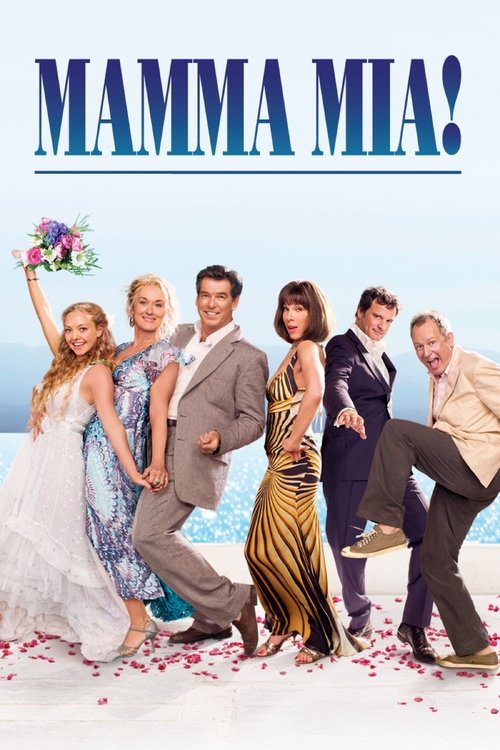
Mamma Mia! (2008)
Directed by Phyllida Lloyd
No · Based
How we score movies →Consciousness Markers
Meryl Streep's casting as a glamorous, desirable middle-aged woman in a leading role provides some implicit body representation, though the film does not explicitly engage with body politics.
The film centers a financially independent middle-aged woman, but the plot still requires her daughter to identify a father figure for validation. Agency exists within traditional narrative structures.
The cast is predominantly white European and Mediterranean. While Meryl Streep leads, the ensemble reflects limited ethnic and cultural diversity for a 2008 film.
Despite ABBA's cultural association with gay audiences, the film contains no explicit LGBTQ representation or themes. Sexual orientation remains entirely absent from the narrative.
Donna's business success is celebrated without critique. The film embraces capitalist achievement and consumer comfort as markers of happiness and fulfillment.
The film prioritizes entertainment and spectacle over messaging. No preachy elements or explicit social instruction present, which paradoxically keeps the woke score lower.
The idyllic Greek island setting is presented without any environmental consciousness. No engagement with climate or ecological themes whatsoever.
The film contains no historical engagement or revisionist interpretations. It exists in a timeless, apolitical space removed from historical context.
No engagement with racial themes or consciousness. The setting and cast reflect a predominantly white perspective with no acknowledgment of this limitation.
No representation or acknowledgment of neurodivergence in any form. The topic is entirely absent from the narrative and characterization.


Synopsis
A spirited young bride-to-be living with her single mother on a small Greek island secretly invites three of her mother's ex-boyfriends in hope of finding her biological father to walk her down the aisle.
Why it received this score
Mamma Mia presents itself as a cheerful celebration of female autonomy, and it is true that Donna (Meryl Streep) operates a successful business and maintains romantic independence. However, the film's progressive credentials are largely accidental rather than intentional. The narrative structure still orbits around a young woman's need to identify her father, a plot device that undermines the supposed feminist framework by centering paternal validation as essential to her wedding day fulfillment. The film's portrayal of single motherhood, while sympathetic, treats it as a circumstance to be resolved instead of as a legitimate and complete form of family structure.
The ensemble includes three successful men presented as equally viable romantic options for Donna, which at least avoids romantic hierarchy, though this mirrors 1970s attitudes more than contemporary progressive sensibilities. There is minimal racial diversity in the cast and setting, which reflects the stage musical's origins but does not excuse the film's lack of intentional representation. LGBTQ representation is functionally absent, despite the musical's historical associations with gay audiences. The film's class dynamics present the island setting as idyllic and timeless, with no engagement with economic realities or structural inequities.
What remains is a product of 2008 popular entertainment that happens to center a middle-aged woman and her agency, but does so within conservative narrative frameworks. The film prioritizes entertainment value and emotional catharsis over any sustained engagement with social consciousness. Its appeal transcends gender, but not because it challenges gender conventions; rather, because it offers pure escapism through ABBA's catalog and Mediterranean scenery.
Analysis generated by our Consciousness Algorithm
Critic Reviews
“It's a delightful piece of filmmaking with a marvelous cast topped by Meryl Streep in one of her smartest and most entertaining performances ever.”
“The movie takes the ABBA jukebox musical that ate London, and is still eating Broadway, and turns it into a surprisingly sensuous experience.”
“The chorus backs the soloists powerfully, and they are as fresh as the rest of the film: fat and fit, homely and handsome, young gods and old codgers – in short, people you might really see in Greece.”
“The story is ... urh. No film has ever had a more irrelevant story.”